Showing posts with label Acer rubrum. Show all posts

Thursday, December 19, 2024

Red Maple (Acer rubrum)


The two older red maples located at the southwest corner of Mickle Hall turned yellow this year. The photos below were taken on December 15, 2024. Older blogposts tell us that color varies from year to year: we have stunning photos from November 2017, that show gorgeous orange hues. Compare the photos below with the older ones found here.


The four-way intersection is dominated by evergreens—yaupon holly and Louisiana palmettos. Plenty of insects and other critters must shelter here during the bare season of winter. Are they hibernating or enjoying the maples' display?

This concrete path, decorated with fallen leaves while the trees are not yet bare, lends a romantic feeling to the environment.

Freshly fallen leaves stand out in the litter like a yellow-brick road.


Red Maple (Acer rubrum)


All photos below are from a single red maple, growing in the west floodplain with a thick trumpet creeper vine stuck to its trunk. You can get a good look at the form of this tree on a previous post from February 2019, found here. In the above photo, we see squirrel teeth marks on our red maple sign. Several arboretum signs have the same markings, as well as our irrigation lids. Someone needs to do a microplastic awareness campaign for our squirrel population.
 

Maples are famous for their foliage. This photo succinctly shows why: each leaf contains a showy display from green to yellow to orange to red.

If you want a natural source of variation in color, these leaves would provide a great model.


Tuesday, March 22, 2022

Springtime in the Arboretum

Spring is officially here, having begun on March 20th, and many of the inhabitants of the arboretum are in full vigor. A walk through will reveal a variety of species putting out new leaves, putting on flowers, performing reproduction, and otherwise enjoying the change in seasons.


These are samaras of the red maple (Acer rubrum).


Here we see flowers of the devilwood (Osmanthus americanus).


Laurel cherry (Prunus caroliniana) flowers are numerous!


These are purple pawpaw (Asimina triloba) flowers.

These are green pawpaw flowers. They will soon turn maroon or purple.


This pretty little white flower is produced by the mayhaw (Crataegus opaca). Last spring, an eastern red cedar was cut down in the hopes that we would see more of these flowers. As compared with the last three years, we are certainly seeing more mayhaw flowers today.

In northwest Louisiana, we love our azaleas, but not all azaleas are native to the southeastern United States. Here we have the stunning flowers of our native yellow-flowered azalea (Rhododendron austrinum).


Tuesday, November 26, 2019

Tree of the Week: Red Maple (Acer rubrum)

Maples are widely appreciated for their fall foliage. In the arboretum, you can compare the autumnal color of five different maple species. Variety of color is also to be found within a single species. Our tree of the week is a red maple (Acer rubrum) with bright yellow leaves. Compare the pictures below with older photos of the other red maples in the arboretum. You can find a red-leaved red maple here, and an orange-leaved red maple here. Below, we discuss only the yellow-leaved red maple.

The yellow-leaved tree pictured center is a red maple (Acer rubrum). Note the oval shape produced by the yellow leaves. Details concerning its history are not available in the arboretum catalogue. We simply know that in 2004, it was planted as a young tree, making it more than 15 years old. This species is a common weed that pops up in disturbed soil and flower pots, so more likely than not, it simply volunteered in a pot in the campus greenhouse and was later relocated to this spot.
This red maple grows in a sunny location on a slope near the intersection of two sidewalks. The southwest corner of Mickle Hall is pictured in the background.
The bright yellow leaves are particularly stunning against a blue sky.
Fall foliage of Acer rubrum
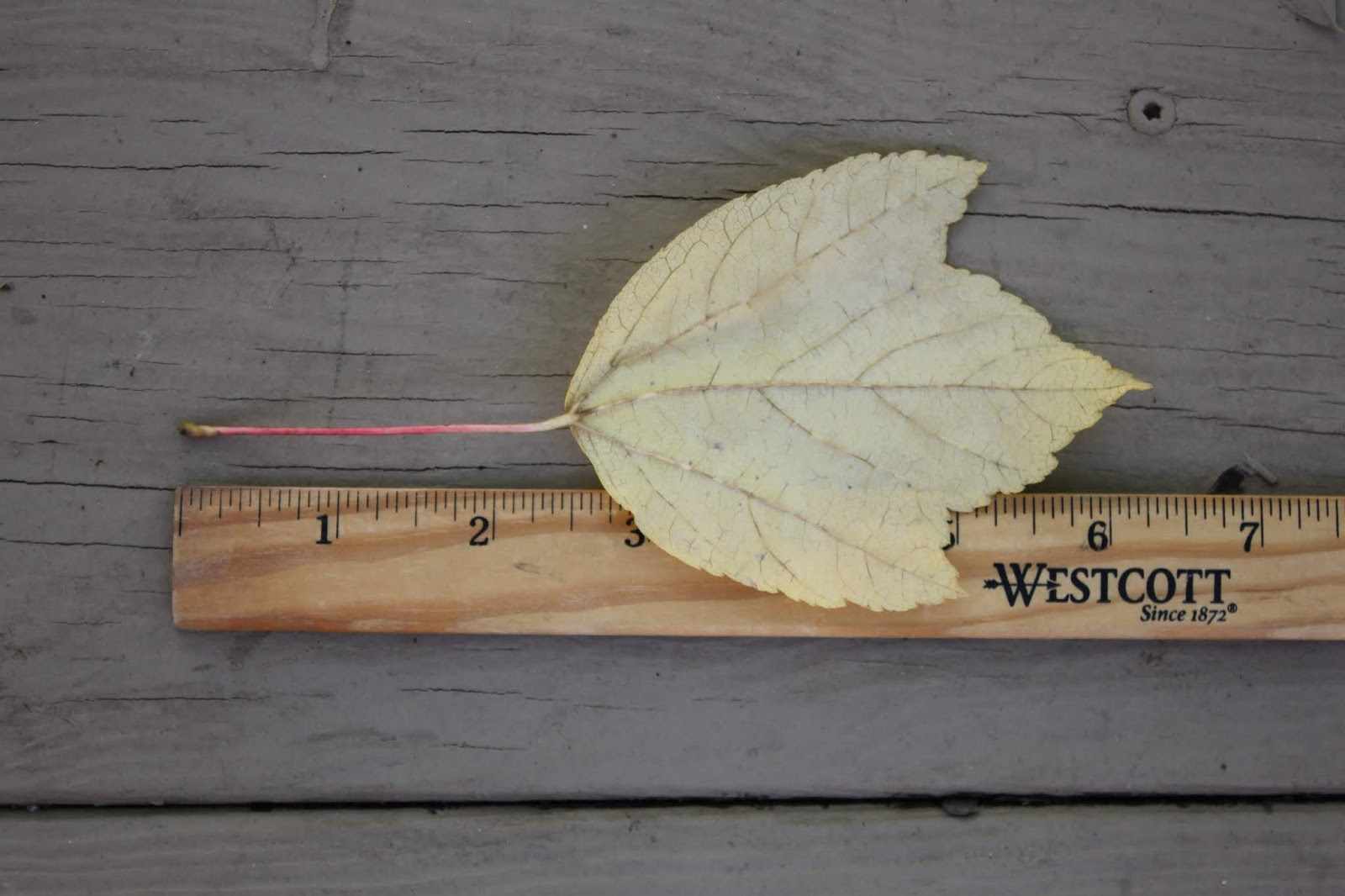
From the leaf litter, the leaves appear to be uniformly yellow with long, pink petioles. The 3-lobed leaves have serrate margins.
Petiole length and leaf size vary. In the photo above, the petiole measures 1¼ inches long, and the leaf measures 3 inches long.
Petiole, 1¾ inches long; Leaf, 3½ inches long
Petiole, 2¼ inches; Leaf, 3¾ inches
Underneath, leaves are cream colored.
Leaf margins are serrate.
The trunk shows two different types of bark. At eye level, we see smooth, light-gray bark.
Toward the base of the trunk, the rough, dark gray bark has shallow fissures.

Sunday, February 3, 2019

Tree of the Week: Red Maple (Acer rubrum)

In the first week of February, people in northwestern Louisiana can find something delightful outside: red maple flowers. Not only are red maples (Acer rubrum) a common landscape choice in our area, they can also be found throughout the wilds of Louisiana and neighboring states. It's a handsome, low-maintenance, fast-growing tree adapted to a generous range of growing conditions.What more could we ask for?

Our tree of the week is a 25-year-old red maple. This individual is a true Shreveport native. It was collected in the fall of 1994, on Line Avenue. On April 15, 1996, it was planted in the ground, in the west floodplain near the stream. Initially, there was more shade in this area, but over the past two decades several large on-site native trees have passed and been removed.

The individual in question, pictured center, is growing on the west side of the arboretum drainage channel. The leafless red maple is shown with an upright trunk and an asymmetrical crown. It's tall and straight. Let's talk a bit about the area. This part of the arboretum, located near the Fitness Center, is a floodplain. During heavy rains, water flows down hill and spans out across the grass, leaving the ground soggy for several days. Some trees would find this situation too wet,  but the red maple loves it. This little floodplain is also home to two sweet bay magnolias, a water tupelo, a basswood, and a clump of four bitter pecans, all pictured in the above photo.
From another angle, we can see the bifurcation of the trunk. Despite the split, the two main branches go straight up. Mickle Hall stands at the top of a steep hill on the opposite side of the drainage channel.
The trunk divides into two main branches. A heavy-looking, light-colored vine is attached to the thicker branch, which, incidentally, is also the south-facing branch. This is a volunteer trumpet creeper (Campsis radicans).
Trumpet creeper is a woody, deciduous vine. Its yellowish gray bark is rough and marked with aerial roots by which it attaches itself to any available structure.
The vine appears to dead-end into the ground. Below ground as above ground this tree and vine are surely intertwined.
Red maples are known for surface roots. This individual exhibits the trait of the species, but so far it hasn't been a problem for the mowers. Should we add a 'watch your step' advisory?
Mature red maple bark is rough with shallow ridges.
This is the immature bark on a small limb. This bark is smooth by comparison.


Finally, we come to the originating comment of this post. This week, our red maples are showing out. Can you see the specks of red along the branches? These are the flowers.
Looking up, we can see more of the red coloration.
In Louisiana, the tiny, red flowers appear during the winter months, well in advance of spring.


Red maple flowers appear in clusters. This particular tree seems to only have female flowers, at least within reach.


Female red maple flowers


Saturday, February 24, 2018

We're nearing the end of February. It's still winter, although the weather has been warm and rainy. For a couple of days, we had high temperatures near 80 degrees. The plants in the arboretum are making the transition from winter to spring.

During the fall and early winter we had drought conditions. Now the ground is soggy.
We do not typically see turtles in the arboretum.
We didn't bother the turtle too much; just enough for a photo shoot.
We see new leaves of the Georgia holly (Ilex longipes).
Red maples (Acer rubrum) produce red flowers, followed by red fruits. From a distance we can really appreciate the color. Here we have the immature fruits.
Shy trillium has been popping up for a couple of weeks. It hasn't bloomed yet.
We can always count on the redbud (Cercis canadensis) to provide some late winter color.