Showing posts with label Quercus shumardii. Show all posts

Tuesday, March 14, 2023

Tree of the Week: Shumard Oak (Quercus shumardii)


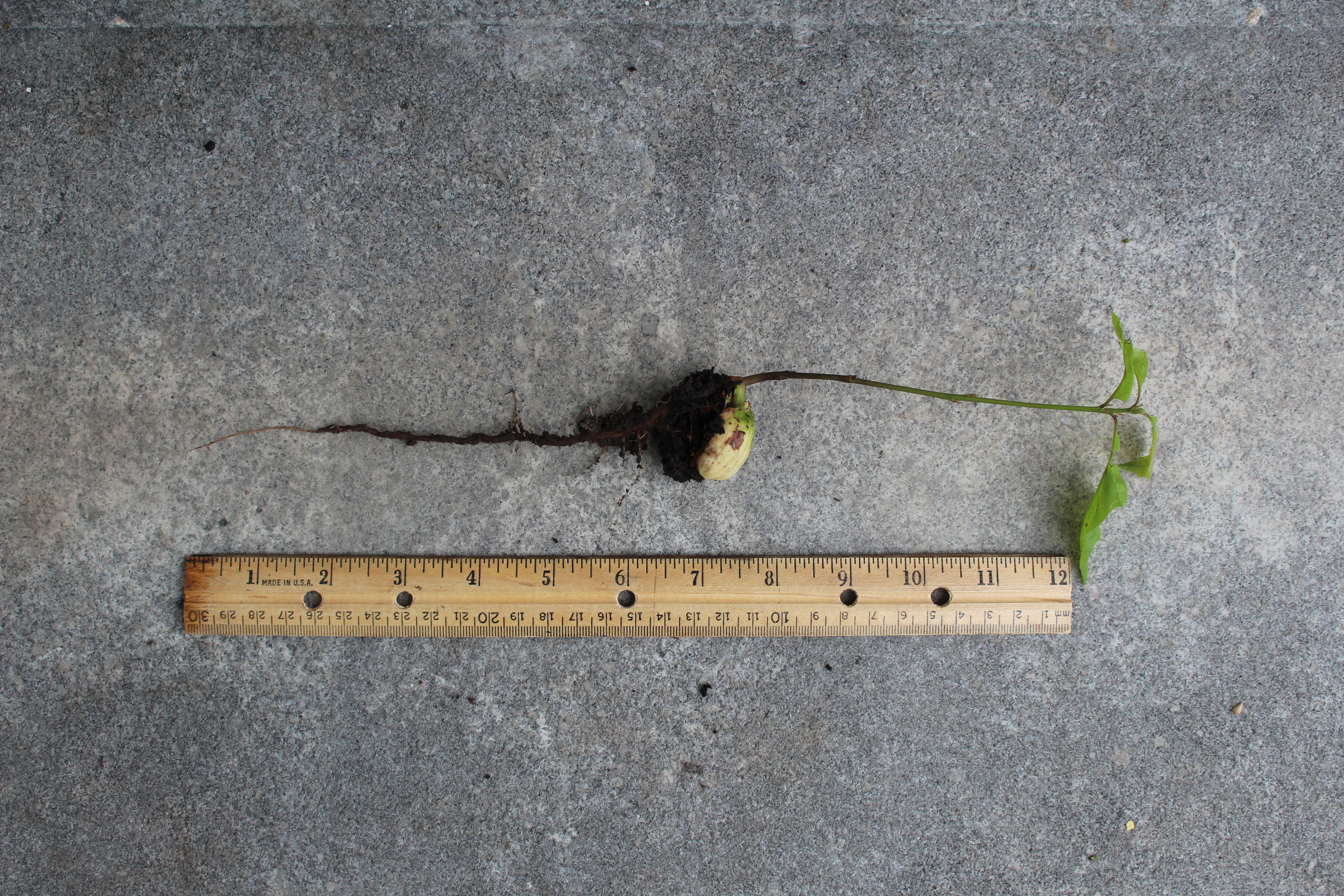
Our tree of the week is a recently germinated oak seedling. In the above photograph, we can see the acorn, visible at the soil surface.


So, which species of oak is it? Looking at the pointy leaves, it must be in the red oak group.


The acorn germinated this winter, under a Shumard oak (Quercus shumardii), which was featured on the blog this past September for our Acorn Watch 2022 (found here). The hard outer shell of the acorn resembles a Shumard oak acorn. Furthermore, there are two additional Shumards nearby, and the other oak species in the immediate vicinity are either white oaks or their acorns do not resemble the acorn shell found here. So, leaving aside, at least for now, the difficulty of oak hybridization, it seems safe to say that this is a new Shumard oak in the arboretum collection.

Fortunately, this seedling was easy to dig up and it appears that the new taproot is in good condition. The above ground growth measures nearly the same length as the taproot.


The taproot measures approximately 7 inches in length.


During the digging process, the soil fell away from the root. The new tree had not yet full immersed itself in its surroundings. Hopefully it won't be too traumatized by the move. It has now been added to the grassy slope on the north side of Cline Hall, and it has a full-sun location, with plenty of room to stretch up and out.


Monday, September 5, 2022

Tree of the Week: Shumard Oak (Quercus shumardii)


Acorn Watch 2022 continues with a look at a volunteer Shumard oak (Quercus shumardii). This tree entered the catalogue some time before 2012, but its exact age is unknown. However, we know that it is old enough to produce acorns!


For the photoshoot, our Shumard oak is wearing a pink sash. The ribbon truly brings out the bumpiness of the ridges, don't you think? The pink ribbon is 4 feet off the ground, and at this height the trunk has a circumference of 21 inches.


As we see in the above photo, the pink flare helps us pick out the Shumard from its surroundings. Even though it stands near a sidewalk, the Shumard is easy to miss. All of its lower limbs have been removed, so we only see the trunk at eye level. Both the light pole and the emergency call station draw our gaze away from the trunk of the tree.


The Shumard oak grows toward the top of a gradual slope. It competes for sunlight with two nearby persimmons. Two older Shumards are nearby, just north of this volunteer.


Leaves are dark green, simple, and lobed. The petiole is nearly 2 inches long, while the blade is approximately 6 inches long.

 
Underneath, leaves are a lighter shade of green and mostly smooth.


Taking a closer look, we see the characteristic fuzzy spots along the midrib.


This leaf measures about 4 inches across.


Leaf edges are bristly. In this snapshot, there are at minimum 10 bristles.


While standing on the ground, it is possible to see several large clusters of acorns; however, a ladder was necessary to take a few photos.

Maturing Shumard acorns, photographed September 4, 2022


The acorn cap looks flat, rather than rounded like a bowl as many other acorns are.

 
This acorn is already of a nice size, measuring over ½ inch.


Sunday, August 16, 2020

Surface Roots

Watch your step! Shumard oaks have surface roots. Along with the tripping hazard, surface roots add interest to the landscape.
Thick roots stretch out from the trunk, running along the surface of the ground, appearing to clutch the earth for stability.
Knobby, protruding roots make lawn maintenance more of a chore, so keep this in mind when planting.


Sunday, July 5, 2020

Trumpet Creeper (Campsis radicans)


Rank growth of trumpet creeper vines obscures the trunk of an old Shumard oak (Quercus shumardii). Vines so thoroughly cling to the tree that folks who are unaccustomed to studying trees might not be able to distinguish vine from tree.

What's a vine, and what's a tree? The green leaves are young trumpet creeper vines. The light-colored bark belongs to a very thick, old trumpet creeper vine. And the dark gray bark belongs to the Shumard oak.

The established trumpet creeper vine is more than three inches across. If the vines are so healthy, where are all of the pretty trumpet flowers?

Most of the trumpet flowers are way up high, entwining the Shumard's branches. From time to time our summer thunderstorms blow a few flowers loose, scattering the bright orange gems on the ground below.

Trumpet creeper flowers are three inches long, and the widest end is about two inches across.

Migratory humming birds are known to enjoy these pretty flowers.


Sunday, November 4, 2018

Tree of the Week: Shumard Oak (Quercus shumardii)


Our tree of the week is an on-site native Shumard oak (Quercus shumardii). It's pictured center, growing next to the sidewalk, and is easy to recognize due to its clingy companion. During the summer months, the mature canopy of this tree provides highly desirable shade to a major thoroughfare. This week we appreciate its handsome fall foliage and its substantial acorns.


This mature tree is situated between Hamilton Hall and the Student Union Building. It is positioned mid-slope.
There aren't any low hanging branches on this old specimen. With the exception of one lower branch that could be accessed with the aid of a 10-foot ladder, all its limbs are way out of reach.
A venerable volunteer trumpet creeper (Campsis radicans) has been allowed to grow alongside this mature Shumard. During the summer months you can find the bright orange trumpet-flowers scattered on the ground around the trunk.
Since its leaves are far above eye-level, for most of the year, this is all we see -- a large, straight, cylindrical trunk.
Of course, it's a handsome trunk. The mature Shumard bark is grey, rough, and fissured.
This week, things are changing.The leaves are turning pretty colors and then falling to the ground.
Light-green leaves are mixed with shades of yellow and orange. The show of color is fleeting!
Shumard leaves are lobed and pointy. The leaf measures approximately 6.5 inches in length.
The leaf-litter yielded up one useful example, a twig with green leaves. We see that the Shumard leaves alternate along the twig.
This dark green leaf is representative of the Shumard during the hot months. It's smaller, measuring less than 5 inches.
The underside is lighter in color, but still very green.
Looking more closely at the underside, we see little fuzzy spots on the midrib.
The fall coloration is accompanied by a large number of acorns this year. You can find these in the leaf-litter. It's hard to imagine, but the USDA maintains (the claim is stated here) that you can make a coffee-substitute out of these acorns.  No recipe is provided.
Shumard oaks have large acorns, measuring an inch in length. The acorn cap is shallow.
Detail of acorn


You can see more pictures of the arboretum's Shumard oaks here.

For more information about this species consult the following:
United States Department of Agriculture
University of Florida IFAS Extension
Virginia Tech Dendrology