Showing posts with label Quercus alba. Show all posts

Thursday, November 24, 2022

2022 Acorn Watch: White Oak (Quercus alba)

In the middle of November, our younger white oaks (Quercus alba) have ripening fruits. In this photo, the leaves are still mostly green, while the acorns are a light pink.


On the same tree, on the same day, we see a little autumnal red on these leaves.


Wednesday, September 28, 2022

2022 Acorn Watch: White Oak (Querucs alba)


A month ago, we looked at the acorns on a young white oak (Quercus alba), approximately 16 years of age. The acorns were numerous; the caps were big; but the green fruit was still small. Over the past four weeks, the fruit has developed significantly.


This cluster of acorns was photographed on August 27th. The caps look nearly fully developed, and the green fruits are nicely rounded but still small. Compare these fruits to those in the below photograph.


This is what the acorns look like this week. The caps now look small compared to the fruit. Will the acorns get bigger, or, having reached their full size, is it time for them to start ripening? Looking at past pictures of ripe acorns from the Centenary arboretum, we expect these white oak acorns to grow to an inch in length, which, as pictured above, they aren't quite there yet.


Sunday, August 28, 2022

Tree of the Week: White Oak (Quercus alba)

Our tree of the week is a white oak (Quercus alba) growing near Rotary and Cline dormitories. Continuing our project, Acorn Watch 2022, we are interested in its large clusters of acorns, but for a moment, study the cute little rain lily flowers, found in the above photograph, to the right of the flaky, white bark. Rain lilies are popping up in the arboretum and alongside the roads of Caddo parish. For the past week, we have had wet weather, and the rain lilies, true to their name, are responding to all of the moisture!

Our tree of the week is approximately 16 years old. It volunteered in the arboretum and was shortly thereafter moved to this sunny location, next to the sidewalk that runs from Cline Hall to the Student Union Building. The red bricks of Rotary Hall are pictured in the background.


This photograph shows the current state of our sunny slope near the dormitories. The hill gradually slopes down to the main drainage channel of the arboretum. The Fitness Center is also located at the bottom of this hill. Hopefully, within the next decade, this spot won't be so sunny.

The white oak is loving its location at the top of the hill. Do you see all of the acorns?!? This tree appears to be thriving. Maybe it also likes the extra water provided by the arboretum irrigation system.

The nut, the green meaty part of these immature acorns, has yet to expand outward. Right now they're snugly nestled down in their caps. We do not expect these acorns to ripen any time soon. In 2018, we had a photoshoot with acorns from our two on-site natives; those acorns weren't dropping until November. You can read that post here.


Sunday, December 2, 2018

White Oak Acorns

These acorns are littering a gravel path near one of our oldest white oaks (Quercus alba). You can read more about the tree here. Note: one of the acorns is split; it has started to germinate.
These are long bullet-shaped acorns, measuring more than an inch.
These white oak acorns have a different shape. They taper much less quickly. They were collected from another old, on-site native, growing in the arboretum drainage channel on the east side of the Student Union Building. Again, one acorn has started to sprout.

We have two different white oaks, with two different acorn shapes. Both are big acorns, but one is longer and the other is fatter. Intraspecies variation on display!


All photos taken on December 2, 2018.

Saturday, September 15, 2018

Tree of the Week: White Oak (Quercus alba)

Today we're following up the Quercus lyrata with its close relative, the true White Oak (Quercus alba). This handsome specimen was featured late last year.

In this last week of the summer season, we have had several rainy days, but today the sun is shining bright. Our tree of the week provides much desired shade along the gravel path to the Fitness Center.
The tree has good, upright growth and very few dead branches.
The handsome bark is streaked with late summer sun.
Its large and tasty acorns are preferred by most wildlife (probably due to a reduced tannin content found in the White Oak group), but crops don't come in every year. Last year, there were no acorns at all. This year, some corpulent examples are pictured below.

These big fellas measure over an inch. Note the tiny cap, as compared to the Quercus lyrata and Quercus macrocarpa.
The small acorns behind are for the following year while the developed acorn is part of this year's crop.
The crown of this tree is lush and full. Curiously, several leaves at the top appear to be wrinkled and discolored. Is this a health problem?
Glossy red-brown terminal buds can be seen at the end of twigs.
Axillary buds can be seen underneath the leafstalks.

Sunday, August 19, 2018

Tree of the Week: White Oak (Quercus alba) with Muscadine Grape (Vitis rotundifolia)

The white oak (Quercus alba) is a valuable member of the oak family. This species provides wonderful foliage in the fall, and its fruits keep wildlife well-fed, as it produces acorn crops on a different schedule than the red oaks.

The species establishes well in the arboretum, with numerous volunteers. This is probably due to a combination of abundant moisture and the sloping terrain of the Centenary campus. A white oak will not tolerate standing water and its drought tolerance is not especially high. Like many plants it will, therefore, do best in places that have both good drainage and an adequate water supply.

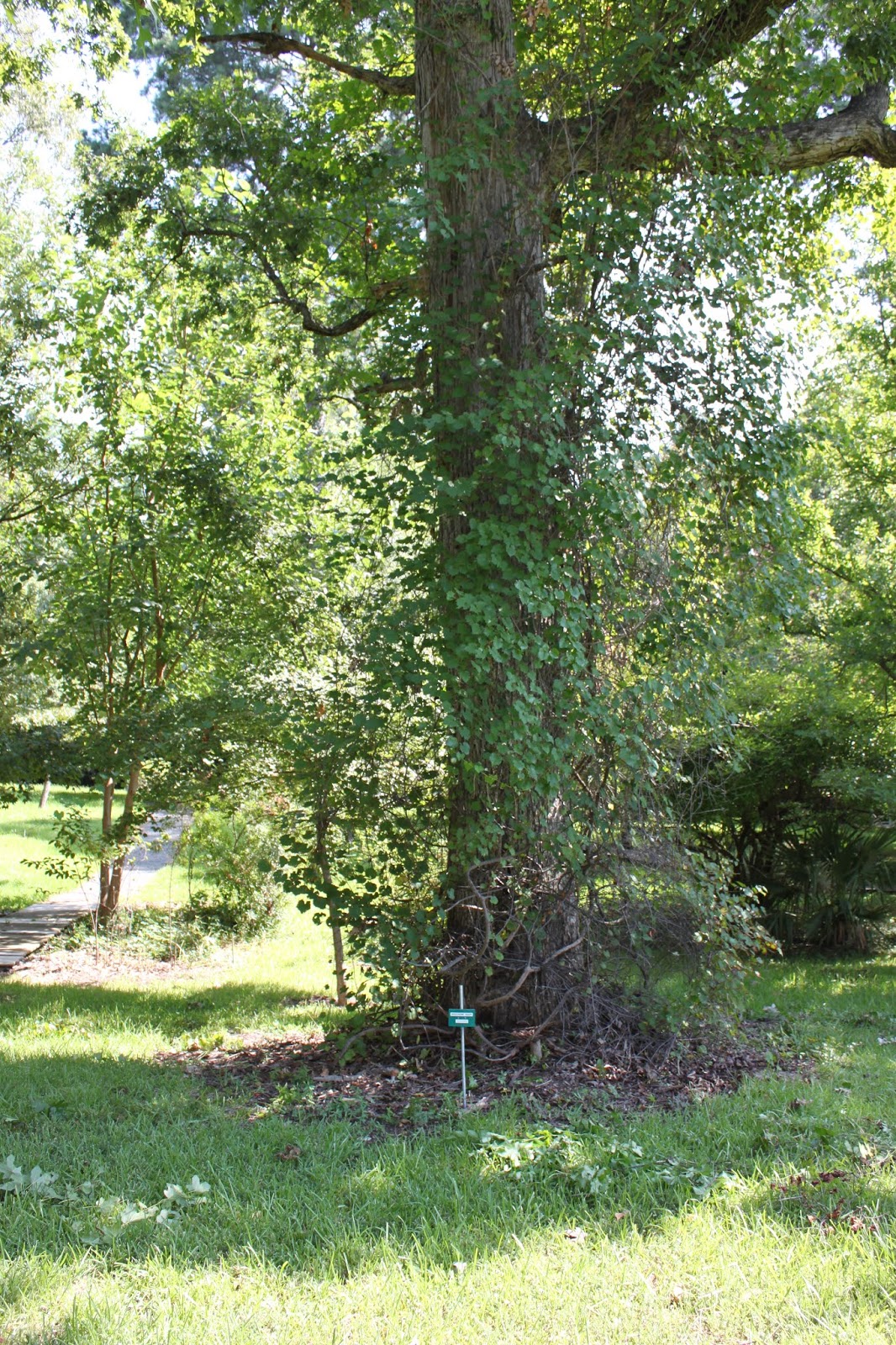
This week, we consider a very large, old white oak. It plays host to our most beloved native North American grapevine, the muscadine (Vitis rotundifolia). While the vine is thriving and producing fruits, the tree looks to be in decline. The following photos illustrate both the declining health of the tree and the advancing success of the vine.

This photo was taken circa 2012. The white oak is pictured center. The old tree has a rounded crown, although not quite full. There is plenty of open-space among the branches. The muscadines form a bush around the base of the straight, white trunk.
From the photo taken today, we see that the white oak no longer has a rounded crown. In the interim several large branches have fallen from the left side of the tree, and several dead branches are visible. The trunk is obscured, as it has been swallowed up by the muscadines.
The muscadine vines cover the south-facing side of the trunk.
Looking upwards, we see the vines are well-established among the old, heavy branches.

But the vines aren't as thick on the west side of the tree.
The gray, rough bark is visible on the west side of the tree.


So, does the demise of the tree follow from the success of the vine? Are we to blame the muscadines for the declining health of the white oak? Has the vine 'strangled' the tree or out-competed the tree for resources? Probably not.

Old-age is another potential explanation for the tree's declining health. This specimen antedates the arboretum, so specific age is unknown, but it's obviously a very old tree, given its large size and the slow growth rate of the species.

Furthermore, white oak longevity might be dependent on a cooler climate (more continental/temperate than subtropical), which we are lacking in northwest Louisiana. The white oak has a very large range; it occupies most of the eastern woodlands in the US.  The species is very common in the state of Louisiana. However, the largest and oldest white oaks in the United States appear to be in the Northern half of its range, particularly the Ohio River Valley and mid-Atlantic seaboard of the New Jersey/Delaware area. The single oldest specimen lived in Basking Ridge, New Jersey, until it was cut down in 2017, after an estimated 600 years of growth. Our tree's declining health is perhaps due to the climate in the south, which is outside of the range of the champion trees of this species.

Enjoy the fruits of the vine!

Muscadine fruits are ripening this time of year. In November of 1997, Ed Leuck planted six seedlings around the base of the white oak. Two seedlings were acquired from Sherwood Akin nursery in Sibley, Louisiana. The other four seedlings were grown from seed collected from the Caroline Dormon Nature Preserve.
Muscadine leaves are toothed with a cordate shape.
The spherical fruits are thick-skinned and spicy. They are approximately a half inch in diameter.

Saturday, December 16, 2017

Tree of the Week: White Oak (Quercus alba)

White oaks (Quercus alba) do very well in the arboretum, particularly towards the bottom of our clay slopes. This is a species that grows naturally on the Centenary campus. Of the nine individuals in the collection, only one tree was brought in from another location. The tree pictured below is a campus seedling: it started growing somewhere on the grounds of the arboretum and was moved to its present location, next to the gravel path that runs between the Fitness Center and the Student Union Building.
The leaves of the white oak turn red in the fall. From a distance, the leaves look burgundy.
Up close, we see that the leaves aren't uniformly colored. Many are in the process of turning
Here we have a waxy green leaf with only a little red on the edges. White oak leaves are lobed with smooth edges
The underside of the waxy leaf is paler green and smooth (not fuzzy). The red leaf shows that leaf-size varies on the same tree, with about an inch and a half between the two leaves.

Looking up, we see that this white oak has a straight trunk. We can also see the characteristic white, shaggy bark, as it appears on both trunk and limbs.
Zooming in on the trunk, the rough, shaggy white bark is very distinctive.


You can find more pictures of the arboretum's white oaks here.

Consult the following sources for more information about this species:
United States Department of Agriculture
Louisiana Plant Identification and Interactive Virtual Tours
Stephen F. Austin State University  

Saturday, September 2, 2017

This past Wednesday a lot of rain fell, accompanied by some gusts of wind. A couple large, dead branches were knocked loose and fell to the ground with the rain. Luckily for us, some branchlets fell, too, giving us a look at this year's growth from the tip-top of the old trees. 

White oak (Quercus alba) leaves and acorns
This bristly fruit fell from the hybrid American chestnut tree (Castanea dentata). Ouch! We aren't going to bust it open quite yet.
Water oak (Quercus nigra) acorn and leaves.
The sweetgum (Liquidambar styraciflua) often acquires a bad wrap because of its pointy fruits. There is one large on-site native sweetgum in the arboretum collection, and, admittedly it does make a mess of the sidewalks. It has sustained damage over the years, so this past summer a volunteer sweetgum growing up in the groundsel bush (Baccharis halimifolia), away from foot traffic, was admitted into the catalogue, so that we have a back-up specimen should something happen to the old one.
This image shows the relative size of the different fruits.
The fruit pods of the strawberry bush (Euonymus americanus) are changing color and opening up.
The orange-red seeds of the strawberry bush are revealed. They should not be eaten!