Showing posts with label Taxodium ascendens. Show all posts

Sunday, July 12, 2020

Immature Cypress Fruits


Pond Cypress (Taxodium ascendens)
growing near the Fitness Center
thin, needle-like leaves & immature, globose fruits
pictured July 12, 2020


Bald Cypress (Taxodium distichum)
growing next to the Fitness Center ramp
feathery leaves & immature, globose fruits
pictured July 12, 2020


Saturday, November 24, 2018

[Fall foliage] Pond Cypress (Taxodium ascendens)

This pond cypress is more than 30 years old. It was purchased from Woodlanders Nursery (Aiken, SC) in 1989. Note the incredibly straight trunk.
It has dropped most of its leaves, but the ones that remain are delightfully orange.
Fall foliage, November 24, 2018


Wednesday, May 16, 2018

Immature Fruit


The pond cypress (Taxodium ascendens) near the Fitness Center is ornamented with clusters of developing fruits.
The globular fruits are bright green.

Saturday, October 7, 2017

Tree of the Week: Pond Cypress (Taxodium ascendens)

We've seen an unusually dry September and the first week of October hasn't been much different; it's stayed warm and dry. The arboretum's sprinklers have been working steadily to keep the plants healthy and the subject of this week's post, a pond cypress (Taxodium ascendens), has been receiving some extra water due to nearby transplants.

According to the LSU Ag Center, late Summer and early Fall are the best times to divide irises. There are several large beds of native Louisiana irises in the arboretum. To alleviate crowding, two dozen were collected from one of these large beds and transplanted underneath one of the pond cypresses. This tree was purchased from Woodlanders nursery (Aiken, S.C.) in the fall of 1994. It was planted in the arboretum stream in 1996. The stream was later transformed into a concrete floodway. Luckily for the pond cypress, the decision was made to build around the tree rather than remove it. Laurel greenbriar (Smilax laurifolia) has been using the tree as a trellis since its initial planting. Now a patch of Louisiana irises is also growing in its dappled shade. 

The pond cypress is pictured above in the middle, with a southern catalpa on the left and a grouping of fringe trees on the right. The pond cypress is  beginning to show its fall color, as the leaves are turning a light copper brown.
This view clearly shows the concrete floodway, which hasn't seemed to bother the pond cypress. Being at the bottom of a steep slope means that this pond cypress receives heavy amounts of water during rainy weather.
The pointy leaves of the pond cypress are turning a light brown for the fall. A fruit is pictured in the middle of the  branch.
Both pond and bald cypresses produce globular fruits. But the leaves are quite different. The pond cypress (pictured above) has pointy leaves, while the bald cypress has feathery leaves. You can see the bald cypress fruits and leaves here.
The pointy leaves are pictured with drooping panicles.
Looking up the trunk of the pond cypress we can see that it doesn't make the best shade tree. The irises recently planted below should receive a good amount of light.
This is the dark brown bark of a pond cypress that is approximately 25 years old. It's rough and shredded.
The laurel greenbriar was collected from the Kisatchie National Forest in 1994, and planted with the pond cypress in 1996. Louisiana irises were added to the mix last week.


You can catch a glimpse of the arboretum's other pond cypress here, in the discussion of the water tupelo.

For more information about this species consult the following:
United States Department of Agriculture 
University of Florida IFAS Extension 
Clemson Cooperative Extension (discussion of pond cypress follows description of bald cypress)

Saturday, September 2, 2017

Tree of the Week: Water Tupelo (Nyssa aquatica)

The sun is shining in Shreveport this weekend. The remnants of Hurricane Harvey brought heavy cloud coverage in the early part of last week and steady rain on Wednesday. Thursday, things cleared up, and on Friday the sun steamed everything up. If you're outside enjoying the late summer weather, you might also be looking for a spot of shade.

There are many beautiful shady spots on Centenary's campus, and if you're in the arboretum, take time to appreciate the water tupelo (Nyssa aquatica), shading the long white wooden bridge. It was purchased from Woodlanders nursery (Aiken, S.C.) and added to the arboretum collection in October 1988, making it more than 30-years-old. Currently, it is doing very well, despite competition, and littering the wooden bridge with its fruits. 
 
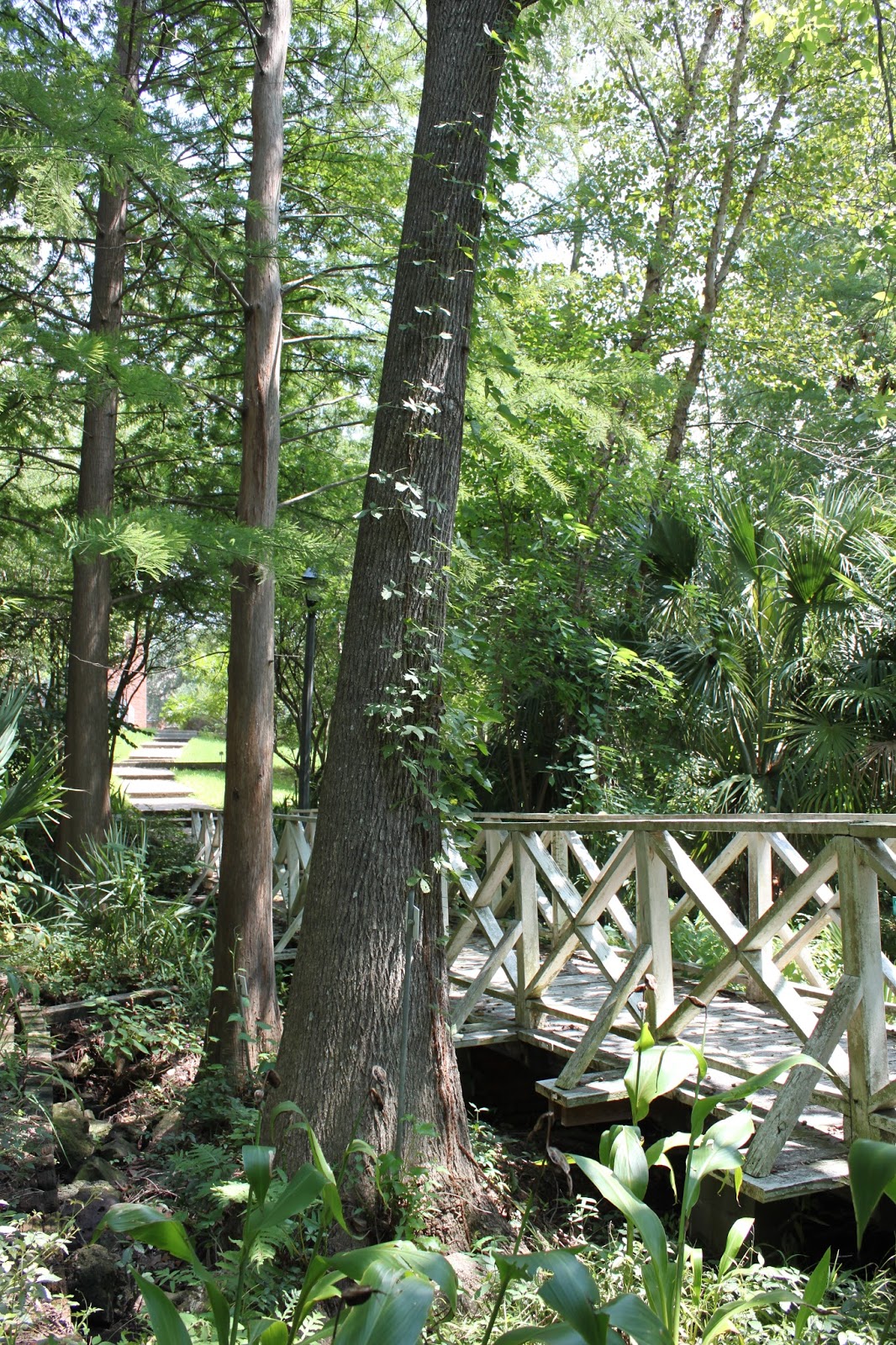
The long white wooden bridge in the arboretum is mostly shaded, with only some dappled sunlight hitting the planks. In this picture, we are looking east, and our tree of the week is pictured to the left of the bridge, growing on its north side.

The water tupelo (the center-most tree in the above photograph) grows in a very wet area. It is in competition with other water-loving trees. Immediately to the left of the water tupelo, we have a pond cypress (Taxodium ascendens). In the background, at the far left, we have a bald cypress (Taxodium distichum).  

This water tupelo is competing for sunlight. Its primary competitor is the pond cypress (Taxodium ascendens), planted a year after the tupelo. The competition might explain the crook in the tupelo's trunk.

There are a lot of fruits on the tree this year.
The elliptic leaf has smooth, wavy edges and a pointed tip.
The numerous speckled drupes blend in with the worn wooden planks.
The off-white background offers a better look at the oblong shape of the fruit.
There are significant accumulations of green fruits on the ground under the tree, and some of the fruits appear to have been gnawed on (lets blame the squirrels). There are also a few patches of sensitive fern (Onoclea sensibilis) growing in the shade of this water tupelo. The fern, which was originally collected from the Caroline Dormon Nature Preserve, is pictured in the bottom left hand corner.
The bark of this tree, which is more than 30-years-old, is deeply furrowed. The trunk shows some characteristic swelling.

For more information about this species consult the following:
Arkansas Agriculture Department (Great picture of old water tupelo!)
Louisiana Plant Identification and Interactive Virtual Tours (LSU AgCenter) 
USDA Forest Service