Showing posts with label Quercus lyrata. Show all posts

Wednesday, November 2, 2022

2022 Acorn Watch: Overcup Oak (Quercus lyrata)

Overcup oak acorns are ripening. On the tree, we see both the acorn and its cap turning from green to brown, and in the leaf litter we see fully ripe acorns. All of the photos below are from October 30, 2022.


Two acorns have turned brown, indicating ripeness, but remain attached to the tree.

This acorn is in the process of turning brown.


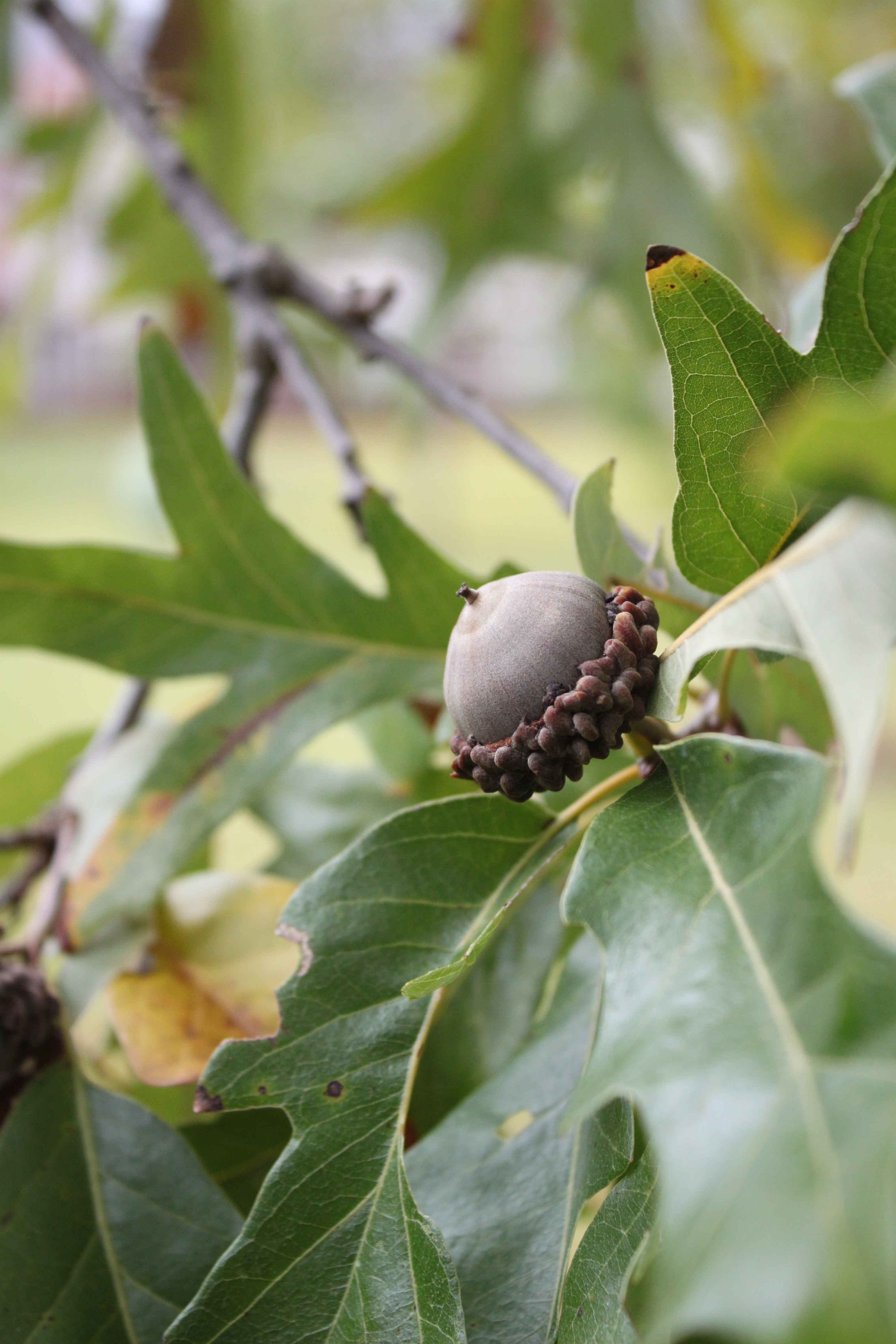
The cap on this acorn is unexpectedly revealing, allowing us to see the acorn itself.


In this photo, we see a ripening nut with a cap that hasn't lost its greenness.

All of these acorns were found in the leaf litter. These are big fruits, easy to spot, if you happen to be looking for them.

Overcup oak acorns, photographed October 30, 2022


Sunday, October 9, 2022

2022 Acorn Watch: Overcup Oak (Quercus lyrata)


This week in the arboretum, check out the developing acorns on the overcup oaks (Quercus lyrata). There are four overcups in the collection, spread out across the arboretum, and each one has at least a few acorns. The specimen pictured below has more than its fair share.

We discussed this individual back in August. At the time, the tree was covered with a profundity of immature acorn clusters, and the individual acorns were mostly concealed by the large caps. You can find those pictures here. Today, as we see from the following images, the acorn itself is visible and the caps vary in size.

This particular tree makes studying acorns a pleasure. Can you see how the lower branches nearly touch the ground as it slopes upward toward Rotary Hall? And there are acorns on these lower branches! No ladder necessary.


Some acorns are solitary.

And there are several clusters as well. You can easily maneuver the branches to study the acorns and appreciate the different textures: the cap is very bumpy, while the acorn itself is smooth.


Immature overcup oak acorns, photographed October 9, 2022


With so many immature acorns to examine, we can see variations.


We snipped two acorns to take measurements and to show the variation in cap shape. These are large fruits, and we see in the above photo that they are already more than an inch in length. The caps cover different proportions of the acorn. The cap on the left nearly engulfs the whole fruit.


Tuesday, August 9, 2022

Tree of the Week: Overcup Oak (Quercus lyrata)

Acorn Watch 2022 continues with a look at one of the arboretum's overcup oaks (Quercus lyrata). 


Our tree of the week is an overcup oak (Quercus lyrata), located on the south side of the arboretum, near Cline and Rotary Hall dormitories. As shown in the picture, there is much sunshine on the grassy slope near the dormitories, but under the oak tree, we have a shady spot. Unfortunately, our arboretum catalogue lacks specific planting information for this specimen, so we cannot say exactly how old it is, but this oak was certainly planted after 1995. It is roughly 25 years old.


Trees, especially oaks, provide excellent habitat for all sorts of critters, including transient kobolds. This one stands about 3 feet off the ground.

At roughly 25 years of age, this overcup oak is producing a large number of acorns. Here, developing acorns of two sizes are visible. The tiny ones are not on track for ripening this year and are expected to drop from the tree as immature fruits.


Despite some predation on the leaves, visible to the right, these larger acorns look quite healthy.

 To see our previous post from four years ago on this species, click here.

Saturday, September 8, 2018

Tree of the Week: Overcup Oak (Quercus lyrata)

The arboretum is home to four overcup oaks, three of which we'll examine in this post. This member of the White Oak group is native to wet bottomlands, something of an inverse to the post oak (Quercus stellata). Due to the major flood control projects carried out by government agencies in the 20th century, the overcup oak has lost ground to other species.

Although this is not a commercial species, it is valuable. Its lumber is mostly substitutable for the true white oak (Quercus alba), and its very large acorns are taken by quadrupeds (Odocoileus virginianus) and tree rats (Sciurus carolinensis).

Two specimens can be found near the wooden bridge that runs in the floodplain between the SUB and the Fitness Center. These trees are the youngest specimens, collected and planted after 1995. Curiously, they show extensive suckering along the lowest branches. Information on this issue is not forthcoming and the trees appear to otherwise be healthy.
In this picture, the suckering phenomenon is apparent. Limbs that would normally be leaf-free when close to the trunk have instead sprouted. Because this behavior is unusual and the leaves also appear to have been feasted on by unknown predators, it will be necessary to monitor these trees more closely in the future.
 Below the retention wall that separates the Arboretum from Hamilton Hall, another overcup oak is growing. To see what it looked like last year, examine our previous post. This is the oldest specimen on campus. Dr. Ed Leuck planted the tree in 1990. It has a good upright form but several dead lower branches. There is very little suckering here when compared to the previous trees.
The bark of the overcup oak is quite handsome, though not shelved and plated to the degree typical of the Quercus alba.
The arboretum's overcup oaks show extensive signs of predation by Sphyrapicus varius, the yellow-bellied sapsucker. These holes are drilled by the bird in order to extract the plant tissues and juices upon which it depends for half its diet.


The likely effect of this activity on the health and longevity of the trees is unknown, although for some species of birch and maple, it is associated with mortality.

An immature acorn of the overcup oak, diameter about 1"
Cluster of immature overcup oak acorns
For comparison, immature acorns of the white oak are smaller and more of the seed is showing.

Saturday, September 30, 2017

Tree of the week: Overcup Oak (Quercus lyrata)

If you take a gander at the overcup oak (Quercus lyrata) this week, you should be able to see its distinctive acorns. There are four healthy overcups in the arboretum collection. The photos below are of a single specimen, purchased in October 1990, from Woodlanders Nursery (Aiken, South Carolina).
This overcup oak (Quercus lyrata) is doing well at the top of a clay slope. Hamilton Hall sits on the plateau above the brick retaining wall.

This is a view looking down the slope, with the overcup oak pictured in the center.
The lobed leaves appear to have a cinched or corseted waist.
The shiny dark overcup oak leaves are pictured with an acorn against the brick retaining wall.
Overcup oak leaves are tinted white underneath.
The common name of Quercus lyrata comes from its characteristic acorn cap. The highly textured acorn cap conceals the nut. It has a rough surface, but it's soft, not spiny.
An acorn from the bur oak (Quercus macrocarpa) is pictured to the left. On the right is the overcup acorn. Both have unique caps.
The white oak (Quercus alba) acorn, pictured on the far right, is smaller than the bur and overcup acorns.
The shaggy gray bark of the overcup oak (pictured) resembles the bark of the white oak (Quercus alba).


You can see more pictures of the arboretum's overcup oaks here

For more information about this species consult the following:
United States Department of Agriculture
University of Florida IFAS Extension
Louisiana Plant Identification and Interactive Virtual Tours


Friday, February 3, 2012

Quercus lyrata

Bark detail of Quercus lyrata, commonly known as the "Overcup Oak."