Showing posts with label Family: Betulaceae. Show all posts

Monday, February 3, 2020

Flowers of the Tag Alder (Alnus serrulata)

It's the beginning of February, and a few species are already flowering. Mature tag alder catkins are to be found in the arboretum this week. The golden flowers dangle in clusters, dancing in the breeze. We also see the old "cones" from last year, as well as the tiny, red female flowers.
Male and female flowers of the tag alder (Alnus serrulata) photographed at the beginning of February
Can you see the tiny specks of red that appear at the end of the twig, positioned directly above the cluster of catkins? These are the female flowers.


The long yellow flower clusters (catkins) are the male flowers. The catkins measure between 2½ inches and 3¼ inches in length. A light touch will release a small cloud of yellow dust.


Here we have a better look at the female flowers. So small!

Thursday, October 24, 2019

Tree of the Week: Tag Alder (Alnus serrulata)

Tag alder (Alnus serrulata) grows as either a small tree or a large shrub. In the arboretum collection, we have one large shrub. It's growing in a very wet location, in partial shade. It would perhaps prefer more light.

The tag alder (Alnus serrulata) is worth an extra look this week: reproductive cones and catkins are mixed in with the remaining summer foliage. You can find the arboretum's tag alder shrub along the drainage channel, between the Student Union Building and Hamilton Hall. This shrub is more than 25 years old. In November of 1993, these plants were collected from Cypress Lake in Bossier Parish, and they were planted in the ground of the arboretum the following month.
From left to right: tag alder leaf, new cones, old cones, and male catkin
Tag alders are deciduous. In Louisiana, during late October, summer foliage remains on the shrub, available for your inspection. The leaves show some signs of yellowing.
Tag alders have simple, alternate leaves.
Tag alder leaves have an ovate shape with serrated, wavy margins.

Small clusters of fresh green cones can be found on the tag alder this week, and for several weeks to come.
These cones are the female reproductive structure.
Dried-out female cones from last year persist on the shrub.
Also, they resemble tiny pine cones.
The fresh green catkins are the male reproductive structures. They are still developing, and we do not expect them to bloom any time soon.


Please consult the following online sources for more information about this species:
Louisiana Plant Identification and Interactive Virtual Tours (LSU AgCenter)
NC State Extension
Virginia Tech Dendrology
United States Department of Agriculture

Sunday, September 1, 2019

Tree of the Week: Eastern Hop Hornbeam (Ostrya virginiana)

As late summer turns toward fall, ripe fruits can be found throughout the arboretum. Last week we posted pictures of tasty muscadines, which are to the point of falling from the vine. This week, we are looking at an interesting, but less appetizing fruit.

Our tree of the week is an eastern hop hornbeam (Ostrya virginiana), more than 25 years of age. It's pictured center. You can read more about its history on a previous blog post, found here.
This past summer several lower branches began to droop significantly, making the tree more difficult to mow around and reducing ease of access. They were removed. So, it's now a little difficult to inspect the leaves and hanging fruit clusters. 
A few of the fruit clusters can still be found on the tree, not too far out of reach. 
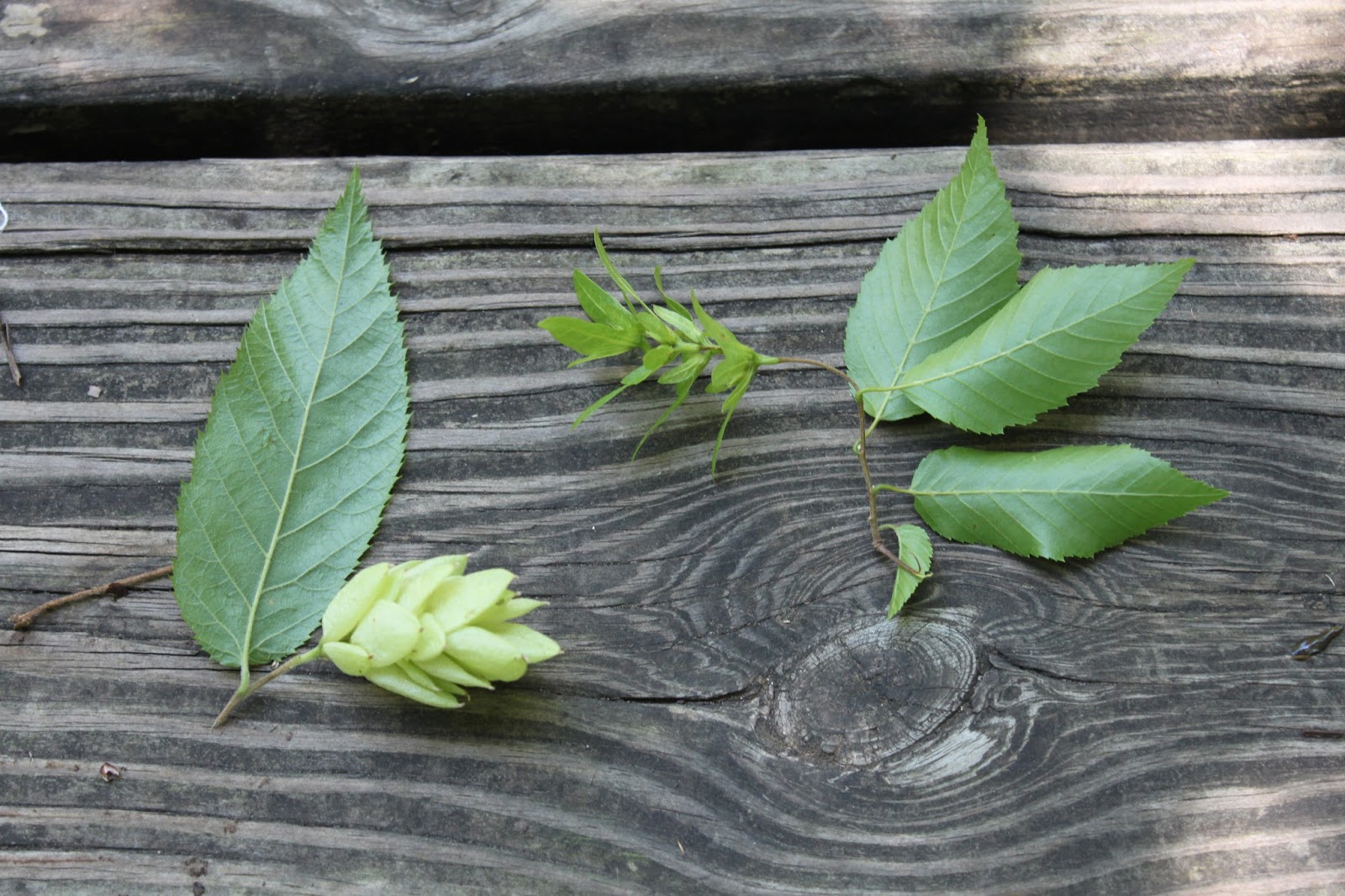
Fortunately, this week, you can inspect ripe hop hornbeam fruits in the leaf litter. Can you pick out the 'hops' from among the crossvine leaves, loblolly pine straw, and pine cone remnants?
In the leaf litter, you can find the individual paper husks, as well as intact ornamental clusters. Pick some up to take home!
These dry, lightweight seed clusters vary in size. This one measures approximately 2 inches in length.
Hop hornbeam seed clusters aren't appetizing to us, but they are enjoyed by the arboretum's all-too-healthy squirrel population.
Beware: Nearly invisible, prickly 'hairs' cover the husks that might irritate your skin. These irritants go unnoticed at first.
The husk feels empty, but each husk conceals one small, light-brown, narrow nutlet.
Each nutlet measures approximately ¼ inch in length.
Curious about the method of dispersion, a few of the lightweight, papery fruits were thrown in the nearby drainage channel. They float!


Sunday, February 18, 2018

Tree of the Week: River Birch (Betula nigra)

It's still winter in Louisiana. Most of the trees are leafless. It's a good time to appreciate the diversity of tree bark in the arboretum. Our tree of the week is identified primarily by its bark. You might see the river birch (Betula nigra) around town, planted as an ornamental tree in lawns and commercial landscapes. In the long hot Louisiana summers the leaves of the river birch provide much needed shade for our buildings and sidewalks. Now that it's winter, the leaves are gone, revealing the interesting form of the tree and its characteristic peeling-flaky bark.

There is one river birch in the arboretum collection. In 1985, two river birches were purchased from Clyde Gorum's Nursery in Shreveport. They were planted on the south side of the long wooden bridge. Ten years later, in 1995, one of the two trees was buried two feet under an embankment that was constructed around the lower pond. The tree survived and is thriving today. It's companion was removed in 2007, due to extensive insect damage.  

The river birch, over 30 years old, is growing in the corner of the embankment overlooking the arboretum's drainage basin. The leaves of two tree palmettos (Sabal palmetto) are partially obscuring the divided trunk of the river birch.
This is one tree with multiple stems.
The tree was planted before the embankment was constructed. In 1995, approximately two feet of dirt was piled up around the base of the tree to construct this wooden retaining wall. The tree didn't have a problem with the extra dirt.
Here we are standing in the drainage basin flanked by tree palmettos. This picture shows the river birch's tripartite trunk.
The river birch and wooden railing have grown very close over the years, perhaps too close, with the river birch complaining of needing 'space' and the railing complaining about being leaned on too much.
This is the characteristic river birch bark. It's shaggy, peeling, flaking, and rough. The top layer of bark is grayish-white, and it peels back to show a reddish-orange layer. This section has been worn off by the long, heavy palm leaves of the tree palmettos.
This is another look at the shaggy, peeling, rough bark with hues of maroon and orange. The LSU AgCenter describes it as 'salmon colored'. Check out their pictures in the link below.


For more information about the river birch consult the following links:
Louisiana Plant Identification and Interactive Virtual Tours (LSU AgCenter)
Virginia Tech Dendrology
U.S. Department of Agriculture, Forest Service 
United States Department of Agriculture

Friday, June 16, 2017

Tree of the Week: Ironwood (Carpinus caroliniana)

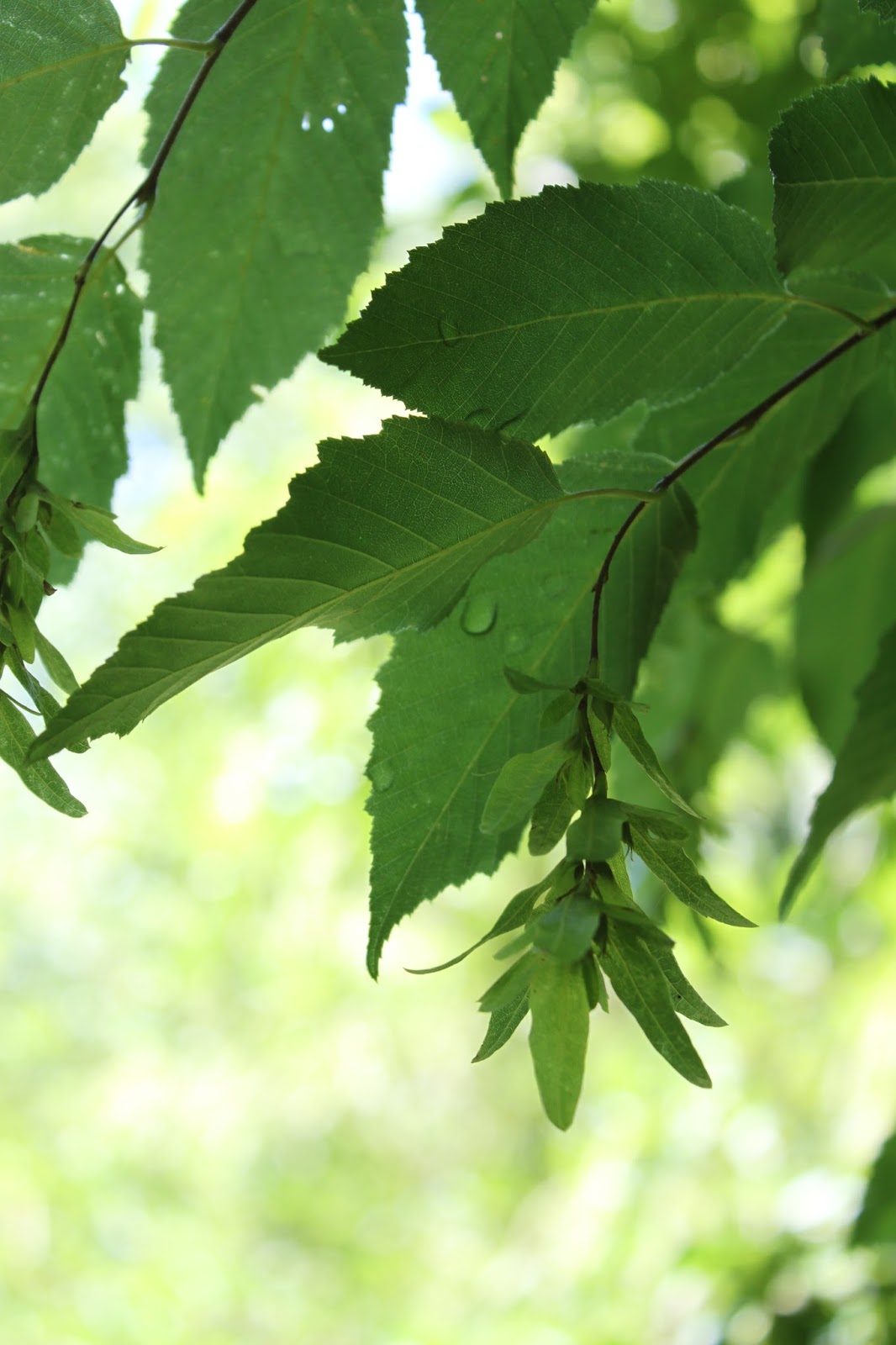
Last week we took a look at the eastern hop hornbeam (Ostrya virginiana), a member of the family Betulaceae, the birch family. This week, we are "keeping it in the family," with a profile of the ironwood tree, Carpinus caroliniana, another member of BetulaceaeThe arboretum collection has a mature specimen of both birches, planted right close to each other. The ironwood is in the floodway down a bit from the eastern hop hornbeam, which is a little up the slope. Both trees are about the same size. Right now (mid-June), each is ornamented with dangling fruit clusters hidden by doubly serrate leaves. A glimpse at the bark is the quickest way to tell the two apart: the hop hornbeam looks like a wildcat climbed the trunk, shredding the bark, while the ironwood has smooth bark that appears to be covering rippling muscles.

This Carpinus caroliniana was collected from Walter Jacobs Nature Park in the spring of 1994 and planted in this bed of Louisiana irises in November 1995. This location of the arboretum can be soggy for a week at a time, whenever the campus gets a heavy rain. 
The fruit of Carpinus caroliniana is a nutlet that is concealed by leaf-like bracts. These nutlets, hidden by their bracts, dangle in inconspicuous clusters.
Branchlet ornamented with dangling fruit clusters
The doubly-serrate leaves are the same color as the light-green bracts.
The nutlets occur in pairs, and each nutlet develops out of a 3-lobed leafy bract.
Ostrya virginiana (left) and Carpinus caroliniana (right) have similar leaves and fruit clusters. 
Carpinus caroliniana is known for its muscular trunk: the grey bark appears to conceal a sinewy musculature.
The smooth bark of Carpinus caroliniana is distinct from the shredded bark of Ostrya virginiana.
Detail of smooth grey bark of Carpinus caroliniana

You can see more images of the arboretum's collection of ironwood trees here.

For more information about this species consult the following:
United States Department of Agriculture
Louisiana Plant Identification and Interactive Virtual Tours (LSU AgCenter)
University of Florida IFAS Extension 

Friday, June 9, 2017

Tree of the Week: Eastern Hop Hornbeam (Ostrya virginiana)

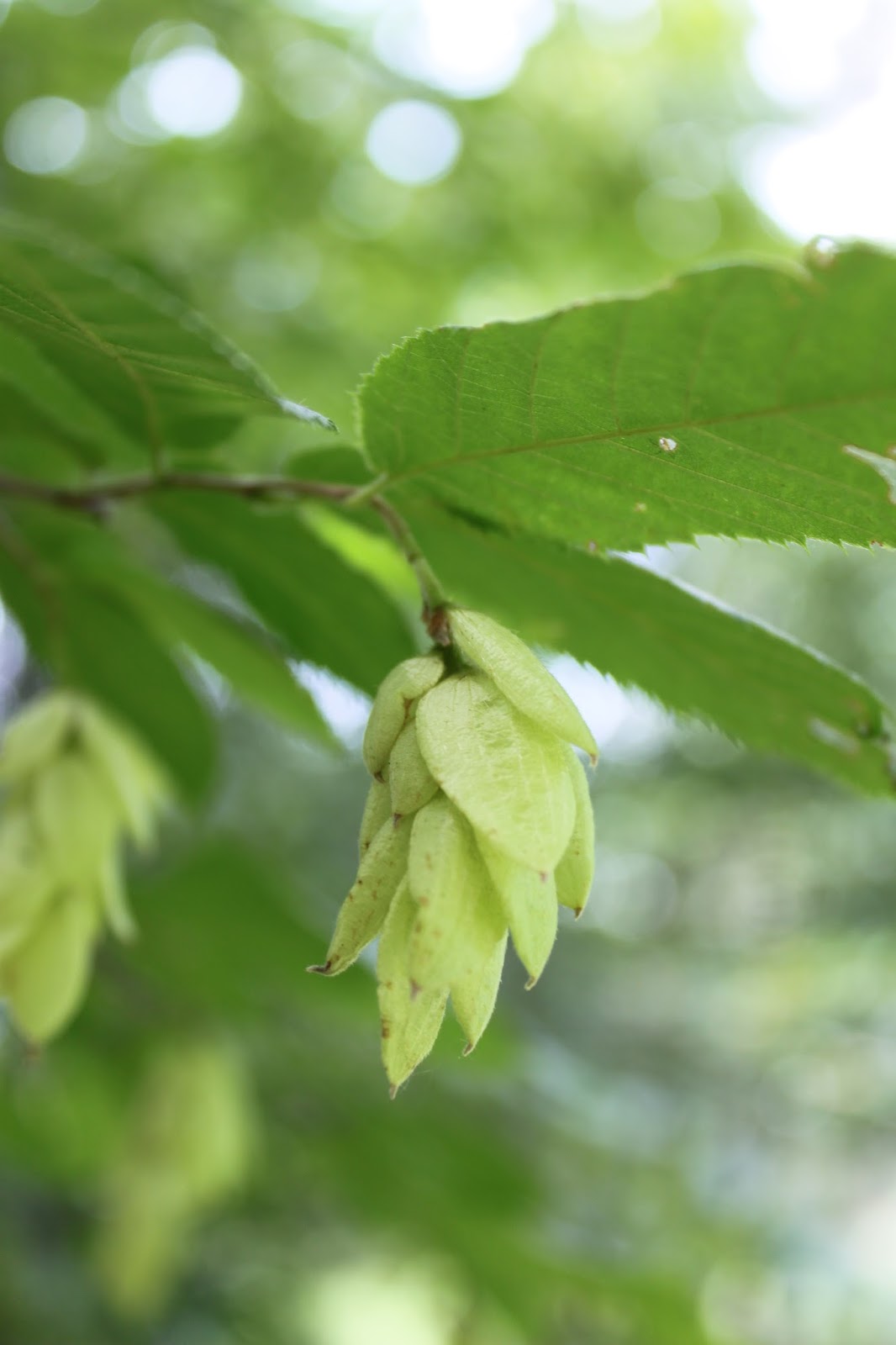
This week we are taking a look at Ostrya virginiana. Now is the right time of year to see why it's called the hop hornbeam tree. The "hop" comes from the tree's papery fruit coverings, which resemble hops, a critical ingredient used in the production of beer. Right now the hop hornbeam fruit clusters are greenish-white. Look closely or you might miss them; they blend in with the foliage.

This specimen of Ostrya virginiana was collected from Walter Jacobs Nature Park in 1994. It went in the ground in the fall of 1997.
This tree grows in the middle of a slope, above the floodway. A very old Pinus taeda, covered in  vines,  grows a little bit further down the slope (pictured above on the left).
The fruit cluster of Ostrya virginiana resembles hops. Each papery husk encloses a nutlet. 
The fruit clusters are abundant, but their greenish-white color makes it easy to overlook them.
Branch with leaves and fruits.
The leaves of Ostrya virginiana are finely-toothed.
Another look at the serrated leaves.
The outermost layer of this Ostrya virginiana's bark is grey colored with a shredded texture.
Beneath that the color is rusty brown.

You can see more images of the arboretum's eastern hop hornbeams here.

For more information about this species consult the following:
United States Department of Agriculture
Louisiana Plant Identification and Interactive Virtual Tours (LSU AgCenter)
University of Kentucky College of Agriculture, Food and Environment