Showing posts with label new recruit. Show all posts

Sunday, March 30, 2025

Mexican Plum (Prunus mexicana)

We've added another Mexican plum (Prunus mexicana) to the arboretum catalogue. This species is a fan favorite, producing delectable and highly-colored fruits that make a complete mess during their season. Squirrels eat them; bugs eat them; we eat them. Raccoons and possums eat them after hours when nobody is looking. The mature trees produce so much fruit that it simply lays about on the ground. This time of year, if you look under any of those trees, you will find seedlings. The individual pictured below is one such seedling.

Last April, this young tree was collected from under the mature Mexican plum growing on the steep slope near Mickle Hall (see here). It survived transplanting and the long hot summer months thanks to an onerous watering regime. Today, it is almost a foot tall.


Since the fresh green leaves developed in full sun, we don't need to worry about shocking it with too much sunlight when we plant it.


We planted it in full sun near the top of a gradual slope on the north side of the Cline Hall dormitory. This is an open, grassy area, and this time of year we allow the wildflowers to grow tall. The stakes with pink tape are necessary for calling attention to our small tree—we don't want it to be stepped on, stomped flat, or mowed over.


Monday, March 17, 2025

Bois D'arc (Maclura pomifera)

Three bois d'arc trees were planted on campus today. All are about a year old, and the tallest is approximately a foot high. You can read about the earlier stage of this project here, where we describe the collection and germination process.


We have three pots of bois d'arc (Maclura pomifera). Each pot has one main sapling, and there are several smaller saplings in each pot that will need to be trimmed back routinely until their roots die. We had such a high germination rate that we are now having to cut back seedlings that we do not have space for.


Our tallest sapling measures a foot high.


We already see new leaves on these young trees. You can also see a couple of thorns along the stem. 


We planted all three trees on the slope between the Student Union Building and Rotary Hall. They were sited along the southern side of the drainage channel. There is typically a small amount of water in this channel, year-round, so we are confident that the bois d'arc trees will find this to be one of the likeliest locations in the arboretum for their future success. Naturally, they will require frequent supplemental watering during their first summer, as they are not yet established.


A cottonwood (Populus deltoides) has thrived nearby. These trees ought to be great friends and get along splendidly, but there is surprisingly very little reference on the internet to them growing together. This must be due to the restricted natural range of the bois d'arc, which historically prevented it from colonizing all those areas suited to it. Self-described "desert rat" Gary Nored mentions on his blog that creekbeds in west Texas, along the US-Mexico border, are habitats for cottonwood and bois d'arc. Locally, we see mature bois d'arc and cottonwood growing together along the Clyde Fant Parkway. So, our bois d'arc saplings ought to do just fine.


In this photo, we are looking down the same slope, into the arboretum. A cottonwood is pictured at the far right edge of the frame. Our saplings are already planted, but they do not stand out in the landscape because of their small size. However, they are carefully marked with protective posts, and they will most likely grow quickly, making themselves more conspicuous.


Friday, December 8, 2023

New Recruits

We have four additions to the arboretum catalogue. All four plants are less than a year old. This past spring, they germinated in a large pot at a homeplace north of Shreveport. The pot was, at the time, meant for a satsuma tree. Oak acorns collected from the Centenary Campus were intentionally planted along with the satsuma, so that might explain the oak seedling that was found in the pot, but the other three seedlings volunteered and were allowed to grow in the pot over the course of the summer. On Wednesday, the four young trees were removed from the satsuma pot and transplanted into the arboretum.


A black cherry (Prunus serotina) was planted at the top of a slope, in full sun, at the southwest corner of the arboretum. It measures 2 feet, 1½ inches.

 
At the bottom of the same slope, in a sea of oak leaves, a leafless redbud (Cercis canadensis) was planted. The metal stakes marked with pink tape are absolutely necessary for protecting such an inconspicuous tree. It's the tallest individual planted, measuring 2 feet, 7½ inches.

Taking a closer look at the redbud, we see the characteristic zig-zag stem.

Across the sidewalk, closer to the Fitness Center, a red mulberry (Morus rubra) was planted. There are two red mulberry trees growing in full sun toward the top of the slope, so now we will see how the mulberry fares at the bottom, with more moisture.


Our red mulberry is 1 foot tall.
 
Lastly, we have a species of oak tree (Quercus sp.). This little tree, only 6 inches tall, was planted toward the top of the grassy slope on the north side of Cline Hall, not too far from the black cherry. We are hoping that this individual is a southern red oak (Quercus falcata). In the fall of 2022, acorns were collected from a mature southern red oak, growing on the Centenary Campus, near the intersection of Kings Highway and Centenary Boulevard. The acorns were planted in the satsuma pot, and in the spring, this oak sprouted, but its leaves do not resemble the leaves of the southern red oak from which acorns were collected. So, what are we to think?


Now, would you say that this oak leaf resembles a duck foot print? If so, then there is no reason to doubt that this is a southern red oak. The experts at LSU explain that, "...leaves of seedlings and saplings typically lack lateral lobes, and have only a few shallow terminal lobes and blade shape that is broadest near the apex, resembling a duck foot print" (Louisiana Plant Identification and Interactive Virtual Tours). At minimum, we must conclude that leaves from a mature tree and leaves from a seedling differ in appearance, so we should be hopeful. But, for now, we will error on the side of caution and tag this individual as Quercus sp.


Tuesday, November 28, 2023

New Recruits: Red Buckeye (Aesculus pavia)

In October, Dr. Rachel Johnson arranged tours of the arboretum for two classes of first-year students. The tours occurred on October 25th, a little more than a month ago. During both tours, students collected red buckeye (Aesculus pavia) seeds. At the conclusion of each tour, each group of students was encouraged to plant five seeds in two separate sunny spots on the grassy slope near Cline Hall. After planting, students hammered stakes in the ground to protect their germination projects and watered the seeds. The ground has remained damp since then. Now that we are at the end of November, seedlings are emerging!


Each planting location has its own sign. This one is for the seeds planted by students in the 8 o'clock class.

The planting sites are small, just big enough for five buckeye seeds. Two stakes protect the space. At first glance, it doesn't look like much is happening here.

If we stoop down to closely examine the soil surface, we can see our first seedling is up and on the verge of unfurling. It's already 4 inches tall! There are two other seedlings in this spot, just beginning to emerge from the dirt.


Not far from the 8 a.m. planting, the seeds planted by students in the 12 o'clock class have a space marked.

Interestingly, as of November 28th, this spot doesn't show any activity. The same planting procedures were followed for both classes, with only four hours separating their activity, so why would one planting of seeds germinate in advance of another? Of course, it could simply be the result of random seed variation. However, it should be noted that the two classes collected seeds from two different groupings of red buckeyes. The 8 a.m. class collected their seeds from the buckeyes planted in 1997; these small trees had fruits still attached, so the seeds were removed directly from the trees. By contrast, students in the 12 p.m. class collected seeds from the older, original grouping of buckeyes, planted in 1986. These seeds were picked up off the ground. So, while the planting procedures were nearly the same, the collection procedures were a little different. The seeds from the two different sources looked the same, so perhaps age has something to do with viability. Only time will tell.


Saturday, June 24, 2023

New Recruit: Elm (Ulmus sp.)


A spice bush (Lindera benzoin) and an elm (Ulmus sp.) have volunteered next to one another in a bed of fringe trees (Chionanthus virginicus) located near the campus Fitness Center. Our previous post was devoted to the spice bush. In this post, we take a look at the young elm.


At less than two years old, this elm is already three feet tall. It's growing at the bottom of a gradual slope, next to a concrete drainage channel. Right now, this is a full sun location.


As seen in the above photo, the young elm does not have a single leader; it is attempting to develop a divided trunk. Ought we allow this, or should we intervene to encourage a single stem?


The tree seems committed to having two trunks: the two stems appear to be of the same thickness and length.


These are simple leaves alternating along the stem. Since we do not see 'wings' along the stems, we will refrain from identifying this as a winged elm (Ulmus alata).


This leaf is 3 inches long, with a miniscule petiole. It has an ovate shape that tapers to a sharp point. The upper surface is rough, gritty like sandpaper, which is characterisitic of slippery elm (Ulmus rubra).


Underneath, leaves are light green.


Leaf margins are doubly serrated, which is typical of elm leaves. However, the base is interestingly symmetrical, which tells us that this isn't a slippery elm (Ulmus rubra).

The arboretum is home to one slippery elm and three winged elms, as well as a cedar elm (Ulmus crassifolia). Elms are known to hybridize, so perhaps we have a hybrid. Close examination of the other elms will be helpful in understanding more about the new recruit.


Tuesday, June 13, 2023

New Recruit: Spice Bush (Lindera benzoin)


On the southern edge of the arboretum, we have two new recuits: a spice bush (Lindera benzoin) and an elm (Ulmus sp.). Last year the young plants volunteered in a bed of fringe trees (Chionanthus virginicus). After thriving for many years, the grouping of fringe trees took a turn for the worse during 2019: we had to completely remove one tree this year, and the two remaining individuals are not particularly excellent examples of the species. With that being said, we need something new in this location, and luckily, we have two vigorous volunteers to fill out the established bed.  This post is devoted to the spice bush.


Pictured center, next to the ruler, we see a spice bush (Lindera benzoin). It stands at 3 feet, 5 inches. It volunteered sometime before the summer of 2022, and its rapid growth was observed over the following months.


This is a spice 'bush,' although it looks to be more like a young tree, with one major stem supporting large leaves and a few delicate branches.


This spice bush is developing quickly; it didn't waste any time this spring putting out fresh, green growth.


The floppy, fragrant leaves alternate along the stem.


The leaf shape is obovate with a pointed tip and wavy margins. This leaf measures 5½ inches long, and the petiole is an additional ¾ inch. The upper surface is smooth.


Underneath, it's a little fuzzy. Crumpling these leaves produces a pleasant aroma, something like lemon and certainly spicy.


Sunday, April 23, 2023

Tree of the Week: Tulip Poplar (Liriodendron tulipifera)


Our tree of the week is a young tulip poplar (Liriodendron tulipifera). Sometime last year it germinated in a very shady location, in a small patch of viburnums on the northern edge of the arboretum. It was first spotted during the fall, as a tiny tree. The area in which the tulip poplar was found just so happens to be downhill from two mature tulip poplars that grow on the outskirts of the arboretum, toward the campus cafeteria. The little tulip poplar officially entered the arboretum catalogue last month, when it was successfully transplanted to a sunnier location. Today, on April 23rd, the new recruit stands less than 8 inches tall, and it can be found within the vicinity of the long wooden footbridge that runs between the Student Union Building and the Fitness Center.

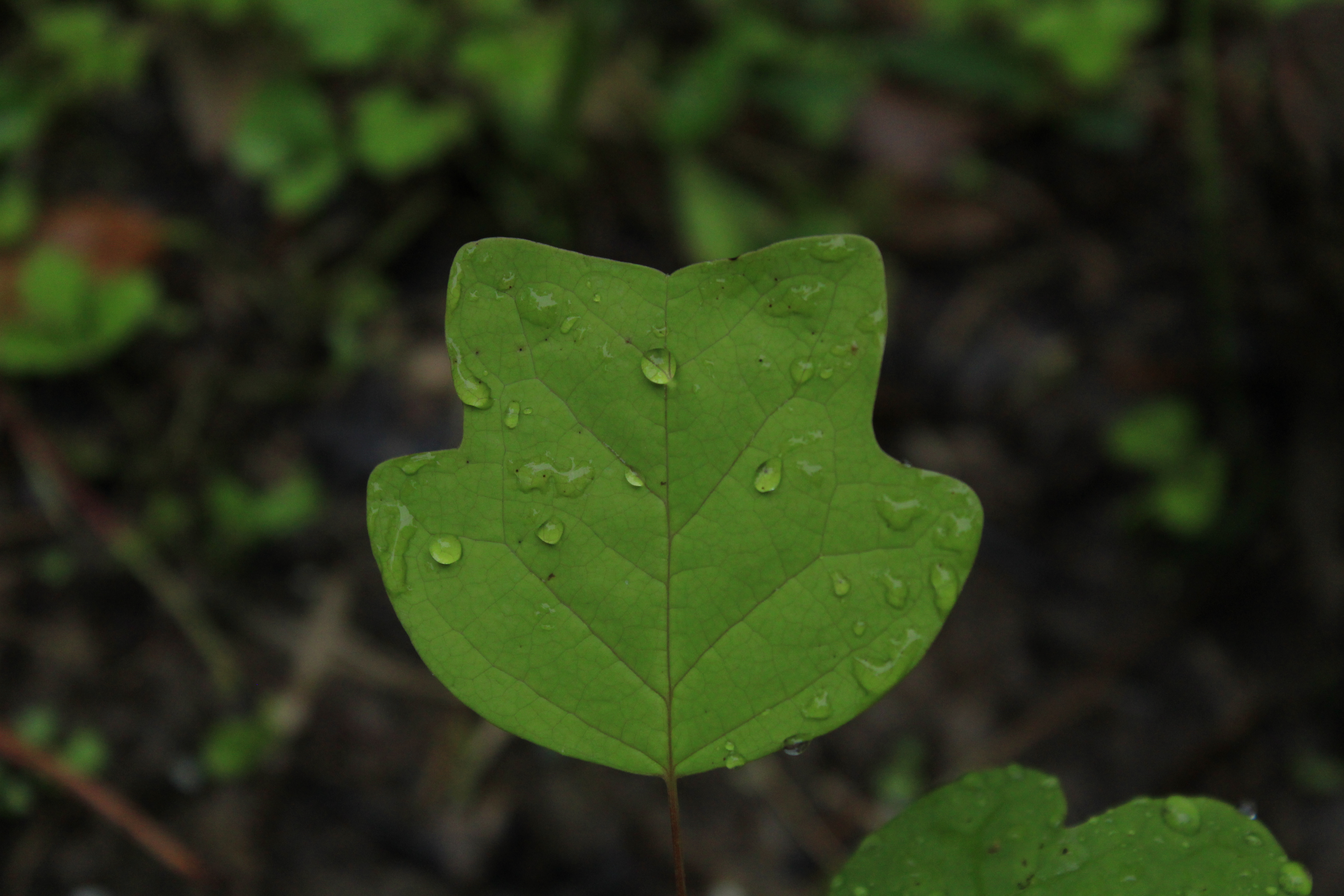
We had a rainy day in the arboretum. Luckily, the rain abated for a brief photo shoot. Droplets of rain water can be seen on the tulip poplar leaves, and a black umbrella serves as the backdrop for the first photo.


Tulip Poplar Leaf, photographed April 23, 2023


You can find more pictures and information about the arboretum's tulip poplars on an older blog post, found here.

Tuesday, March 14, 2023

Tree of the Week: Shumard Oak (Quercus shumardii)


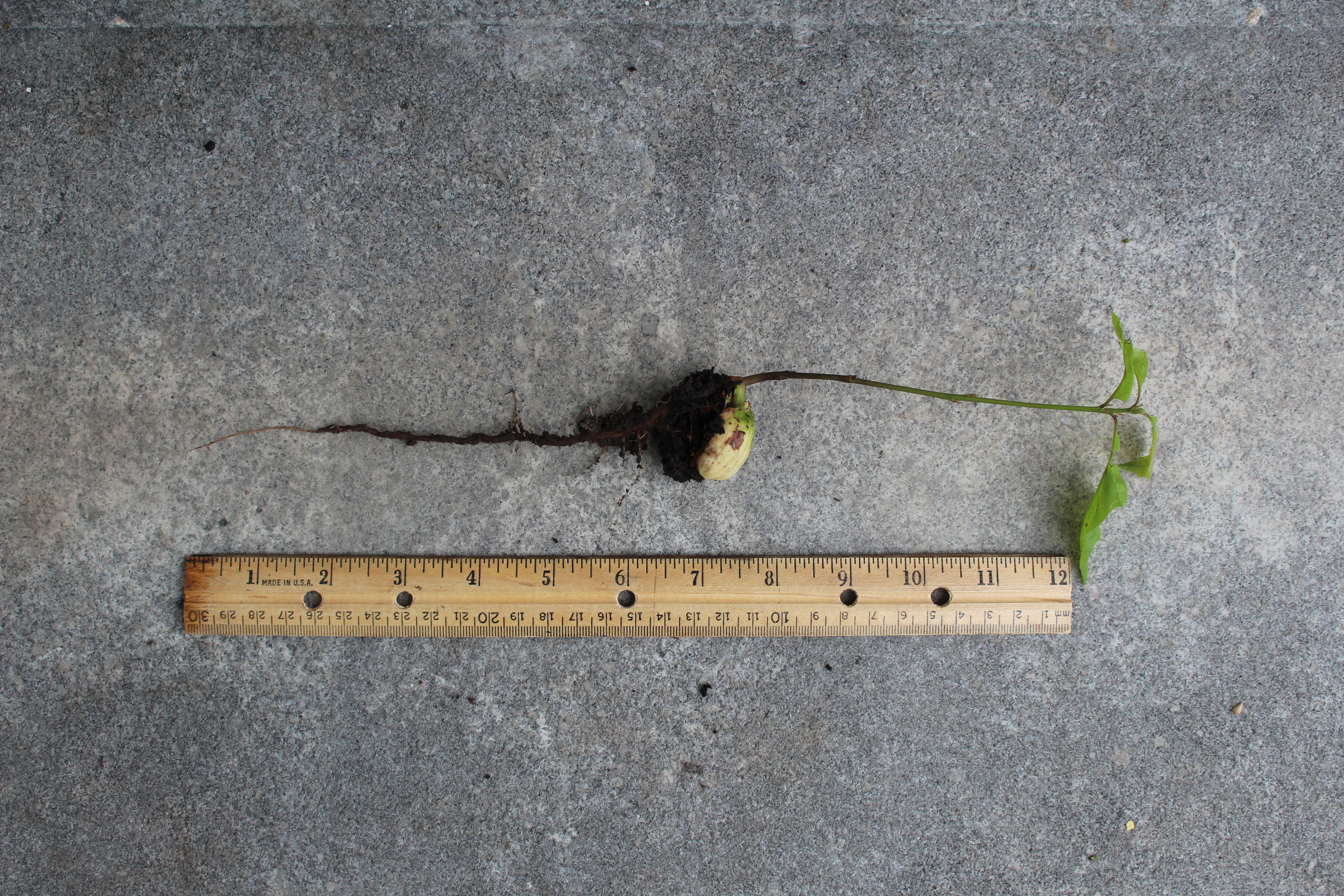
Our tree of the week is a recently germinated oak seedling. In the above photograph, we can see the acorn, visible at the soil surface.


So, which species of oak is it? Looking at the pointy leaves, it must be in the red oak group.


The acorn germinated this winter, under a Shumard oak (Quercus shumardii), which was featured on the blog this past September for our Acorn Watch 2022 (found here). The hard outer shell of the acorn resembles a Shumard oak acorn. Furthermore, there are two additional Shumards nearby, and the other oak species in the immediate vicinity are either white oaks or their acorns do not resemble the acorn shell found here. So, leaving aside, at least for now, the difficulty of oak hybridization, it seems safe to say that this is a new Shumard oak in the arboretum collection.

Fortunately, this seedling was easy to dig up and it appears that the new taproot is in good condition. The above ground growth measures nearly the same length as the taproot.


The taproot measures approximately 7 inches in length.


During the digging process, the soil fell away from the root. The new tree had not yet full immersed itself in its surroundings. Hopefully it won't be too traumatized by the move. It has now been added to the grassy slope on the north side of Cline Hall, and it has a full-sun location, with plenty of room to stretch up and out.


Wednesday, March 1, 2023

Tree of the Week: Pine (Pinus sp.)

Although according to the calendar it hasn't officially arrived, the season of spring is upon us. The air temperature is noticeably warmer, and by walking around the arboretum you will see all of the usual spring time flowers: redbud, Mexican plum, red buckeye, laurel cherry, and our 'weedy' wildflowers, such as butterweed. Everyone's favorite ground-dwelling rodent celebrity, Punxsutawney Phil, was definitely wrong about his prediction for 2023: spring seems to be coming too soon this year. Due to this accelerated schedule, several transplanting projects still need to be completed before the soil warms up too much. 

One ongoing transplanting project is to reduce the amount of grass on that grassy slope north of Cline Hall. We need more trees and shrubs in that part of the arboretum. So, this past week, we have put 8 plants in the ground near Cline Hall. One such plant is pictured below.


In this photo, we see a little pine tree. It was collected in Caddo parish, not far from Shreveport. For the time being we will refrain from putting an explicit species name on it, although it was collected near a grouping of loblolly pines. It is now growing in full sun on the grassy slope north of Cline Hall. Hopefully it will grow fast, and we can properly measure the length of those needles!

Wednesday, December 7, 2022

New Recruit: Black Willow (Salix nigra)


Some time in recent history, in rural Bossier Parish, a black willow seed settled in an abandoned boot, in a forgotten ice chest, in the back of a derelict pick-up. The boot and the ice chest proceeded to fill up with detritus. Despite a singularly inauspicious beginning, a vigorous plant came forth, growing in full sun and living on accumulated rain water and whatever nutritious fare that floated through the air and landed in the unexpected "flower pot".

Then, that black willow (Salix nigra) came to live at the Centenary College arboretum.


The black willow and its boot were easily removed from the ice chest.


Interestingly, 13 intact bottles of Aquafina water were in the ice chest, along with other refuse. There was only a thin layer of leaf litter, mostly pine needles, mixed in with the plastics. In some Mad Max universe, we might be happy to have the bottles of water, but, we aren't there yet, so they found their way to the dumpster, along with the ice chest.


The young tree has produced an impressive root ball, surrounding its beloved boot.

 
For the most part, the roots were easy to detach from the boot, with a small exception, so a piece of the boot was cut out, to be buried with the root ball.


The black willow is now in the ground of the arboretum, in full sun, approaching the Fitness Center. This is near the bottom of a gradual slope.

Our weedy black willow is clearly a tough plant. How will it like the ground of the arboretum? As long as we don't let it dry out for too long, and the Louisiana winter makes that unlikely, it ought to do nicely.


There was a young willow who lived in a shoe

in a chest in a truck, that just won't do.

It's out of the boot and off to the arboretum

to be planted for students in hopes that you please them.