Showing posts with label shade. Show all posts

Saturday, July 21, 2018

Tree of the Week: Bitter Pecan (Carya aquatica)

This past spring the bitter pecan (Carya aquatica) was the last tree in the arboretum to leaf-out; this should be noteworthy, given the number of species involved. We discussed this issue in a 'tree of the week' post back in May. You can find it here. At that point, the light-green leaves were still stretching out, and they were accompanied by catkins. Today, in the latter part of July, the mature leaves are providing ample shade, and we see large, developing fruits.

The fused-together clump of four bitter pecan trees is pictured center. Their combined canopies provide luxuriant shade. Shortly past noon on a full-sun day, very little light is hitting the ground under these trees. The white light of full-sun exposure can be seen in the background.
The large, compound leaves are catching all of the rays for us.
Among the four bitter pecans, we see some intraspecies variation in the leaves. We see both rounded and pointed tips on leaflets and we see leaflet margins with varying degrees of serration. Differences aside, the bitter pecan leaves are pinnately compound with 9 or 11 leaflets.
Leaflets are lighter underneath.

The leaflets are also fuzzy underneath and along the stems and twigs.
Fuzzy leaf stems alternate along fuzzy twigs.
If you look closely, you should be able to see a few of the peculiar fruits.
The greenness of the unripe fruit blends in with the surrounding foliage.
This is a cluster of three bitter pecan fruits.
Bitter pecan fruits are large and bulbous, but also flattened with four noticeable seams. At this stage of development, they measure approximately an inch in length. The insides are soft, watery, and contain a pressurized sac that will eventually develop and harden into a recognizable nut.
Glossy, dark-green leaves and unripe, light-green fruits of the bitter pecan


Saturday, June 30, 2018

Tree of the Week: Basswood (Tilia caroliniana)

It's the end of June. We had a couple of rainy days this past month, which were a real treasure. However, for the past several days it has been blue skies, blindingly bright sunshine, and sweltering heat. We need some shade to block out that summer sun.

Basswood (Tilia caroliniana) is a lesser-known native that makes for a great shade tree. It needs more water than some trees, but it grows fast and provides a lot of cover. The basswood pictured below shades one of our main thoroughfares. This individual was collected in the spring of 1994, from the Walter Jacobs Nature Park, located here in Caddo Parish. At more than twenty years of age, this basswood provides a bounty of shade.
This is a low, shady spot in the arboretum. Several trees are making this a cool retreat. The photographer is standing in the shade of a flowering magnolia, a sweetgum, and a swamp white oak. The basswood is pictured to the right of the white bridge. It's growing next to the arboretum drainage channel.
In this photo, the thick basswood trunk is pictured immediately to the left of the white bridge. The view of the basswood is obstructed by the very healthy grouping of Hercules'-club.
The basswood is growing next to the sidewalk, which results in excellent shade for those passing through the arboretum. But some light still gets through, as we see dappled sunlight on the trunk.
The trunk is divided near the base of the tree, giving this basswood an interesting form.
The trunk divides into two unequal branches.
The bark shows division as well. Smooth, light-gray bark is juxtaposed with rough, dark-gray bark.
The trunk and branches mostly have smooth gray bark.
Patches of deeply grooved, dark-gray bark are found near the base of the tree, particularly above the division in the trunk.
Following the trunk upwards we mostly see smooth gray bark surrounded by light branches and innumerable leaves, providing all that good shade.
A few immature fruits can be found hidden among the leaves.
Basswood leaves alternate along the branch.
On this twig we see large, rounded leaves and long, yellow-green bracts. The immature spherical fruits are attached to stalks that emerge from the bracts.
The upper surface of the basswood leaf is dark green and smooth. Leaf and stalk together measure under 6 inches in length.
Underneath, the basswood leaf is light-green and smooth (hairless). Note the asymmetrical shape and uneven base. Leaf margins are toothed.
Leaf, bract, stalk, and immature fruit
The flower/fruit stalk emerges from the bract.
Basswood fruits are small and inconspicuous, measuring approximately a quarter of an inch.


Last June, the basswood flowers were featured in a 'What's in Bloom?' post. You can see a picture of the tiny, fragrant flowers here.

For more information about this species consult the following sources:
Texas A&M (Forest Service)
Texas A&M University (Aggie Horticulture)
United States Department of Agriculture (zoom-in on distribution map)

Thursday, September 14, 2017

Tree of the Week: Bur Oak (Quercus macrocarpa)

The autumnal equinox is next week, marking an end to summer. The cooler weather over the past week has signaled the coming change in seasons. With plenty of cloud coverage and a nice breeze, we haven't been desperate for shade. So, with the end of summer so goes too our discussion of shade trees. The last entry for 2017 in this series is the bur oak (Quercus macrocarpa).

There are two bur oaks in the arboretum collection. Both are over twenty years old and both provide a good amount of shade on the eastern clay slope of the arboretum. The images below are from the older of the two trees. This bur oak was purchased from Home Depot and planted in October 1993. It is of interest this week because of its curiously large acorns. It's hard to say if the cap of the acorn more closely resembles the Scottish tam, the Russian ushanka (ear-flaps tied up), or the Caucasian papakha.

All photos below were taken shortly before noon on a mostly cloudy day.

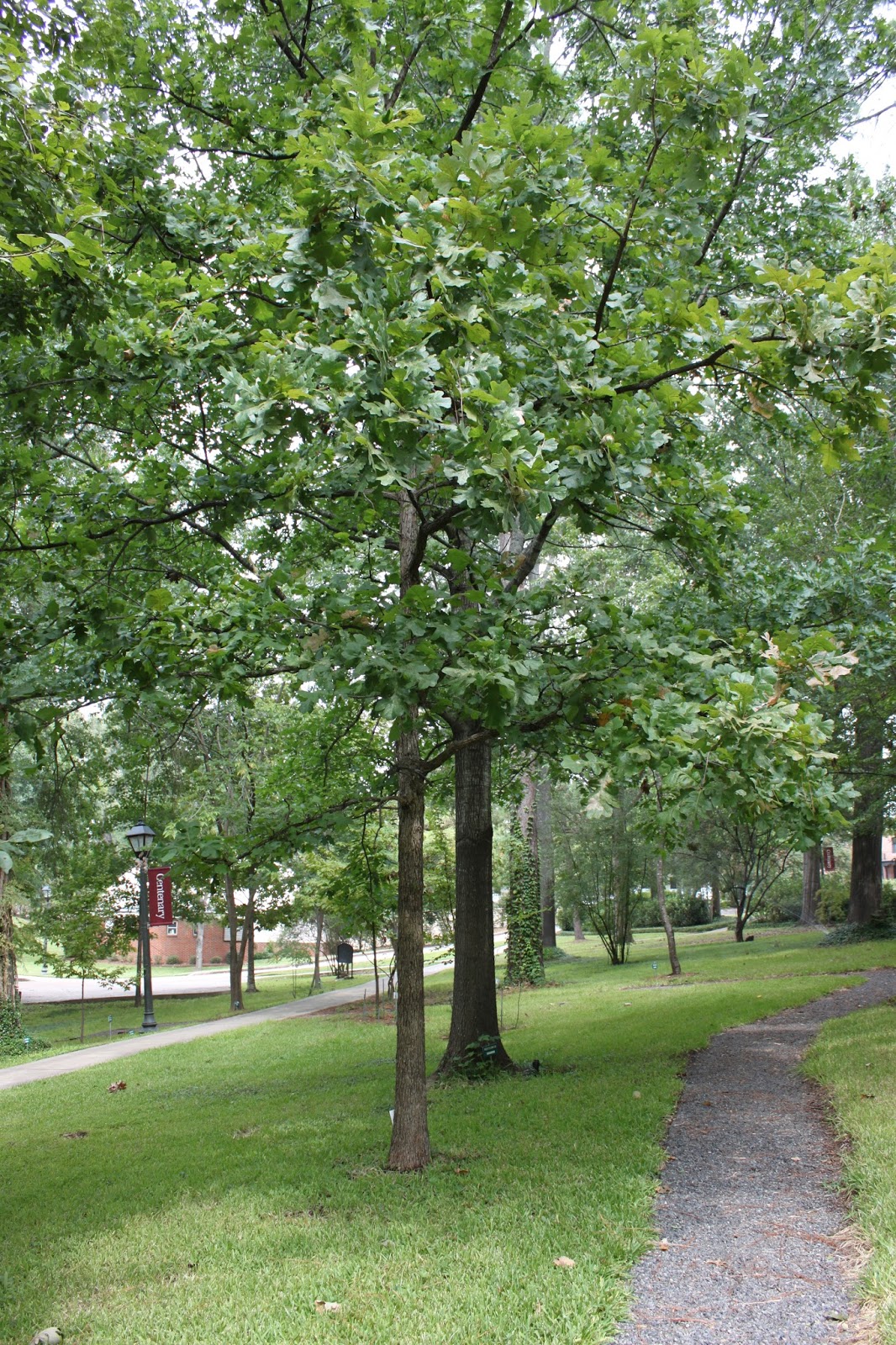
The bur oak is pictured above in the foreground, with a Shumard oak (Quercus shumardii) directly behind it. The Shumard is a few years older and has an obviously thicker trunk. The two compete for sunlight on this eastern clay slope, shading the gravel path during the heat of the day.
The bur oak is pictured front and center, with a long-leaf pine (Pinus palustris) and French mulberry bushes (Callicarpa americana) closer to the brick wall.
Approximately 25 years-old, this bur oak is already providing a good amount of shade.
The underside of the lobed leaf (quite large) is light green and hairy to the touch. 
The branches of the bur oak have corky ridges similar to those seen on the bark of the winged elm (Ulmus alata) and the sweetgum tree (Liquidambar styraciflua).
The bur oak is known for its large fruit and unique cap.
This acorn, cap included, measures more than 1.5 inches.
By comparison, the water oak (Quercus nigra) acorns are very small.
The dark green leaves of the bur oak are large; this leaf blade is 8 inches long.
Rough, shaggy bark of the bur oak (Quercus macrocarpa)


You can see more pictures of the arboretum's bur oaks here.


For more information about this species consult the following:
University of Florida IFAS Extension
United States Department of Agriculture 
The Ohio State University

Saturday, September 2, 2017

Tree of the Week: Water Tupelo (Nyssa aquatica)

The sun is shining in Shreveport this weekend. The remnants of Hurricane Harvey brought heavy cloud coverage in the early part of last week and steady rain on Wednesday. Thursday, things cleared up, and on Friday the sun steamed everything up. If you're outside enjoying the late summer weather, you might also be looking for a spot of shade.

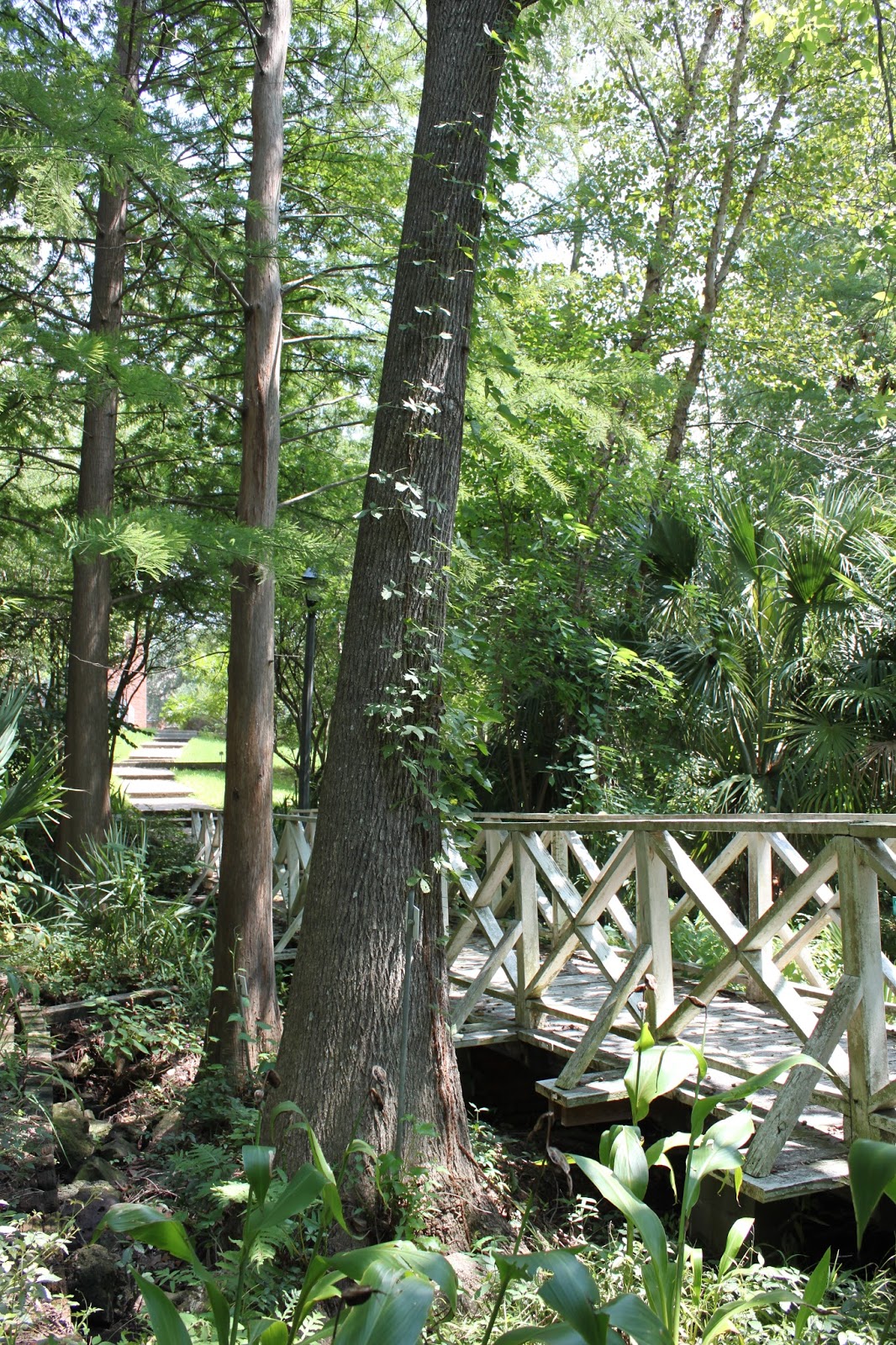
There are many beautiful shady spots on Centenary's campus, and if you're in the arboretum, take time to appreciate the water tupelo (Nyssa aquatica), shading the long white wooden bridge. It was purchased from Woodlanders nursery (Aiken, S.C.) and added to the arboretum collection in October 1988, making it more than 30-years-old. Currently, it is doing very well, despite competition, and littering the wooden bridge with its fruits. 
 
The long white wooden bridge in the arboretum is mostly shaded, with only some dappled sunlight hitting the planks. In this picture, we are looking east, and our tree of the week is pictured to the left of the bridge, growing on its north side.

The water tupelo (the center-most tree in the above photograph) grows in a very wet area. It is in competition with other water-loving trees. Immediately to the left of the water tupelo, we have a pond cypress (Taxodium ascendens). In the background, at the far left, we have a bald cypress (Taxodium distichum).  

This water tupelo is competing for sunlight. Its primary competitor is the pond cypress (Taxodium ascendens), planted a year after the tupelo. The competition might explain the crook in the tupelo's trunk.

There are a lot of fruits on the tree this year.
The elliptic leaf has smooth, wavy edges and a pointed tip.
The numerous speckled drupes blend in with the worn wooden planks.
The off-white background offers a better look at the oblong shape of the fruit.
There are significant accumulations of green fruits on the ground under the tree, and some of the fruits appear to have been gnawed on (lets blame the squirrels). There are also a few patches of sensitive fern (Onoclea sensibilis) growing in the shade of this water tupelo. The fern, which was originally collected from the Caroline Dormon Nature Preserve, is pictured in the bottom left hand corner.
The bark of this tree, which is more than 30-years-old, is deeply furrowed. The trunk shows some characteristic swelling.

For more information about this species consult the following:
Arkansas Agriculture Department (Great picture of old water tupelo!)
Louisiana Plant Identification and Interactive Virtual Tours (LSU AgCenter) 
USDA Forest Service 

Friday, August 25, 2017

Tree of the Week: Nutmeg Hickory (Carya myristiciformis)

This week our shade tree is the nutmeg hickory (Carya myristiciformis). The cloudy, rainy weather hasn't given us much opportunity to appreciate the shadiness of this tree, but rest assured: it does good work. The fruits of the tree make it a stand-out specimen for this series. Large nuts, quite similar to pecans, are developing on the branches. Let's keep an eye on them, to make sure the squirrels don't have all the fun.

There is only one nutmeg hickory in the arboretum collection. In 1990, it was purchased from Woodlanders nursery (Aiken, South Carolina) and planted the same year. That makes the tree approximately 30 years old. Its companion, bought and planted at the same time, is a soapberry tree (Sapindus drummondii). A Shumard oak (Quercus shumardii) was added nearby in 1993. All three trees are doing great, on a gradual slope, at the far north side of the arboretum.

Note: All photos below were taken on a cloudy day. We have had more cloudy, rainy weather this week, and more of the same is predicted for next week, with Hurricane Harvey making landfall tonight, on the southern coast of Texas.

This is a shady spot on the north side of the arboretum, with the band shell in the background. Three trees are pictured, all approximately 30 years old. LEFT: Shumard oak (Quercus shumardii); CENTER: Nutmeg hickory (Carya myristiciformis); and, RIGHT: Soapberry tree (Sapindus drummondii). A yaupon holly bush can be seen in the background, occupying the middle space between the hickory and soapberry.
On a cloudy day, the impact of the shade tree isn't as noticeable.
Looking up
The topside of the leaf is a shiny green. This particular leaf has 7 leaflets, but the number of leaflets can range from 5 to 11.
The toothed edges of the leaflets can be seen in this photo. The underside of the leaf is a whitish-green with a hint of yellow.
Branchlet, twig, and fruit
There are a good many nuts on the tree this year, but this is still a young hickory, not yet producing its maximum potential.
The yellow husk conceals the fruit, which is said to be sweet, though difficult to get to.
Bark of tree approximately 30 years of age: we can see vertical strips in the bark, and some splitting, but the trunk doesn't have the shaggy appearance of what is considered an 'old' specimen.


You can see more photos of the arboretum's nutmeg hickory here.

For more information about this species consult the following:
United States Department of Agriculture
Texas A&M University Aggie Horticulture (check out the distribution map)
Stephen F. Austin State University