Showing posts with label Family: Tiliaceae. Show all posts

Sunday, October 28, 2018

Tree of the Week: Basswood (Tilia caroliniana)

Fall color comes late to Northwest Louisiana. At the end of October most of the trees' foliage is still green. This week, the basswood is an exception; its leaves are light-green and yellow. The photos below were all taken today, which was remarkably warm and sunny. To compare, check out the photos here, to see what this tree looked like in the heat of summer.

The afternoon sun illuminates the yellow leaves of the basswood. To the left, we see the green leaves of the sweet-shrub (Calycanthus floridus) and the hybrid chestnut (Castanea dentata), and to the right we see the fallen leaves of the swamp white oak (Quercus michauxii) covering the gravel path.
The basswood is pictured to the left of the short, white wooden bridge. It's growing near a bald cypress (Taxodium distichum) and a stand of Hercules' club (Aralia spinosa).

Leaves turn pretty colors and then drop, revealing the structure of the trunk.
You can see that most leaves have turned, but the presence of some green ones indicates the change is happening right now.
These cordate leaves are lightly spotted and are a delightful shade of yellow.

Sunday, October 14, 2018

Our Lopsided Friend, the Carolina Basswood (Tilia caroliniana)

As detailed previously, the passing of the sweetgum resulted in damage to surrounding trees. A Carolina basswood (Tilia caroliniana) was in the path of destruction: the broken crown of the sweetgum rested in the basswood's upper branches until the arborists removed it. After the clean-up operation, it first appeared that the fallen sweetgum had completely stripped the limbs from the northside of the basswood. Upon further inspection, the basswood turned out to be just fine. It suffered only minor and cosmetic damage. What was revealed, however, was the lopsided growth pattern of this tree--its branches are all growing on the same side, facing south towards the Fitness Center.

This tree was one of two collected by Dr. Ed Leuck from the Walter B. Jacobs park in spring 1994. It was planted in the ground two years later and has grown... well, quite mysteriously. No information could be found online regarding this curious growth pattern. Information about this species is not much available, although it has recently been described as an 'underutilized' native.

Here we can see clearly that the tree has grown with all its branches on one side. Will this change now that the bare-side has more light?
On the northside of the tree, all branches are pointing away from us, toward the south, presumably stretching out for more southern rays of sunshine.
Despite its lopsidedness, the tree has a straight trunk. The bark is smooth and gray.
At the base of the trunk we can see the development of mature basswood bark.
The mature bark is deeply fissured and extremely handsome.

Saturday, June 30, 2018

Tree of the Week: Basswood (Tilia caroliniana)

It's the end of June. We had a couple of rainy days this past month, which were a real treasure. However, for the past several days it has been blue skies, blindingly bright sunshine, and sweltering heat. We need some shade to block out that summer sun.

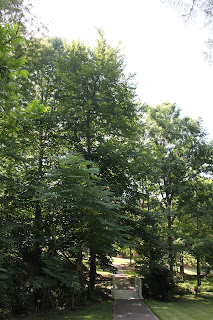
Basswood (Tilia caroliniana) is a lesser-known native that makes for a great shade tree. It needs more water than some trees, but it grows fast and provides a lot of cover. The basswood pictured below shades one of our main thoroughfares. This individual was collected in the spring of 1994, from the Walter Jacobs Nature Park, located here in Caddo Parish. At more than twenty years of age, this basswood provides a bounty of shade.
This is a low, shady spot in the arboretum. Several trees are making this a cool retreat. The photographer is standing in the shade of a flowering magnolia, a sweetgum, and a swamp white oak. The basswood is pictured to the right of the white bridge. It's growing next to the arboretum drainage channel.
In this photo, the thick basswood trunk is pictured immediately to the left of the white bridge. The view of the basswood is obstructed by the very healthy grouping of Hercules'-club.
The basswood is growing next to the sidewalk, which results in excellent shade for those passing through the arboretum. But some light still gets through, as we see dappled sunlight on the trunk.
The trunk is divided near the base of the tree, giving this basswood an interesting form.
The trunk divides into two unequal branches.
The bark shows division as well. Smooth, light-gray bark is juxtaposed with rough, dark-gray bark.
The trunk and branches mostly have smooth gray bark.
Patches of deeply grooved, dark-gray bark are found near the base of the tree, particularly above the division in the trunk.
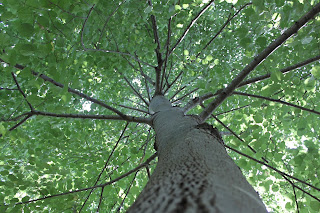
Following the trunk upwards we mostly see smooth gray bark surrounded by light branches and innumerable leaves, providing all that good shade.
A few immature fruits can be found hidden among the leaves.
Basswood leaves alternate along the branch.
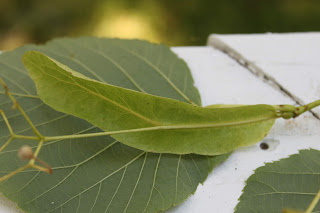
On this twig we see large, rounded leaves and long, yellow-green bracts. The immature spherical fruits are attached to stalks that emerge from the bracts.
The upper surface of the basswood leaf is dark green and smooth. Leaf and stalk together measure under 6 inches in length.
Underneath, the basswood leaf is light-green and smooth (hairless). Note the asymmetrical shape and uneven base. Leaf margins are toothed.
Leaf, bract, stalk, and immature fruit
The flower/fruit stalk emerges from the bract.
Basswood fruits are small and inconspicuous, measuring approximately a quarter of an inch.


Last June, the basswood flowers were featured in a 'What's in Bloom?' post. You can see a picture of the tiny, fragrant flowers here.

For more information about this species consult the following sources:
Texas A&M (Forest Service)
Texas A&M University (Aggie Horticulture)
United States Department of Agriculture (zoom-in on distribution map)

Sunday, January 22, 2012

Tilia americana var. caroliniana


The leaf arrangement of Tilia americana var. caroliniana is alternate.


The bright green, heart-shaped leaves of Tilia caroliniana have deeply toothed margins and pale undersides.
The grey-brown, nearly-smooth bark of Tilia americana var. caroliniana is divided into shallow longitudinal fissures.