Showing posts with label cedar apple rust. Show all posts

Monday, August 10, 2026

Cypress Rust or Cypress Galls?

As students are currently flooding back onto campus and things are once again shifting into active term, your arboretum curator has taken the opportunity to remove branches and limbs from walking spaces. Living limbs, dead ones, branches covered in leaves, bare ones, and even the soft needles of cypress trees are being pruned away from the "head spaces" across the arboretum. While performing this seasonal maintenance near the Student Union Building, we noticed some rust-like growths in the pruned branches. Having struggled against cedar-apple rust (Gymnosporangium juniperii) for more than a decade, we are well-accustomed to unsightly rusts. But the simultaneous presence of white and purple growths on nearby branchlets made us do a double-take. 


What is going on with these cypress leaves? The unexpected amount of color variation gave us pause and attracted our attention.


These aren't rust at all! They're galls! Galls are growths created by tiny flies called cypress gall midges (Taxodiomyia sp.). These little critters are obligate parasites of the cypress, and the adult flies are terribly small. If you carefully dissected the large green-yellow gall on the right of the above photo, you could find tiny larvae crawling around in there, exerting chemical/enzymatic control over the tree. How odd!

Here we can see the life-cycle progress of gall-formation. They begin as white, budding, geometric-like structures seen on the left, which ripen into a frosty purple, pictured center. The galls then continue to mutate into more bulbous rusty lumps, like the one pictured on the right. These eventually fall from the tree and overwinter on the ground, finally releasing new midges during the following summer.

Beginning stage of gall development

Further development

Toward the end of gall development


See our previous post on this baldcypress from September 2019, which ends with a mention of this issue! Much water has passed under the bridge of life since then, but some things, including the Cecidomyiidae family of gall midges, never change.


External Link

NC State Extension Fact Sheet on Cypress Gall Midge 

Monday, April 8, 2024

Mayhaw Success!


These are the arboretum's four mayhaws. This is definitely the most famous, at least in our region, member of the genus Crataegus.


Right now in the arboretum we are happy to see pristine-looking mayhaw fruits, something that we haven't had for more than 5 years.

Not only do we see red-ripe fruit, we also have green fruits coming in behind them. Look how healthy the leaves look! A new era is dawning.

All efforts to control the arboretum's cedar apple rust were unsuccessful. In 2018, we undertook to spray the mayhaws with a fungicide (you can see photos of that here). We made multiple applications and documented the development of the cedar apple rust galls. As previously explained on this blog, we ultimately made the decision to remove the eastern red cedars (Juniperus virginiana) in favor of the crabapple tree and various haws. This process was carried out over several years, as documented in 2021 and 2023.

What we're observing now with the improved health of the Mayhaws (in both leaf and fruit) is that we made the correct decision, insofar as our goals are now being achieved.


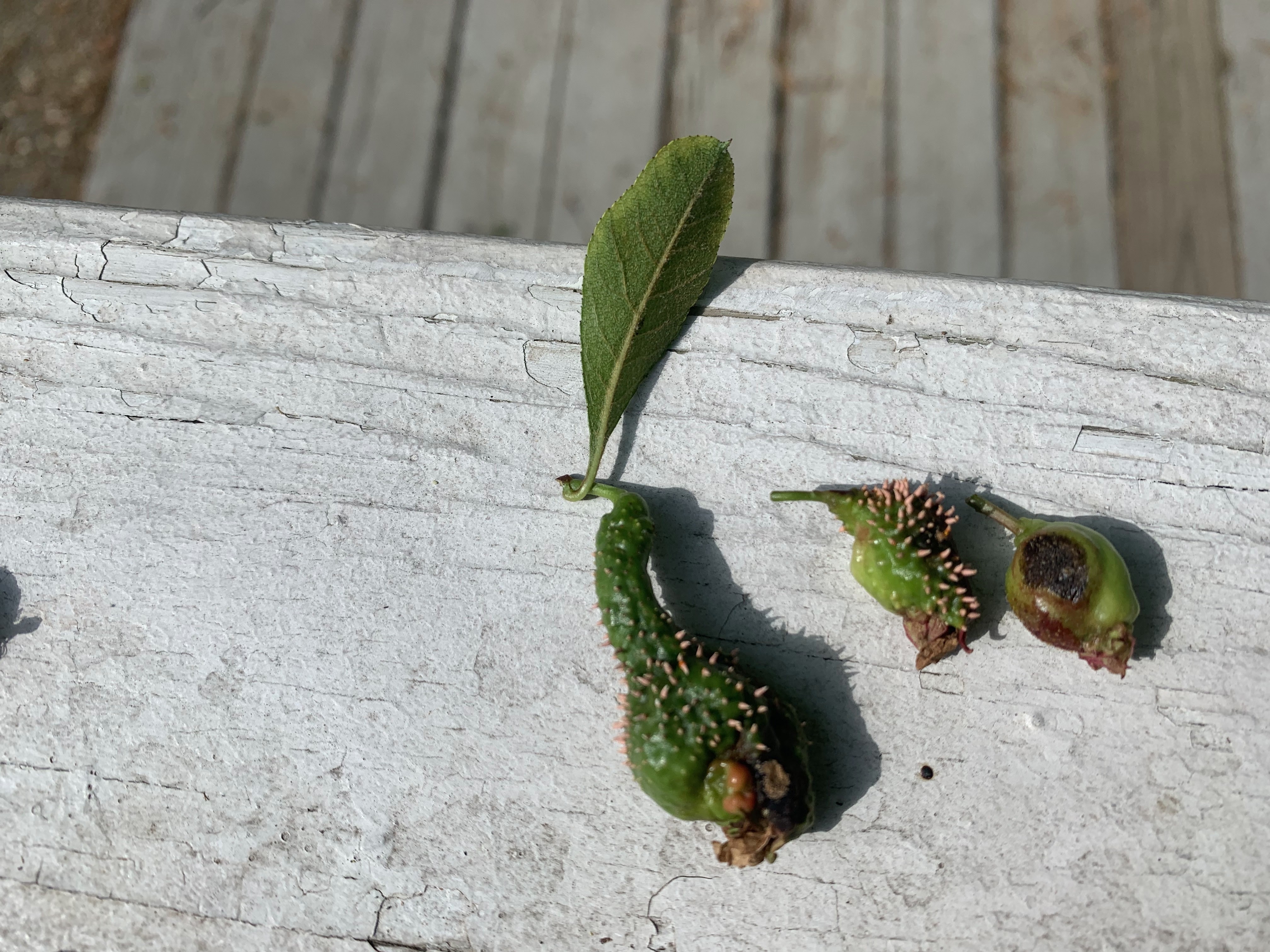
Nevertheless, we're not entirely out of the woods. These three groups of mayhaw fruits, all collected today, show that it may be a year or two before the disease is entirely purged. The majority of fruits we observed today were healthy (see far left duo). Some had a small blemish.  A few have been transformed into monstrous mutants, reminding one of John Carpenter's 'The Thing' (see center green fruit, studded with pink horns). If these tell you they're "just fine" or "all better," don't believe them. Finally, as pictured on the far right, we can see that some fruit simply withered on the tree and failed to grow at all. This was a failure for the cedar apple rust as well, as it requires the developed fruit to spread the infection.

This is unsettling to look upon, but we feel obligated to document it. Yuck.


While carefully examining the trees for new fruit, several dead branches were noticed, so a little pruning was necessary. When working around mayhaws, watch out for spines! These branches will poke you.