Showing posts with label Pinus taeda. Show all posts

Monday, March 16, 2026

Loblolly Pine (Pinus taeda)

A young pine tree in the arboretum is now in need of a sign. Due to uncertainty about its species, we have delayed creating an official arboretum placard. To see the post from March 2023, when this specimen entered the arboretum collection, click here. 

Upon collection from the wild in a wooded area north of Shreveport, the tree was so young and small that it lacked obvious species-defining features. It just looked like "native pine." Rather than risking misidentification, which can be a more-or-less permanent issue, we left its classification an open question and waited...for years.

In spring 2026, our young "native pine" is looking more grown-up! 


This fine specimen grows on the grassy slope north of Cline Hall, an area that is open and sunny, but is steadily planted with young trees.

We can confidently identify this specimen using photos of its needles and flowers, its male cones. It's a loblolly (Pinus taeda). No surprises here! In our region, this is a default and commonplace pine, especially dominant in forestry. Its lumber is often sold as SYP (Southern Yellow Pine) and its binomial name Pinus taeda is a Latin-Greek mashup that could be translated as 'Pine-pine' or 'Resinous Resin-tree.' This name doubles-down, to an unusual degree, on the piney-ness of this tree.

This tree is developing a proper and upright growth pattern due to its generous allotment of sunlight and favorable position. Young trees in the wild will be spindly due to the "battle of the understory" that most of them undergo.

Here's the source of that delightful yellow dust covering your car, your outdoor furniture, your pets, etc. Achoooooo!

The identifying features that the juvenile tree lacked: fully-developed needles and reproductive structures. This is the first year that we have seen flowers on the tree, and not many are present. 


The fully-developed needle clusters come in trios and are around 6-7 inches long. A shortleaf pine would have needles half that length and usually come in twos. Longleaf pine needles come in threes, but would generally start at 8" in length.


The pollen cones are yellow, banana-shaped and approximately an inch in length. Longleaf pollen cones are a startling blue-purple or an orange-red. Shortleaf cones are similar in color and shape to loblolly, but tend to be only half-an-inch or a little larger.


There are several on-site native mature loblolly pines in the arboretum and on the campus as a whole, so we might argue that the arboretum doesn't need 'just one more loblolly....' However, the campus loses at least one mature loblolly each year, so it's important to continually replace those old pines. And, it's super neat to see the different stages of a tree's development because as they age, loblolly pines lose those lower branches and we only see that beautiful brown, seemingly perfectly round trunk. So, we are happy to have this young loblolly on that grassy slope in front of Cline.


For further online reading, please consult the following websites: 

NC State Extension page on Loblolly Pine 

Article on Loblolly from "The Tree and Its Environment" (1990) 

Ladybird Johnson Wildflower Center page on Loblolly 

Saturday, September 12, 2020

Hurricane Laura Damage: Loblolly Pine (Pinus taeda)

 On August 27th, Hurricane Laura blew through northwest Louisiana. Strong winds uprooted trees and knocked limbs loose, resulting in significant property damage and extended power outages. Compared to the surrounding area, the Centenary College campus suffered relatively minor inconveniences.

Hurricane Laura's aggressive blowing uprooted a loblolly pine (Pinus taeda) near the Student Union Building.

When the loblolly fell, a fringe tree was crushed and other nearby trees lost a few branches. You can find a video of the wreckage on the Centenary College Facebook page.

The root ball popped out of the ground, next to the sidewalk, without disturbing the concrete.
 
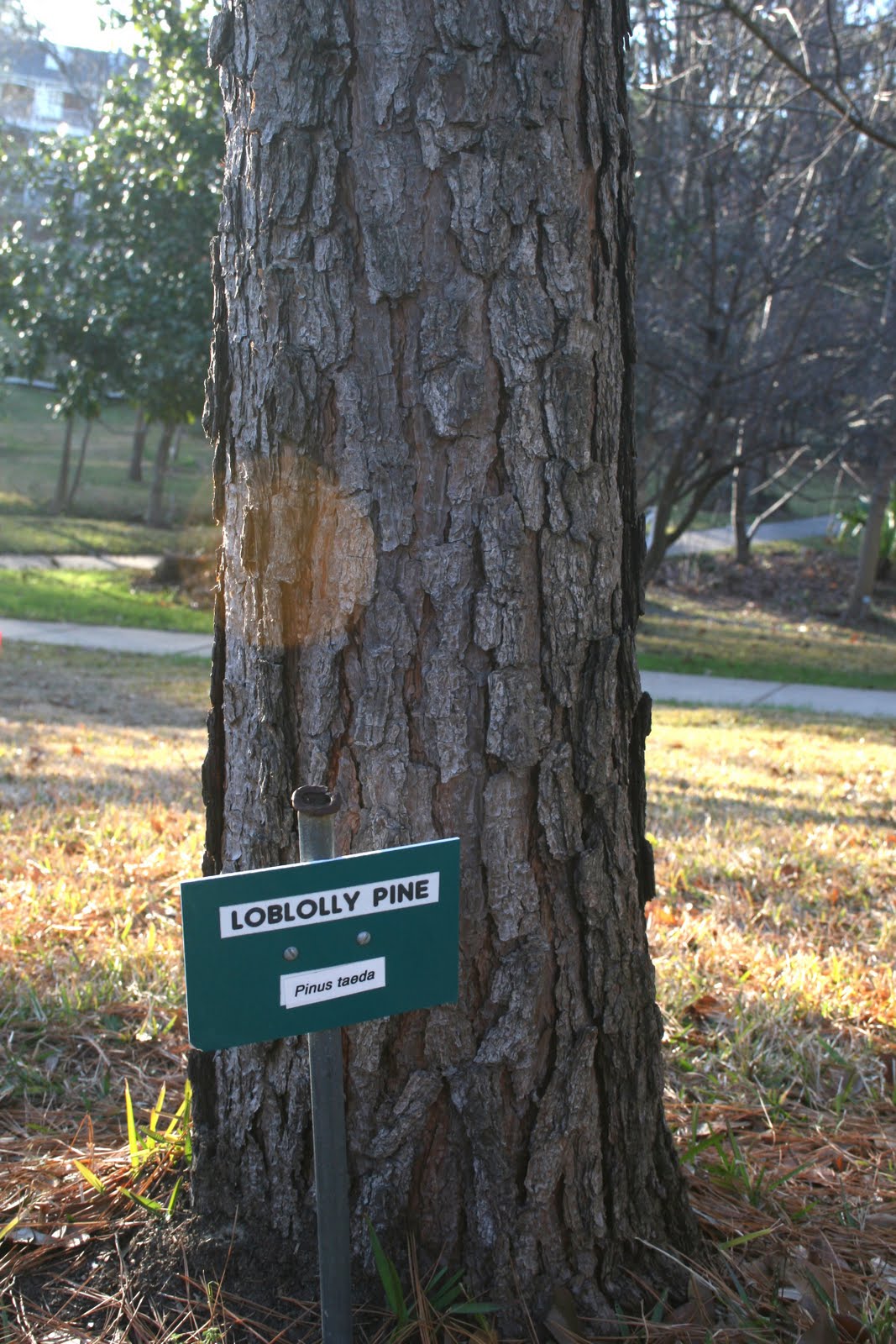
Loblolly pines have rough bark broken into large, cinnamon-colored plates.

Luckily, the tree fell away from the Student Union Building.

Why did it fall one way rather than another? Is it just a matter of which way the wind was blowing? Surely the concrete foundation of the Student Union Building interfered with the loblolly's root development, resulting in a weakened constitution.
 
Leaves were collected for inspection, to confirm that the ruined tree is in fact a loblolly.

Needles measured more than 6" and less than 7½".

Leaves are bundled in groups of three, which is a good indicator that this pine was a loblolly.


Friday, October 27, 2017

Tree of the Week: Loblolly Pine (Pinus taeda)

There are five on-site-native loblolly pines (Pinus taeda) in the arboretum collection. These trees have been growing unaided on the clay slopes of the campus since we-don't-know-when, and they have survived the construction of our campus buildings. They grow here naturally, spontaneously, and they grow to be very tall. The photos below are of an individual loblolly near Hamilton Hall.

This is a very shady spot in the arboretum. The large loblolly trunk is pictured in the middle, with an on-site-native water oak (Quercus nigra) pictured to the right, closer to the brick retaining wall.
Looking down the slope, the tall, cylindrical trunk of the loblolly is pictured in the center. The green leaves are a long way up, out of view, but there is a good amount of pine straw on the ground.

The green leaves are only seen from a distance, way up high. Pinus taeda is pictured in the middle, with Quercus nigra pictured on the right.
These leaves (needles) are 7 inches long. The singular needles appear in bundles of three.
For comparison, spruce pine (Pinus glabra) leaves are pictured above the loblolly leaves. The spruce pine needles are much shorter, measuring approximately 2.5 inches long.
Prickly cones are dropping out of the loblolly.
This cone measures to about 5 inches long and 3 inches wide.
The spruce pine cone (pictured on the left) is much smaller than the loblolly cone.
Walking through the arboretum, you will most likely only see the trunks of the loblolly pines. Mature loblolly bark is reddish-brown and heavily fissured.
The bark is formed into large thick plates.


You can see more pictures of the arboretum's loblolly pines here.

Check out the following links for more information about this species:
United States Department of Agriculture
USDA Forest Service
Oklahoma Forestry Services
Louisiana Plant Identification and Interactive Virtual Tours