Last week we took a look at the eastern hop hornbeam (
Ostrya virginiana), a member of the family Betulaceae, the birch family. This week, we are "keeping it in the family," with a profile of the ironwood tree,
Carpinus caroliniana, another member of Betulaceae
. The arboretum collection has a mature specimen of both birches, planted right close to each other. The ironwood is in the floodway down a bit from the eastern hop hornbeam, which is a little up the slope. Both trees are about the same size. Right now (mid-June), each is ornamented with dangling fruit clusters hidden by doubly serrate leaves. A glimpse at the bark is the quickest way to tell the two apart: the hop hornbeam looks like a wildcat climbed the trunk, shredding the bark, while the ironwood has smooth bark that appears to be covering rippling muscles.
 |
| This Carpinus caroliniana was collected from Walter Jacobs Nature Park in the spring of 1994 and planted in this bed of Louisiana irises in November 1995. This location of the arboretum can be soggy for a week at a time, whenever the campus gets a heavy rain. |
 |
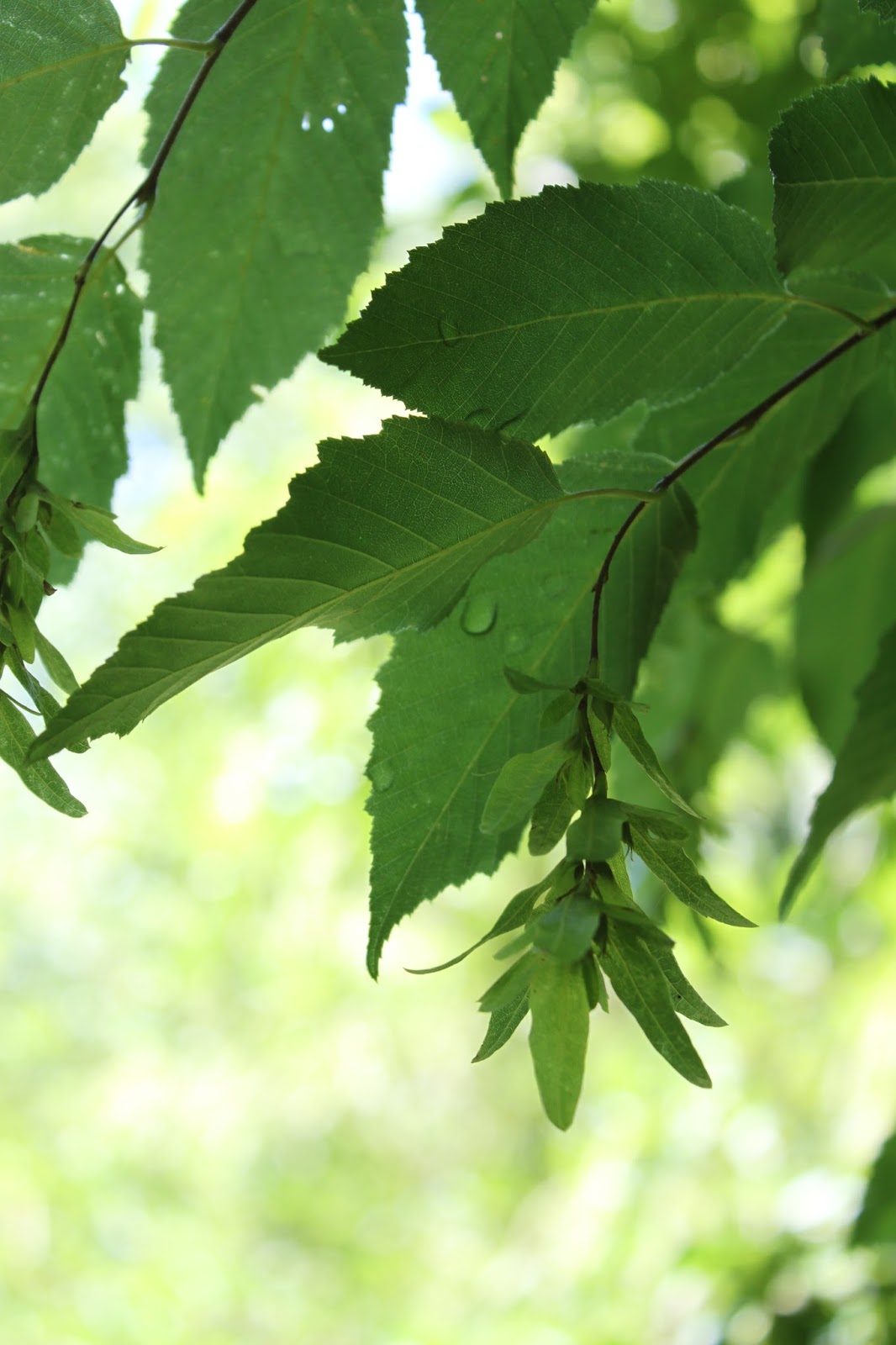
| The fruit of Carpinus caroliniana is a nutlet that is concealed by leaf-like bracts. These nutlets, hidden by their bracts, dangle in inconspicuous clusters. |
 |
| Branchlet ornamented with dangling fruit clusters |
 |
| The doubly-serrate leaves are the same color as the light-green bracts. |
 |
| The nutlets occur in pairs, and each nutlet develops out of a 3-lobed leafy bract. |
 |
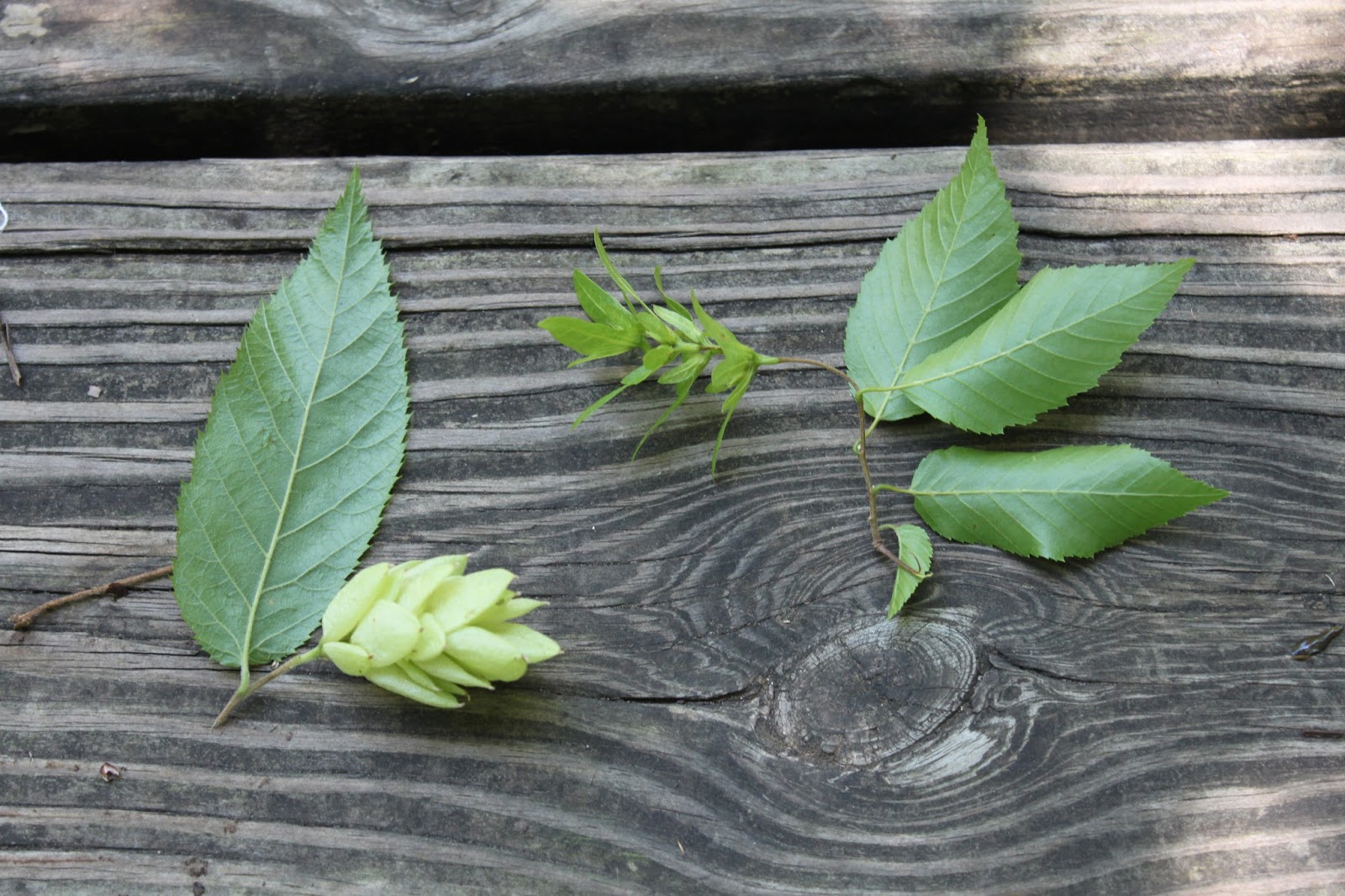
| Ostrya virginiana (left) and Carpinus caroliniana (right) have similar leaves and fruit clusters. |
 |
| Carpinus caroliniana is known for its muscular trunk: the grey bark appears to conceal a sinewy musculature. |
 |
| The smooth bark of Carpinus caroliniana is distinct from the shredded bark of Ostrya virginiana. |
 |
| Detail of smooth grey bark of Carpinus caroliniana |
You can see more images of the arboretum's collection of ironwood trees
here.
For more information about this species consult the following:
United States Department of Agriculture
Louisiana Plant Identification and Interactive Virtual Tours (LSU AgCenter)
University of Florida IFAS Extension