Showing posts with label Crataegus aestivalis. Show all posts

Monday, April 8, 2024

Mayhaw Success!


These are the arboretum's four mayhaws. This is definitely the most famous, at least in our region, member of the genus Crataegus.


Right now in the arboretum we are happy to see pristine-looking mayhaw fruits, something that we haven't had for more than 5 years.

Not only do we see red-ripe fruit, we also have green fruits coming in behind them. Look how healthy the leaves look! A new era is dawning.

All efforts to control the arboretum's cedar apple rust were unsuccessful. In 2018, we undertook to spray the mayhaws with a fungicide (you can see photos of that here). We made multiple applications and documented the development of the cedar apple rust galls. As previously explained on this blog, we ultimately made the decision to remove the eastern red cedars (Juniperus virginiana) in favor of the crabapple tree and various haws. This process was carried out over several years, as documented in 2021 and 2023.

What we're observing now with the improved health of the Mayhaws (in both leaf and fruit) is that we made the correct decision, insofar as our goals are now being achieved.


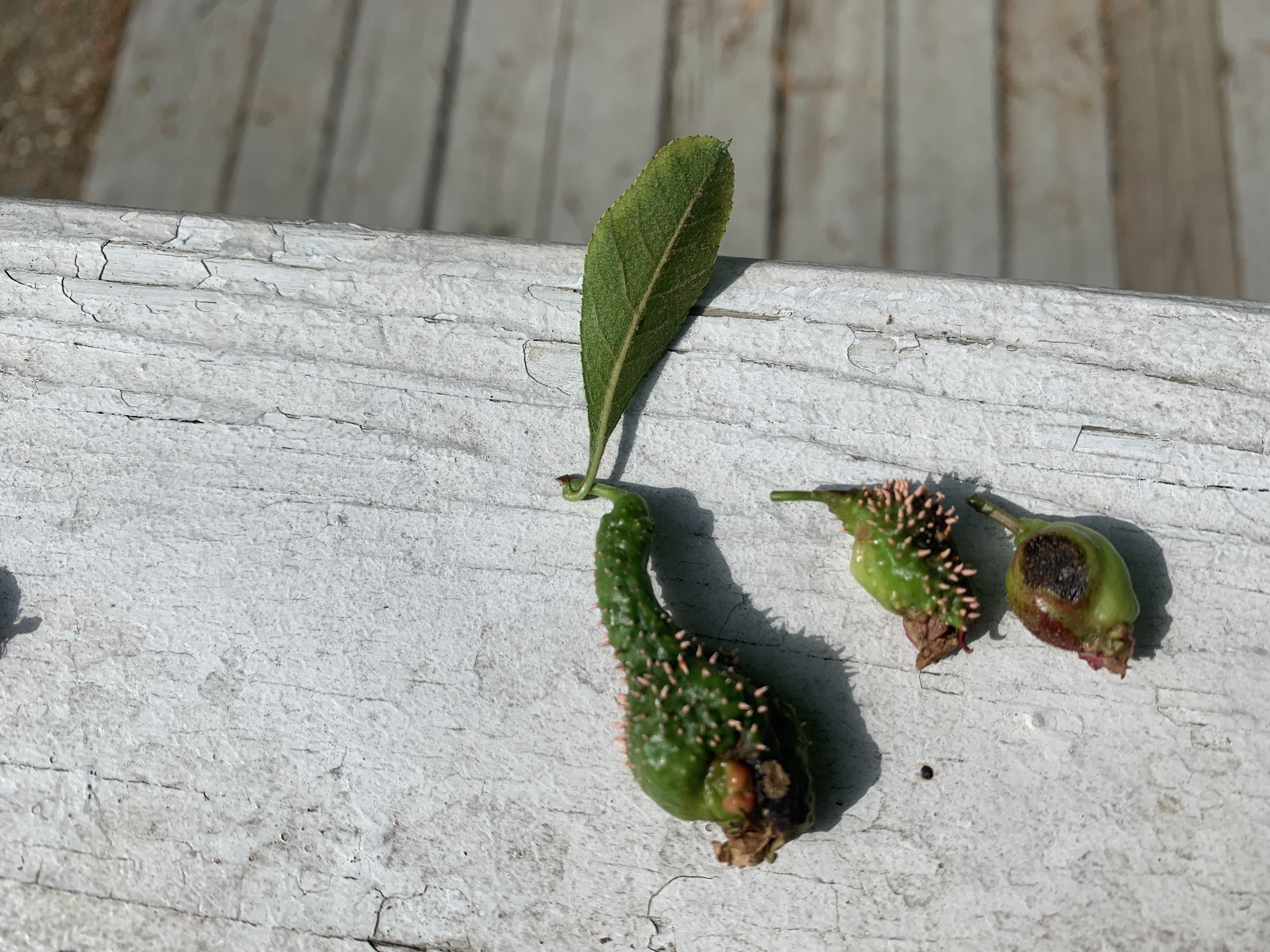
Nevertheless, we're not entirely out of the woods. These three groups of mayhaw fruits, all collected today, show that it may be a year or two before the disease is entirely purged. The majority of fruits we observed today were healthy (see far left duo). Some had a small blemish.  A few have been transformed into monstrous mutants, reminding one of John Carpenter's 'The Thing' (see center green fruit, studded with pink horns). If these tell you they're "just fine" or "all better," don't believe them. Finally, as pictured on the far right, we can see that some fruit simply withered on the tree and failed to grow at all. This was a failure for the cedar apple rust as well, as it requires the developed fruit to spread the infection.

This is unsettling to look upon, but we feel obligated to document it. Yuck.


While carefully examining the trees for new fruit, several dead branches were noticed, so a little pruning was necessary. When working around mayhaws, watch out for spines! These branches will poke you.


Tuesday, February 16, 2021

Winter Flowers

There is always a little color in the Louisiana landscape, even in 'the dead of winter'. Walking through the arboretum on February 12th, shortly before a predicted winter storm, a modest bouquet was collected. Some flowers are right on time, while others are appearing out of their expected season.


One sprig of lyre-leaf sage (Salvia lyrata) was found flowering all by its lonesome. We typically see these purplish-blue flowers in early spring.
One Louisiana iris hybrid was also found flowering out of season.

 
More than a few mayhaw flowers were found. Our mayhaws are expected to flower in February, and sometimes we see flowers in January.


A purple cone-flower in February is a rare sight. This patch of cone-flower is new to the arboretum; they were planted last April.

Echinacea sp.

It's not surprising to see flowers on the eastern red-cedars (Juniperus virginiana). During winter, the male individuals of this species take on a golden hue: tiny, yellow male cones cover the branches, altering the evergreen color when viewed from a distance.


Saturday, February 10, 2018

Cedar-Apple-Rust Update

This winter in the arboretum we have been working towards bringing an endemic disease under control. The cedar-apple-rust, although entirely a native affliction, reduces fruit yields of the mayhaw trees and has definite aesthetic drawbacks. A large number of galls growing in one specific Eastern Red Cedar brought our attention to the rust. After further investigation into the issue, it was determined that the best course of action is to interrupt the life cycle of the fungus by spraying a known host of the rust, the mayhaws. So far, three applications of the fungicide Immunox have been applied to the four mayhaws. This week, we noticed that the galls in the eastern red cedars are undergoing a change, taking on an orange hue and becoming even more hideous. For educational purposes, pictures follow....

Using a pruning hook, galls were removed from the low-hanging branches of the eastern red cedars. Unfortunately, the largest galls are out of reach. The specimens pictured are sized between a walnut and a chicken egg.
Three different stages of gall development.
This gall is opening, preparing to release spores into the environment. The most disturbing form has yet to appear.
Breaking the galls up into pieces, we see that the inside is changing colors, turning orange. Previously, the interior was green and white like the interior of an apple.
The mayhaws were sprayed with Immunox again this week. The flower buds are opening up!
The flower buds appear in clusters.


Thursday, January 11, 2018

Tree of the Week: the Mayhaws (Crataegus opaca and Crataegus aestivalis)

Over the past couple of weeks we have been studying the eastern red cedar (Juniperus virginiana). This attention has resulted in a decision to deal with the irksome cedar-apple-rust, whose galls are currently developing in the eastern red cedars. These galls are expected to 'open' soon, releasing their spores into the environment. Rather than targeting the galls themselves, which are housed in the inaccessible heights of the cedars, we decided to begin with a more manageable project: protecting the alternative hosts, and victims, of the rust.

The eastern and western mayhaws are susceptible to infection. These are small, early-blooming fruit trees that produce cranberry-like fruits. They are a southern gem. The best known way to protect the fruit tree is to spray the flower buds just before they open. Because the buds are currently developing, now is the time for action.

There are four mayhaws in the arboretum collection. Three western mayhaws (Crataegus opaca) are from Louisiana Forestry. They were acquired in 1994, and planted the following November, making them more than 20 years old. Our only eastern mayhaw (Crataegus aestivalis) was purchased from Woodlanders Nursery (Aiken, South Carolina) and planted along with the others. The four mayhaws dwell south of the long white wooden bridge, near the drainage channel that runs through the arboretum. The pictures below show that there has been some competition for sunlight; the crowns of the four trees have grown together.

The pictures below were taken on a cool cloudy January day.

We are looking toward the east, with the red bricks of Mickle Hall in the background. The eastern mayhaw is pictured center. Two western mayhaws are pictured to the left of the center tree, and one western mayhaw is pictured to the right. All three western mayhaws are leaning south, and one trunk is noticeably thicker than the other three.
Here we are looking north. The one mayhaw trunk is still noticeably thicker than the other three.
Two flowers were spotted on the branches, blooming ahead of season. This pretty white flower was found on the southern-most western mayhaw (C. opaca). As you can see, the flower appears in a cluster.
Most of the flower buds look like this. They aren't opening yet.
The buds are a rosy pink.
After researching cedar-apple-rust and comparing several options for treatment, Immunox was found to be the best option for protecting the mayhaws.
There are specific instructions for mayhaws on the Immunox bottle. For our sprayer, we mixed 2/3 fluid ounce of Immunox for each gallon. The instructions tell us that the best time to spray is when the buds are opening. Other recommendations advise a first spray during the "pink bud stage," which is the option we chose.
Precautions were taken to protect our skin from the fungicide solution, wearing rubber gloves, hats, and protective eye-wear.
The instructions state "apply to all parts of the tree to point of runoff", so we made sure to thoroughly spray the mayhaw branches.
This is the gray bark of the eastern mayhaw (C. aestivalis). Note the orange specks of new bark (see C. marshallii). The tree trunks were also thoroughly sprayed with the fungicide solution. 


You can see more photos of the arboretum's eastern mayhaw here. 
And you can find photos of the western mayhaw here. 


For more information about the mayhaws, consult the following links:
United States Department of Agriculture -- Western Mayhaw (Crataegus opaca)
United States Department of Agriculture -- Eastern Mayhaw (Crataegus aestivalis)
University of Florida IFAS Extension -- Eastern Mayhaw (C. aestivalis)
Temperate Climate Permaculture