Showing posts with label Campsis radicans. Show all posts

Thursday, February 29, 2024

Retaining Wall Cleanup: Trumpet Creeper (Campsis radicans)


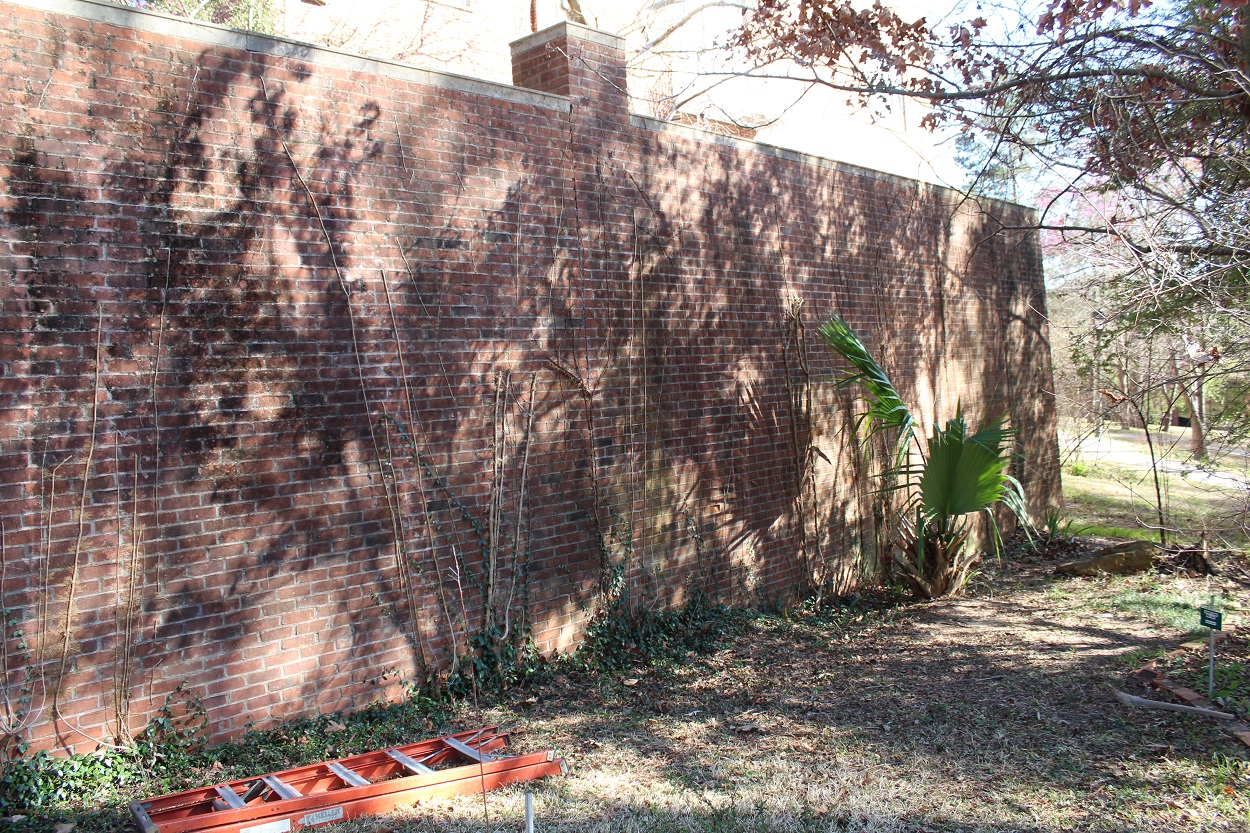
Here we can see a mix of vines which are properly attached to the wall, and some that have been detached and thrown over by the grounds crew. We'll finish the job by preserving as much as we can of the healthy vines while disposing of the clutter.


This aerial tangle is composed of dead vines, live vines, tree branches, and dead palmetto stalks.

Now it's all cleaned up!


Now the wall's cleaned up and will hopefully support some trumpet creeper flowers later in the year.

 
You've probably not recently seen a pile of vines this large.

Sunday, July 5, 2020

Trumpet Creeper (Campsis radicans)


Rank growth of trumpet creeper vines obscures the trunk of an old Shumard oak (Quercus shumardii). Vines so thoroughly cling to the tree that folks who are unaccustomed to studying trees might not be able to distinguish vine from tree.

What's a vine, and what's a tree? The green leaves are young trumpet creeper vines. The light-colored bark belongs to a very thick, old trumpet creeper vine. And the dark gray bark belongs to the Shumard oak.

The established trumpet creeper vine is more than three inches across. If the vines are so healthy, where are all of the pretty trumpet flowers?

Most of the trumpet flowers are way up high, entwining the Shumard's branches. From time to time our summer thunderstorms blow a few flowers loose, scattering the bright orange gems on the ground below.

Trumpet creeper flowers are three inches long, and the widest end is about two inches across.

Migratory humming birds are known to enjoy these pretty flowers.


Sunday, June 21, 2020

What's in Bloom?


During the long, bright, hot, dry days of summer splendid orange flowers can be found throughout Louisiana, blooming under the harshest conditions, unfurling like trumpets sounding out through the green. Trumpet creeper vine (Campsis radicans) flourishes in the arboretum. It grows as a volunteer and steadily tries to invade and conquer new territory.
These tropical delights are known to cause skin irritation for some, so pluck and handle with care!
Pictured above, trumpet creeper vine (Campsis radicans) blooms along the red brick retaining wall between Hamilton Hall and Mickle Hall. The above photographs were taken during June 2020.

Sunday, February 3, 2019

Tree of the Week: Red Maple (Acer rubrum)

In the first week of February, people in northwestern Louisiana can find something delightful outside: red maple flowers. Not only are red maples (Acer rubrum) a common landscape choice in our area, they can also be found throughout the wilds of Louisiana and neighboring states. It's a handsome, low-maintenance, fast-growing tree adapted to a generous range of growing conditions.What more could we ask for?

Our tree of the week is a 25-year-old red maple. This individual is a true Shreveport native. It was collected in the fall of 1994, on Line Avenue. On April 15, 1996, it was planted in the ground, in the west floodplain near the stream. Initially, there was more shade in this area, but over the past two decades several large on-site native trees have passed and been removed.

The individual in question, pictured center, is growing on the west side of the arboretum drainage channel. The leafless red maple is shown with an upright trunk and an asymmetrical crown. It's tall and straight. Let's talk a bit about the area. This part of the arboretum, located near the Fitness Center, is a floodplain. During heavy rains, water flows down hill and spans out across the grass, leaving the ground soggy for several days. Some trees would find this situation too wet,  but the red maple loves it. This little floodplain is also home to two sweet bay magnolias, a water tupelo, a basswood, and a clump of four bitter pecans, all pictured in the above photo.
From another angle, we can see the bifurcation of the trunk. Despite the split, the two main branches go straight up. Mickle Hall stands at the top of a steep hill on the opposite side of the drainage channel.
The trunk divides into two main branches. A heavy-looking, light-colored vine is attached to the thicker branch, which, incidentally, is also the south-facing branch. This is a volunteer trumpet creeper (Campsis radicans).
Trumpet creeper is a woody, deciduous vine. Its yellowish gray bark is rough and marked with aerial roots by which it attaches itself to any available structure.
The vine appears to dead-end into the ground. Below ground as above ground this tree and vine are surely intertwined.
Red maples are known for surface roots. This individual exhibits the trait of the species, but so far it hasn't been a problem for the mowers. Should we add a 'watch your step' advisory?
Mature red maple bark is rough with shallow ridges.
This is the immature bark on a small limb. This bark is smooth by comparison.


Finally, we come to the originating comment of this post. This week, our red maples are showing out. Can you see the specks of red along the branches? These are the flowers.
Looking up, we can see more of the red coloration.
In Louisiana, the tiny, red flowers appear during the winter months, well in advance of spring.


Red maple flowers appear in clusters. This particular tree seems to only have female flowers, at least within reach.


Female red maple flowers


Saturday, August 5, 2017

Summer Update


Trumpet creeper (Campsis radicans) has been flowering for a couple of months now. The water droplets in the photo are courtesy of the arboretum's sprinklers. Although, over the past couple of days we have had some rain.
Fruits of the persimmon tree (Diospyros virginiana) blend in with the leaves. They aren't ripe yet, but getting bigger.
The red buckeyes (Aesculus pavia) still have most of their leaves and their fruits are conspicuous.
The big-leaf snowbells (Styrax grandifolia) are covered in little fruits.
There is only one, but very large, nut on the little pignut hickory (Carya glabra).
Mexican plum (Prunus mexicana) fruits are ripening on the branch. Much of the fruit has dropped to the ground early.
Louisiana catchfly (Silene subciliata) flowers are a brilliant red. There are several nice patches scattered throughout the arboretum.
We're waiting on Magnolia grandiflora to reveal its bright red seeds.
Cones are hanging from the branches of the spruce pine (Pinus glabra).
The stunning fruits of the French mulberry (Callicarpa americana) bushes are typically a sign of the end of summer, transitioning to fall. There are approximately 10 significant bushes throughout the arboretum, with only one or two bushes showing off their ripening berries.