Showing posts with label Juniperus virginiana. Show all posts

Thursday, December 28, 2023

Tree Removal: Eastern Red Cedar (Juniperus virginiana)

For nearly five years the arboretum has been plagued by a fungal epidemic: cedar-apple rust. The wild crabapple, mayhaws, and several different hawthorns have suffered from this fungus, which depends on the eastern red cedar for its lifecycle. At first, in 2018, we treated the mayhaws with an anti-fungal spray. This labor intensive job resulted in no noticeable effect: the following spring, the mayhaws were still thoroughly infected with the fungus, potentially threatening their longevity.

The next step was to remove an eastern red cedar, which was both growing in proximity to the mayhaws and exceptionally ornamented with the developing fungal galls. The decision to cut down a healthy tree was not easy; its removal occurred in April 2021. You can read about the process here. Within a year of its removal, there was a noticeable improvement in the arboretum's lone wild crabapple. While the mayhaws were still infected with the fungus, their overall health improved. 

Then, in 2022, one of the parsley hawthorns showed signs of a terrible infection. The remaining eastern red cedars were examined, and two cedars were shown to be harboring the fungal galls. They were removed in late 2022. 

Two eastern red cedars remain, and today one is on the chopping block. Galls were discovered on this cedar last winter, and over the summer the hawthorns growing on the grass slope near Cline Hall looked pitiful from the rust. So, with the aim of eliminating the cedar-apple rust in the arboretum, we are removing yet another eastern red cedar. 


An established, volunteer eastern red cedar (Juniperus virginiana) is pictured center. This is one of our two remaining eastern red cedars. Its age isn't documented, but we know with certainty that this individual germinated here prior to 2012. It's a happy tree, doing well in this area, although it would be larger and stouter with more sunlight. A mature white oak (Quercus alba) looms above it.


Due to the existence of cedar-apple rust galls developing in its canopy, this eastern red cedar was marked for removal. Today, the process began. The first step was to climb the tree and cut off as many branches as possible. This will make the tree less messy when it is taken down.

These are the removed branches. A few of them carry the developing cedar-apple rust galls, currently hard and dry.


The trunk and remaining branches will come down this weekend. Then there will be one remaining eastern red cedar in the arboretum catalogue, which can be found in the Mickle Hall parking lot. You can read about it on an older blog post, found here. As of right now, that cedar does not have any visible galls. It, however, suffers from being confined to a small growing space, so it too will most likely have to be removed for poor health. The fate of the eastern red cedars in the arboretum is unfortunate, but this tree is very common in our area and can be enjoyed elsewhere. We have many important species in the arboretum to look after, and this one was simply too dangerous to its neighbors.

Sunday, April 18, 2021

Tree of the Week: Eastern Red Cedar (Juniperus virginiana)


"'What are my parasites to me? May they live and prosper! I am strong enough for it.'" -- F.W.N. Eastern Red Cedar (Juniperus virginiana), photographed January 5, 2018

In 2018, we identified a problem: the plant disease known as cedar-apple-rust prevented the arboretum's four mayhaws from producing fruit. A fungus, Gymnosporangium juniperi-virginianae, had made itself at home in a particular eastern red cedar (Juniperus virginiana), pictured above, and this fungus seasonally infected the mayhaws. While this organism can be observed on many cedars, this tree has supported a particularly virulent and aggresive population. Since it was deemed more practical to treat the mayhaws rather than the cedar, all four mayhaws were sprayed with a fungicide. You can read about that project on a blog post (here).

Spraying the mayhaws with a fungicide proved ineffective at breaking the cycle between cedar and mayhaw. Each spring, the mayhaw twigs were thoroughly covered in rust and could not produce fruit. Subsequently, our one wild crabapple (Malus angustifolia), which stands between the cedar and the mayhaws, lost its vigor and looked near death. Upon examination, rust was discovered here too. Furthermore, for the past two years, five other species of Crataegus have been infected with rust, and, perhaps coincidentally, the hog haw (Crataegus brachyacantha) died last summer.

Since the rust is deleterious to the health of so many trees, I, the arboretum curator, decided to remove the primary host of the rust, i.e., this eastern red cedar. There are four other eastern red cedars in the arboretum collection. One tree lives in near isolation on an island in the Mickle Hall parking lot, which you can read about here; it does not appear to have any parasites. The other three trees are in a cluster on the north side of the arboretum; these trees have parasites each year, but only a negligible amount. The only cedar that is thoroughly parasitized is the individual pictured above, located at the southern edge of the arboretum near the Fitness Center. You can read about it here. This beautiful, vigorous 'bad apple' was chopped down this week.


A handsaw and a chainsaw were used to remove the middle and lower branches, leaving a triangular green crown.


With the foliage removed, we see ascending branches and a slight curve in the trunk.

Trunk bark is rough and peeling.

The heartwood is a beautiful color and fragrant.

Amber-colored sap bleeds from where the branches were cut. This sap is very sticky and stains clothes.

While cutting branches, we were thoroughly reminded of the reason for removing this particular tree. Among the leaves we see numerous round objects. From a distance, they resemble mature bald cypress fruits.

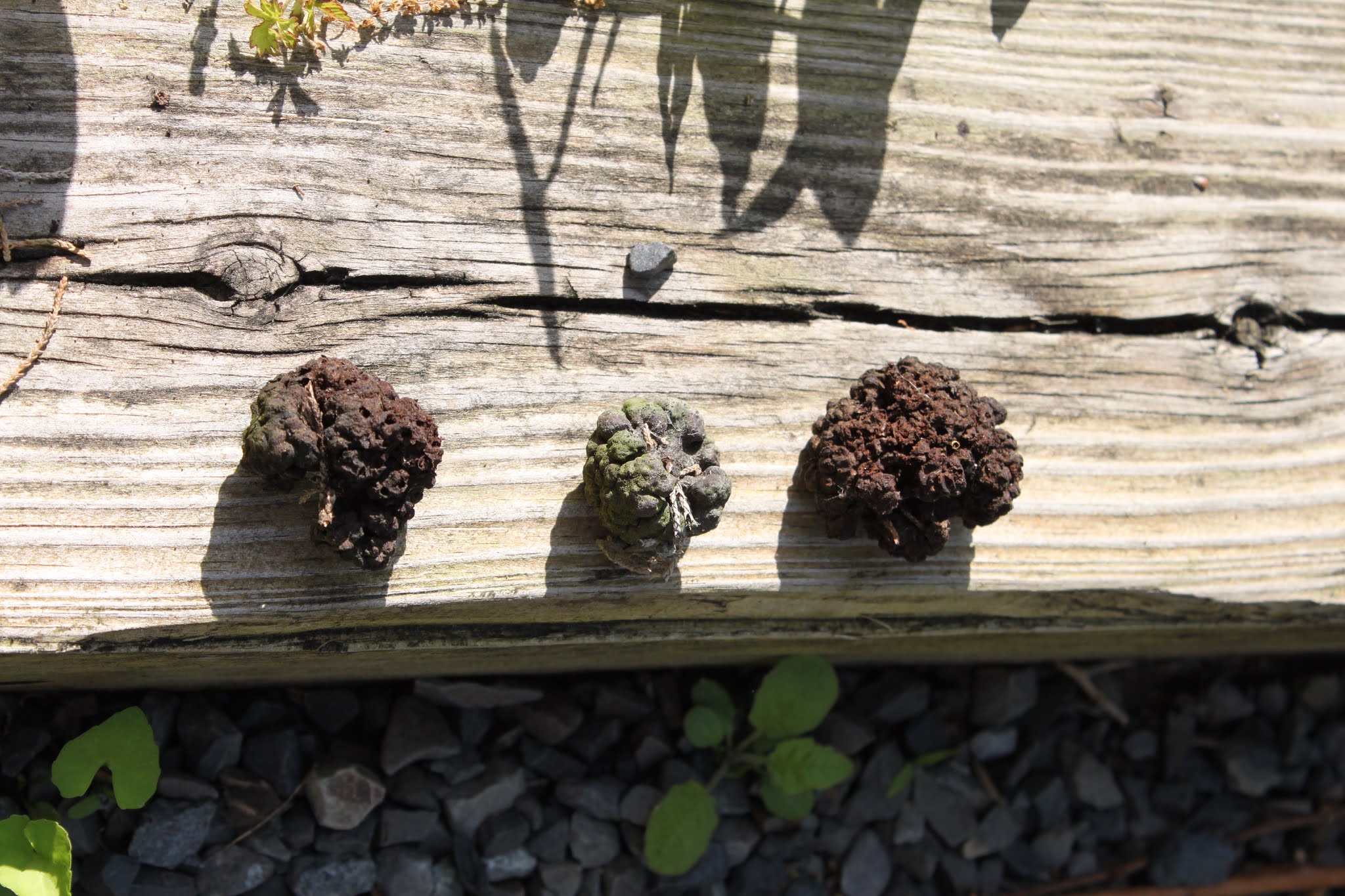
They are not fruits of the tree. This is a fungus that lives as a parasite on the eastern red cedar. Pictured above are old, inactive galls of the plant disease Gymnosporangium juniperi-virginianae.

When smashed, the old galls crumble and turn into dust.


Right now, in the spring, the fresh galls are activated by rainy weather. From seemingly inert, dark-brown bulbous blobs, they transform into ooey-gooey orange tentacled monsters.  Haws certainly have nightmares about it. Will you, too?

While sawing off branches, there was plenty of opportunity to get up close and personal with these jelly-like fungi. It appears that the central gall extrudes tentacles of orange slime though dozens of nodules. Perhaps upon drying, wind spreads the spores.

So, the cedar has been stripped to the trunk. Removing all that material is a large and dirty job; watch out for the sap. Since the fungus feeds on living branches, it will no longer spread from this tree. Enjoy the trunk, which makes a handsome pillar. It's quite fragrant and will serve as a fine lookout post for birds, squirrels, insects, and the rest of the arboretum's mobile inhabitants.


Tuesday, February 16, 2021

Winter Flowers

There is always a little color in the Louisiana landscape, even in 'the dead of winter'. Walking through the arboretum on February 12th, shortly before a predicted winter storm, a modest bouquet was collected. Some flowers are right on time, while others are appearing out of their expected season.


One sprig of lyre-leaf sage (Salvia lyrata) was found flowering all by its lonesome. We typically see these purplish-blue flowers in early spring.
One Louisiana iris hybrid was also found flowering out of season.

 
More than a few mayhaw flowers were found. Our mayhaws are expected to flower in February, and sometimes we see flowers in January.


A purple cone-flower in February is a rare sight. This patch of cone-flower is new to the arboretum; they were planted last April.

Echinacea sp.

It's not surprising to see flowers on the eastern red-cedars (Juniperus virginiana). During winter, the male individuals of this species take on a golden hue: tiny, yellow male cones cover the branches, altering the evergreen color when viewed from a distance.


Sunday, February 10, 2019

Tree of the Week: Eastern Red Cedar (Juniperus virginiana)

This week across northwest Louisiana you might notice a color change in half of our eastern red cedars (Juniperus virginiana). The male trees of this species are producing multitudes of tiny yellow cones, resulting in an overall change of appearance. Our tree of the week is one such specimen. The individual pictured below is a young eastern red cedar, a little more than 15 years of age, growing in unmistakably man-made conditions. It is changing color, too.
Our tree of the week grows on an island in the Mickle Hall parking lot. Initially, the tree volunteered somewhere in the arboretum and was transplanted to a container. Sometime around 2006, Professor Ed Leuck planted the little eastern red cedar in this concrete culvert. It was planted with the hope of making the culvert more conspicuous, thereby reducing vehicular damage and damage to the culvert.
As evinced by the photographs, the tree does not have much room to grow. It is unknown how much soil and surface area the tree has access to below the concrete. We positively know that this little spot does not have its own irrigation unit, so once a month during the summer, a water hose must be brought out to this concrete box. The eastern red cedar was selected for this spot because of its drought tolerance, but we don't want to push our luck!
The knobbiness of the trunk shows that our eastern red cedar has endured much pruning over the years. Its drooping branches have been removed to make way for the vehicles.
This week, this eastern red cedar is of special interest for its golden hue. All of the branches are covered in yellow male cones, resulting in an overall change of color, from dark green to unpolished gold.
The small cones are numerous and appear in clusters. The cones develop from the tips of the branchlets.

Saturday, February 10, 2018

Cedar-Apple-Rust Update

This winter in the arboretum we have been working towards bringing an endemic disease under control. The cedar-apple-rust, although entirely a native affliction, reduces fruit yields of the mayhaw trees and has definite aesthetic drawbacks. A large number of galls growing in one specific Eastern Red Cedar brought our attention to the rust. After further investigation into the issue, it was determined that the best course of action is to interrupt the life cycle of the fungus by spraying a known host of the rust, the mayhaws. So far, three applications of the fungicide Immunox have been applied to the four mayhaws. This week, we noticed that the galls in the eastern red cedars are undergoing a change, taking on an orange hue and becoming even more hideous. For educational purposes, pictures follow....

Using a pruning hook, galls were removed from the low-hanging branches of the eastern red cedars. Unfortunately, the largest galls are out of reach. The specimens pictured are sized between a walnut and a chicken egg.
Three different stages of gall development.
This gall is opening, preparing to release spores into the environment. The most disturbing form has yet to appear.
Breaking the galls up into pieces, we see that the inside is changing colors, turning orange. Previously, the interior was green and white like the interior of an apple.
The mayhaws were sprayed with Immunox again this week. The flower buds are opening up!
The flower buds appear in clusters.


Friday, January 5, 2018

Tree of the Week: Eastern Red Cedar (Juniperus virginiana) VOLUME II

2018 arrived in Caddo parish with an arctic chill. This past week we experienced temperatures in the teens, finally putting the mosquitoes to bed for the winter (*fingers crossed*). Thankfully the cold air wasn't accompanied by any precipitation, so the trees and woody vines were unfazed.

With most of the trees leaf-less, the evergreen species stand out. This week we are taking another look at the eastern red cedar (Juniperus virginiana). Last week we discussed two volunteers growing on the slope west of Hamilton Hall. The individual pictured below is also a volunteer, approximately 15 years of age. It germinated under the canopy of an old sweet gum tree (Liquidambar styraciflua). The sweet gum was removed more than a decade ago, allowing the eastern red cedar plenty of room to stretch its limbs.
Our tree of the week is pictured center. A few other evergreen species are also pictured. At the far left, we have the leaves of Magnolia grandiflora. Towering over the landscape, behind the eastern red cedar, is a very old loblolly pine (Pinus taeda). Palmettos, the fetter-bush, and a red bay are the other spots of green.
This eastern red cedar has the characteristic Christmas-tree appearance. It germinated on the south side of a very large sweet gum tree, and had the sweet gum lived, the eastern red cedar would not have had the necessary room to develop its conical shape.
The pale blue cones indicate that this is a female eastern red cedar.
Zooming in on the female cones, we also see the scale-like leaves.

Among the leaves and cones, something else is hanging from the branches.
This irregularly shaped brown growth might be mistaken for tree reproduction. It's actually a gall produced by a fungus called Gymnosporangium juniperi-virginianae. This fungus is responsible for the plant disease 'cedar-apple rust'.
The eastern red cedar serves as a host for the fungus, which is detrimental to susceptible apple trees, hence the name 'cedar apple rust'. Pictured above: the gall was removed from the tree and broken into pieces revealing a hard greenish-white interior. If we had allowed it to continue its life-cycle, it would have continued to develop until the first several warm rainy days, at which time it would release spores into the environment.
This is a dead gall. It appears to have killed the twig.

Despite the fungal infection, this eastern red cedar is doing marvelously. Overall, eastern red cedars are not harmed by the cedar apple rust.
Typical reddish-brown shreddy bark of the eastern red cedar
.
 

Friday, December 29, 2017

Tree of the Week: Eastern Red Cedar (Juniperus virginiana)

Last week autumn concluded with a generous rain storm, punctuating a remarkably dry season. Winter has made quite an impact, despite being a new arrival. The weather has been cloudy and chilly, with temperatures dipping down into the 20s just before sunrise. The local meteorologists are forecasting an extremely cold New Year's Day: they say we might have temperatures in the teens! Brrrrrrr..... 

With winter officially here, most of the deciduous trees have dropped their leaves, opening up the vistas in the arboretum; there aren't as many leaves blocking the view of our undulating landscape. Now is a good time to appreciate the overall form of the tree as its bones are laid bare. Some trees have a uniform shape: an erect trunk, symmetrical branches, and a rounded top. Other trees have branches that go every-which-way, lacking apparent order. And with the leaves out of the way, now is also a good time to appreciate the great variety of tree bark: smooth, rough, spiked, checkered, shredded, and still others.

But there are also a number of evergreen species adding interest to the bare landscape. Our tree of the week is one of those beauties. The eastern red cedar (Juniperus virginiana) is a handsome tree all-year-round, but in the wintry months it shines. These trees have a pleasant Christmas-tree-shape and can also be seen decorated with elegant blue 'berries' and tiny golden cones.

There are five eastern red cedars in the arboretum collection. All are volunteers, owing to the widespread and frequent occurrence of the species in our area. The photos below are of two older individuals aged about twenty years.

These two eastern red cedars are approximately 20 years of age. The male tree is pictured on the left; the female to the right. They are growing in the middle of the slope on the west side of Hamilton Hall. The red brick building barely visible in the photo is the Student Union Building.

Female Tree: This is the northern-most of the two trees. It has a characteristic straight trunk and a conical shape. Behind and to the left, a medium-sized hydrangea bush has few leaves remaining. Mickle Hall is pictured in the background.
Male Tree: the southern-most of the two trees blends in with its surroundings. The trunk isn't as straight, with a slight curve towards the middle, but it possesses the conical form.
The pale blue 'berries' add a subtle beauty. The berries are actually female cones. 
Eastern red cedars have very small  leaves.
Under magnification we can see the small, flat scalelike leaves. These are leaves from one of our 20-year-old individuals. Young eastern red cedars have pointy (surprisingly painful!) leaves rather than these smooth scalelike leaves.

Very small golden cones.
Zooming in on the young male cones
Looking up the trunk we see the reddish shreddy bark and numerous straight branches. 
Eastern red cedars have rough, shreddy bark, and typically the bark has a reddish hue.


You can find additional pictures of the arboretum's eastern red cedars here. The older photos were taken on a bright, sunny day.

Please consult the following sources for more information about this species:
NC State University
United States Department of Agriculture
Virginia Tech Dendrology