Showing posts with label Populus deltoides. Show all posts

Tuesday, January 10, 2023

Tree of the Week: Eastern Cottonwood (Populus deltoides)

Like people, some trees are easy going while others require more maintenance. The eastern cottonwood (Populus deltoides) is particularly high maintenance. When growing in a wild setting, it is irksome because it sends its 'cotton' outward into nearby civilized areas, covering window screens, clogging ducts, and making a general nuisance. And when growing in a maintained landscape, it stands out from its peers as being a problem case. See below for more details.


Our tree of the week is approximately 25 years old. It grows between Rotary dormitory and the Student Union Building. It was one of two eastern cottonwoods planted at approximately the same time: one seedling was from Walter B. Jacobs Memorial Nature Park, and one seedling was a volunteer from the campus greenhouse. We cannot say which of the two trees remains, but we have before us a very tall, imposing, troublesome tree.

In January, there are plenty of leaves to cover the ground. Leaves do not all fall at once, so there are several opportunities for outdoor fun, if you like raking (or blowing) leaves. And, it must be noted, eastern cottonwoods do not only drop their leaves during the autumn and winter months. This specimen in particular has been known to drop piles of leaves during dry summer months. But why waste your time raking leaves? Why not just mulch them with a lawn mower?

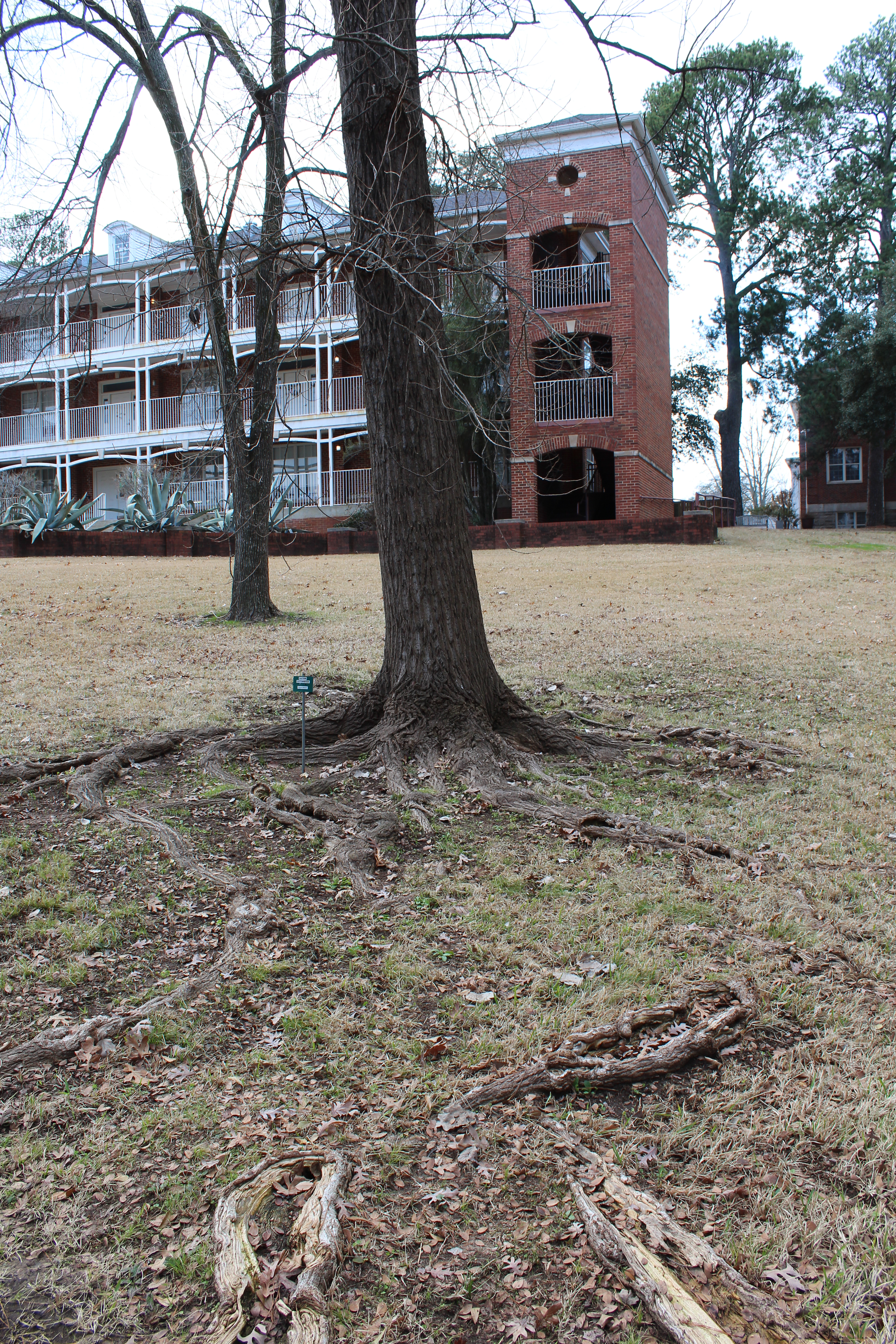
Extensive surface roots make it nearly impossible to mulch these leaves with a mower. Looking at the above picture, we see lawn mower damage that these roots have sustained.


Using a blower might save you some time; however, depending on what you intend to do with the collected leaves, you might need to sort through your leaf piles for the numerous twigs and branchlets. The above wheelbarrow is full of twigs collected from under the cottonwood.


Twigs tend to be at minimum a foot in length.

Eastern cottonwood twigs are characteristically knobby.


Examining the roots and base of the trunk, we see young stems growing from the root structure.

Looking closer,  we see that this is not the first time that a shoot has grown in this spot. This area has previously been trimmed. For the sake of aesthetics, these stems will also be cut.

Oh, hey there ladybug. Whatcha doin'?

Leaves have been raked away from surface roots and the collected twigs were hauled off to the dumpster. In maintaining the grounds of the arboretum, we try to retain as much organic matter as possible, so all leaves are mulched and stay on the lawn. This provides a recycling of natural resources and minimizes waste.


There are still leaves on the ground, but not under the eastern cottonwood!


With the leaves removed, we can really appreciate the surface roots. In all seriousness, the above ground root structure appears to undulate, suggesting the movement of water, calling to mind the banks of a stream or river—the cottonwood's natural habitat. It's unfortunate that the roots have sustained so much damage from the mowers.


Saturday, November 30, 2019

Fall Foliage: Eastern Cottonwood (Populus deltoides)


In cultivated settings some trees require more work than others. A tree might be known for dropping too many large leaves, twigs, or messy fruits, or a tree might require regular pruning for proper cultivation. The eastern cottonwood (Populus deltoides) is one of those 'messy' trees that require extra maintenance. These are fast growing trees that produce a lot of leaves, and when they drop, cottonwood leaves blanket the ground. In the photo above, the cottonwood is pictured to the left of center: it has a straight trunk that casts a long straight shadow.
Eastern cottonwood pictured on November 23, 2019

Lawn maintenance under an eastern cottonwood is doubly difficult: the thick bed of leaves obscures large surface roots that make it impossible to simply mulch the leaves with a lawn mower. You can find photographic evidence of those impressive roots here.

Sunday, June 2, 2019

Tree of the Week: Eastern Cottonwood (Populus deltoides)

Cotton has been in the air for the past several weeks. Little pieces of white fluff floating to the ground. Where does it come from? The eastern cottonwood (Populus deltoides) is your best guess. You can find this native tree all over town. It grows like a weed, popping up opportunistically in wet places. You might find one in a flower pot that you've been watering consistently. It's especially prolific along the banks of our Red River.

In the arboretum you can find one very large, although not very old, specimen. In April of 1998, this individual was collected from the Walter B. Jacobs Memorial Nature Park, in Caddo Parish. Potted and then nurtured over the summer, it was planted later that year in November. It's located in a sunny spot on the west side of the arboretum, along a major drainage channel.

Our tree of the week is pictured center. This eastern cottonwood is a tall, straight tree, a little more than 20 years old. This species is known for its rapid growth.
The eastern cottonwood grows near the northeast corner of Rotary Hall. Jackson Hall is pictured directly behind the cottonwood, further up the slope.
This individual has developed impressive surface roots that make lawn maintenance more difficult. It's great for creating a 'natural setting,' but be wary of cottonwoods growing in areas that need to achieve that 'manicured look.'
The roots stretch across the grass and then appear to dead-end at the sidewalk.
These protruding roots inevitably sustain lawnmower damage. Do they also damage the lawnmower? Violence goes both ways.
The undamaged surface roots have handsome, deeply furrowed bark.
In the shade, the trunk bark is dark gray.
With a little sun shining on the trunk, we see light gray furrows with dark ridges.
A diamond pattern is visible on some portions of the trunk. Do these resemble the scales of some fantastic beast?
During the past several weeks cotton has accumulated on the ground around the cottonwood. The edges of the sidewalk are lined with light-gray fluff.
A few catkins were collected from the leaf litter for examination. Eastern cottonwoods are dioecious. This is a female catkin. It's mostly bare at this point. The white fluff is an open fruit. The fluff floats through the air or on water, disseminating the cottonwood seeds. There are two unopened fruit capsules still on the catkin.
The fruits are small, measuring approximately ¼ inch.
The female catkins measure approximately 5 inches in length. Some are straight, others curved.
This is a female eastern cottonwood catkin with one open fruit remaining.
This is a female eastern cottonwood catkin with several opened fruits.
So much cotton!


For more information about this species consult the following:
United States Department of Agriculture
Louisiana Plant Identification and Interactive Virtual Tours (LSU AgCenter)
US Forest Service