Showing posts with label Salix nigra. Show all posts

Sunday, June 30, 2024

Black Willow (Salix nigra) Update

Perhaps when you see a tree, you think: "Look at this messy pile of lumber and twigs. I don't have anything in common with this thing." Always remember, however, that you and the tree share one thing: a will to live. This will is more apparent in fast growing trees that thrive in harsh, or seemingly impossible, conditions. 


The following photos show us a black willow (Salix nigra) that has an ignominious history. Like a fairybook creature from some nursery rhyme, it grew up in a discarded boot. You can read about that in a previous post. The last time we checked in on this specimen, nearly a year ago, it was about nine feet tall.

Given the height of these two boys, I'd say this tree has grown to around twelve feet tall. Three extra feet is not bad for less than a year of new growth.


Individuals from all walks of life (indeed, some vertical walks...) can enjoy a black willow. Here is a green anole (Anolis carolinensis) doing just that.


Black willows can grow to be fifty feet tall or end up as a very large complex of shrub-like growth. If it keeps growing at this rate, we'll need to prune this fellow one day soon.


Sunday, October 1, 2023

Tree of the Week: Black Willow (Salix nigra)

Last week we looked at a tree that didn't fare so well during the August heat wave. This week, we are admiring the surprising hardiness of a tree that doesn't appear to show any damage. Below, we have pictures of our young black willow (Salix nigra).


In December of last year, a black willow (Salix nigra) was added to the arboretum collection. It germinated in an inundated old boot, found in an ice chest, in the back of an inoperable pick-up truck parked in Haughton, Louisiana. Since this specimen was growing so happily in water, it seemed like a gamble to plant this black willow in a lawn, rather than at the water's edge.

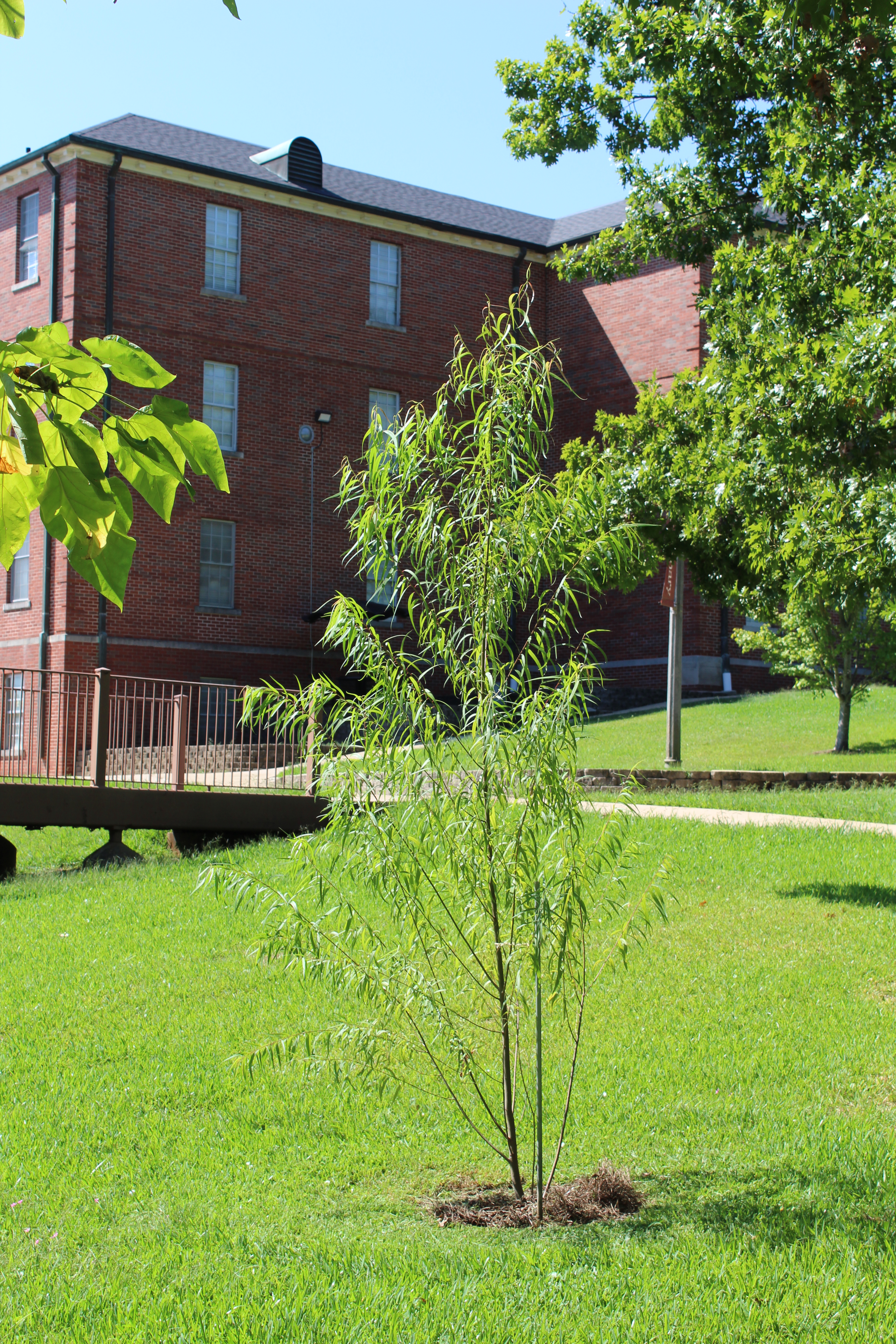
Today, it's as if we never had anything to worry about. Our black willow looks excellent! Given the harsh growing conditions in August, we would at least expect the black willow to be shorter in stature or to have fewer leaves. Instead, we have a young tree that is showing rapid development. It measures approximately 9 feet tall.

During the several weeks in which the arboretum's irrigation system was out of order, a water hose was brought out to this tree once a week for a thorough soaking. The nearest spigot is located in the background, on the exterior wall of Cline Hall.


This young tree has one major trunk and two thinner stems, which will most likely be pruned to encourage the single trunk. This species can develop as a tree or a shrub.


The twigs and petioles have a pretty pinkish-red coloration.

Leaves are long and narrow, tapering to a sharp point. Some leaves are curved. Here we have four leaves, measuring between 5 and 7½ inches. This is the upper side of the leaf.

 
Underneath, leaves have the same green coloration, but the mid-rib is noticeably white.

For more information about this species, please consult the following online resources:

Louisiana Plant Identification and Interactive Virtual Tours

NC State Extension

United States Department of Agriculture

U.S. Department of Agriculture: Forest Service


Wednesday, December 7, 2022

New Recruit: Black Willow (Salix nigra)


Some time in recent history, in rural Bossier Parish, a black willow seed settled in an abandoned boot, in a forgotten ice chest, in the back of a derelict pick-up. The boot and the ice chest proceeded to fill up with detritus. Despite a singularly inauspicious beginning, a vigorous plant came forth, growing in full sun and living on accumulated rain water and whatever nutritious fare that floated through the air and landed in the unexpected "flower pot".

Then, that black willow (Salix nigra) came to live at the Centenary College arboretum.


The black willow and its boot were easily removed from the ice chest.


Interestingly, 13 intact bottles of Aquafina water were in the ice chest, along with other refuse. There was only a thin layer of leaf litter, mostly pine needles, mixed in with the plastics. In some Mad Max universe, we might be happy to have the bottles of water, but, we aren't there yet, so they found their way to the dumpster, along with the ice chest.


The young tree has produced an impressive root ball, surrounding its beloved boot.

 
For the most part, the roots were easy to detach from the boot, with a small exception, so a piece of the boot was cut out, to be buried with the root ball.


The black willow is now in the ground of the arboretum, in full sun, approaching the Fitness Center. This is near the bottom of a gradual slope.

Our weedy black willow is clearly a tough plant. How will it like the ground of the arboretum? As long as we don't let it dry out for too long, and the Louisiana winter makes that unlikely, it ought to do nicely.


There was a young willow who lived in a shoe

in a chest in a truck, that just won't do.

It's out of the boot and off to the arboretum

to be planted for students in hopes that you please them.