Showing posts with label Tree of the Week. Show all posts

Sunday, May 5, 2024

Spring Storm Damage: Water Locust (Gleditsia aquatica) and Yaupon Holly (Ilex vomitoria)

This spring we have had quite a few significant rain events, thoroughly washing out the gravel paths of the arboretum, as well as noteworthy thunderstorms, with powerful winds, mangling and toppling trees in the local community. On Sunday, April 28th, a storm blew through the arboretum, nudging over a weakened water locust (Gleditsia aquatica). Since last fall, the water locust had been marked for removal due to its unhealthy trunk. A licensed arborist with an experienced crew would have been the preferred method of removal, as such planned, controlled events tend to result in less overall damage. The 'wait-and-see' strategy of tree removal has resulted in undesirable damage to surrounding plants.


Yellow caution tape was seen in the arboretum this week.


A large area was cordoned off using yellow tape to discourage pedestrians from getting too close to the fallen water locust (Gleditsia aquatica) and the mangled yaupon hollies (Ilex vomitoria).


The fallen water locust is suspended on an interwoven network of yaupon holly branches.


This is a major pathway through campus. There were perhaps several disgruntled, or at least surprised, pedestrians this week. No doubt they were annoyed with the necessity of walking around this mess. Of course, it was also Finals Week.


"Dead end! Turn around!" or "Halt! Frogs only beyond this point!"


Our fallen water locust was collected locally, in 1995, from Dr. Dana Kress's property on Cross Lake.


For nearly 30 years, the water locust grew happily in the 'lower pond' area of the Arboretum, surrounded by Sabal sp., Iris sp., Taxodium distichum, Aralia spinosa and a nearby Planera aquatica, as well as a Betula nigra.


A railing helped break the fall of the water locust.


A smashed railing. What do you think the impact sounded like?


The water locust has such interesting bark! Not only are its spines terrifying, but they also function as a trellis for green-briar vines.

Although its trunk was rotten at the base, the water locust remained alive all winter. Green leaves are pictured here.


Fresh green growth of the water locust.


The water locust fell on top of two groupings of yaupon holly, one marked 'male' and the other marked 'female.' Both groupings of holly sustained similar damage, and both are expected to make a full recovery.

This yaupon holly is marked 'female.'

The thick water locust trunk rests on the splitting yaupon holly.


This yaupon holly is marked 'male.' That's an important consideration for dioecious trees. Male yaupons won't make the pretty red berries!


This yaupon holly trunk is split and will need to be cut.


The two yaupon hollies will be just fine. Unfortunately we lost our only specimen of Gleditsia aquatica. Luckily, a seedling was growing in the leaf litter. Earlier this week we dug it up and potted it. Hopefully this volunteer will grow up quickly and be transplanted back into the arboretum, although it might be difficult locating a suitable spot for it. But where there's a will, there's a way.


Thursday, February 29, 2024

Tree of the Week: Willow Oak (Quercus Phellos)

Previously we described two willow oaks that we obtained from local tree enthusiast Gladden Willis. It's been a few years, so it's a nice time to check on those trees. The previous blog post had pictures of the willow oak planted closer to the Student Union Building. All photos below are from the individual planted toward the Fitness Center.


This tree is coming into its own and growing large enough to assert itself. Recently we've added some friends to its base that will keep it company. Who doesn't like native roses?


Our willow oak has a straight trunk, and in this photo we see that, after so many years, the green, plastic nursery tag is intact, describing the tree's origin.

 
Tiny buds are visible on the branches. Leaves are coming soon.


Trunk bark appears to be splitting at the base. Is this an indication of maturity? No damage or infection is visible.

Saturday, December 16, 2023

Tree of the Week: Sabal Palm (Sabal Palmetto)

It's mid-December. Leaves cover the ground in the arboretum. For the most part, the air temperature is cool or a little warm. Although the mosquitoes have not completely disappeared, they certainly have reduced activity and ferocity. So, now is a good time to start working on the overgrown, wet areas of the arboretum that receive little attention during the hot, fast-growth months of the year.

This is the area of the arboretum previously known as 'the lower pond'. It's on the south side of the long white wooden bridge that runs between the Student Union Building and the Science Building, Mickle Hall. This is one of our wet areas of the arboretum, although today it does not retain water. From late-June through October or November, this area is left unto itself due to the high number of mosquitoes. As we near the winter solstice, this area is grown up with new trees, weeds, dewberry, drooping limbs, and generally thick with palmetto leaves. A large patch of Louisiana irises is waiting to be revealed.

In order to more easily walk around in this area, trimming the drooping leaves of the sabal palm (Sabal palmetto) is one of the first things to do.

 
Large, drooping leaves obscure the handsome trunk of this tree.


Leaves of the sabal palm are really big! Petioles are super long and the leaf blades are long and wide. All of these leaves were removed from one trunk. There are three sabal palms in the arboretum collection

From this point of observation, we see the fuzzy, thin trunks of the Chinese windmill palms (Trachycarpus fortunei), one of our few exotics; a pair of loppers hangs from the foremost trunk. The newly trimmed sabal palm, which has a thick trunk by comparison, is further in the background. Overall visibility in the lower pond is increased by simply trimming the one sabal palm. Much manual weeding needs to be done to prepare the iris patch for the spring.


You can read more about this individual sabal palm on an older blog post, found here.

Sunday, November 5, 2023

Tree of the Week: Toothache Tree (Zanthoxylum clava-herculis)

Autumnal weather has arrived in northwest Louisiana. This week we experienced low temperatures in the 30s, and over the next several days we expect high temperatures above 80℉. Although the mosquitoes are still buzzing about, the overall drop in temperature means that we can start moving plants around without fretting too much about survival rate. Today, a young, volunteer toothache tree (Zanthoxylum clava-herculis) was transplanted to a better location and officially added to the arboretum catalogue. 


The volunteer toothache tree is pictured center. Some time within the past few years it germinated in the patch of dewberry (Rubus trivialis) on the west side of Mickle Hall, not far from the mature toothache tree. After the dewberry and yellow passion flower vines were pulled away from it, we could see the form of the young toothache tree: it is a little less than 2 feet tall, and it has a very long surface root.


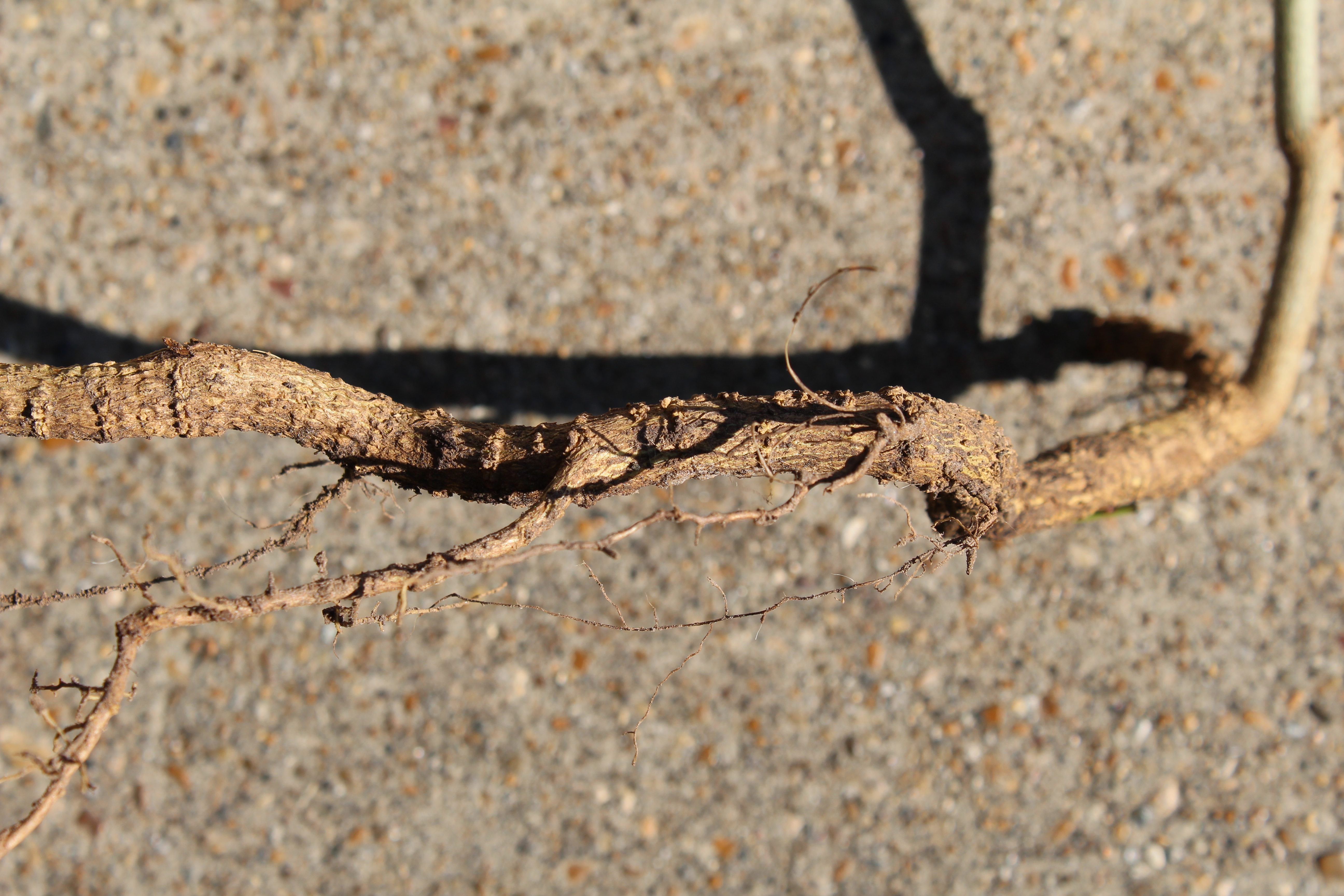
This is a detail image of the toothache tree's long surface root. The little tree isn't connected to the soil at the base of its trunk, and it seems that the vines that had grown up around it were doing much of the work of holding it up straight.


Examining the volunteer toothache tree gave us another look at the giant swallowtail caterpillar (Papilio cresphontes). We talked about this species on our previous blog post.


 In this video we can see the caterpillar eating part of a toothache leaf. (The video also shows how windy it was today!) When humans chew on the leaves of this tree, we experience a tingling sensation in the mouth, and if we chew on enough of the leaves, we experience a numbing effect.


This large, chunky caterpillar with a very interesting color scheme was relocated to the nearby mature toothache tree.


This toothache tree only has shallow roots, with one particularly long surface root. Not much digging was required to remove the tree from the dewberry patch.


The root system is surprisingly sparse, especially considering how healthy the trunk looks.


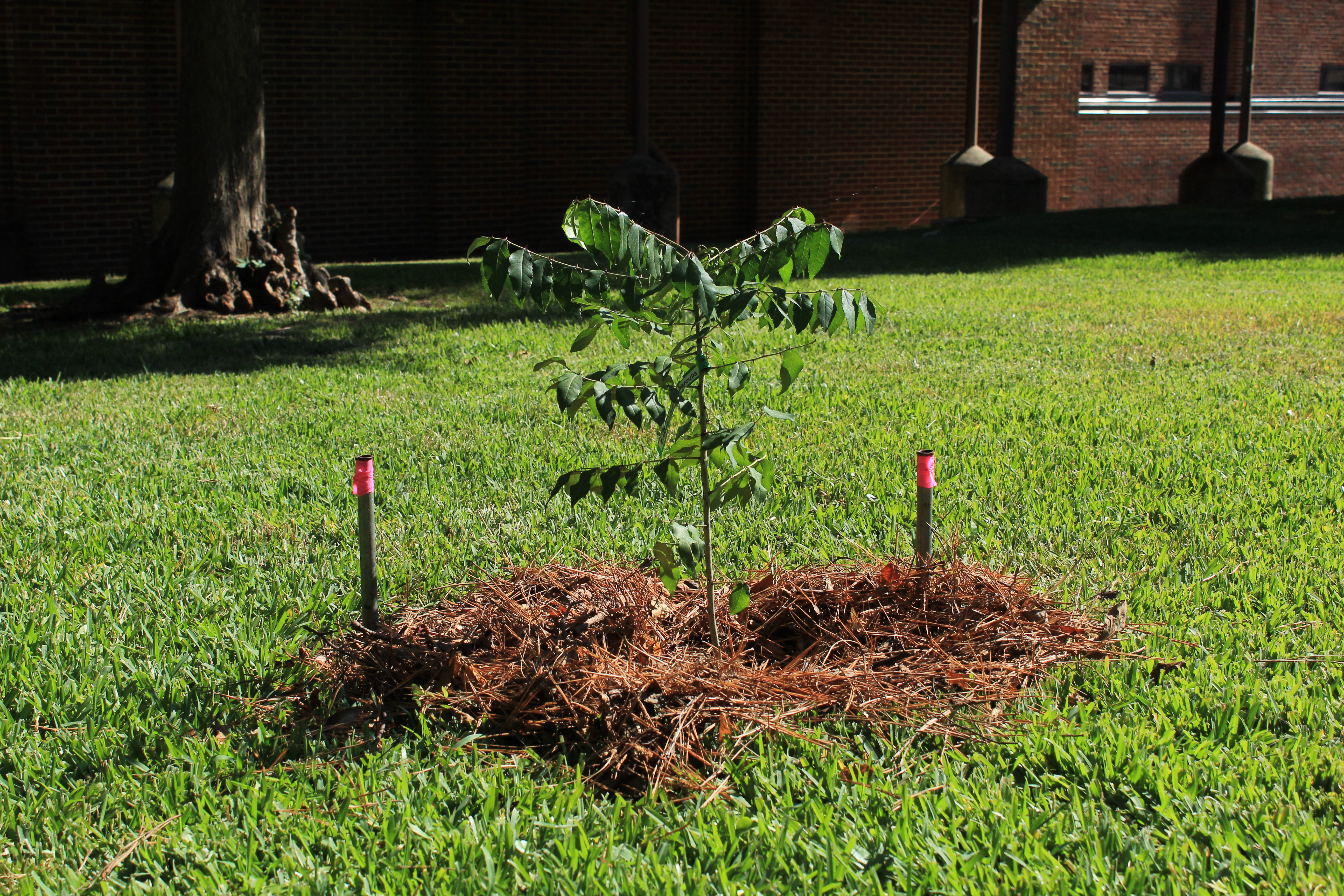
The toothache tree was transplanted from the top of a hill to the bottom of a hill in the hopes that it will have access to more water. It appears to be all by its lonesome on the Fitness Center lawn. A black oak (Quercus velutina) and black willow (Salix nigra) are growing nearby.


Two metal stakes flagged with pink tape serve as protection against lawn mower damage, and the pine straw mulch will help the soil retain moisture. This individual was thoroughly watered after planting was complete, and the soil moisture will need to be monitored until the tree enters dormancy.


Leaves at the very top already started to droop from the stress of relocation. They will hopefully perk back up soon. This same thing happened to the two other toothache trees that were transplanted this past spring. You can read about them here. Both of those young trees survived the summer.


Monday, October 16, 2023

Tree of the Week: Water Locust (Gleditsia aquatica)


There is currently one water locust (Gleditsia aquatica) in the arboretum collection. Next week, that number might be zero. So go check it out while you can!


You can find our water locust in the middle of the arboretum. This nearly 30-year-old specimen stands on the south side of the long white wooden bridge that runs between the Student Union Building and Mickle Hall. It is pictured center, leaning to the left. But has it always leaned this much?

Nope! Consulting the photographic record, we see a fairly straight trunk, especially compared with the current state. This picture was taken on February 2, 2018. For comparison, note the lack of movement in the large tree behind it. You can see more pictures from that photoshoot on an old blog post, found here.


So, if the tree is leaning, what's going on at the base of the trunk? In order to answer this question, we need to be able to see the base of the trunk! During the summer months, the overwhelming mosquito population dissuades human activity in this wet area, so it's largely left unto itself, resulting in a thick mat of vines, mostly dewberry, but also Carolina moonseed, covering the ground. These vines and a few small trees had to be pulled away from the water locust so that we could examine the trunk.


Pulling weeds from around the base of this tree is no easy task; you can't drop your guard around this one. 


Not only is the trunk armed, but these spines, like natural caltrops, fall off and litter the ground around the trunk.


On this individual, most of the spines are located further up the trunk.


With the vines removed, we can appreciate the cypress knees that have grown up around the water locust.

We allowed a couple of laurel cherry trees (Prunus caroliniana) to remain, as something will need to fill the gap left by the removal of our water locust. The laurel cherry trees might as well have a chance at success since they are already here.

Looking at the base of the trunk, we see that the bark has rotted. There is an obvious breaking-away from the ground, which doesn't give us confidence in the tree's strength to remain standing for much longer.


Looking further up the trunk, we see a lot of blue sky. The remaining branches are scraggly and concentrated on one side of the tree.

Way up top, we see locust leaves. So, this tree is certainly alive, and perhaps it could go on living in this condition for some time to come. However, since it's located in the center of the arboretum, a relatively high traffic area, our only water locust must go. In recent years, water locust seedlings have been spotted in the surrounding area, so hopefully we can identify and preserve another one in the following months.


Sunday, October 8, 2023

Tree of the Week: Black Oak (Quercus velutina)

Healthy trees are always growing, and in many cases, upward growth results in a loss of lower branches. It's no coincidence that the majority of mature trees in the arboretum lack their lower limbs. Healthy branches are often removed to make the landscape more accessible for foot traffic or, for safety concerns, to increase visibility. Some species take care of this for us; the trees naturally shed their lower limbs. Yet these dead branches don't immediately fall off a tree and may remain attached for years. While we normally allow these things to resolve themselves naturally and clean up the mess, sometimes we need to be proactive.

This past week, we decided to remove the unsightly dead branches from a black oak (Quercus velutina), located near the fitness center. This individual had accumulated a large number of dead branches, and since it's growing on the periphery of the arboretum, in a high-traffic area, we decided to improve its appearance. Here we show the results:


Our tree of the week is a black oak (Quercus velutina) that needed some cosmetic work done. This tree was planted near the Fitness Center less than 25 years ago but details of its planting history are unavailable.


A ladder was needed to do the tree trimming. These surface roots made it very difficult to position the ladder on solid ground. Be careful when doing this kind of work!

The surface roots are thick and bulbous, showing obvious signs of damage from lawn equipment.

Surface roots of Quercus velutina, photographed October 7, 2023

Surface roots of Quercus velutina, photographed October 7, 2023

Protruding from the ground makes these roots a sure target of lawnmowers and trimmers.


These dead branches started about eight feet above ground level and continued to around fifteen feet up. That required some climbing!

The tree looks a bit sparse, but much better overall.


With the dead branches removed, we can appreciate the black oak's straight trunk and dark bark.


These dead branches were all removed from one tree.


We will be watching this black oak over the next couple of months; we are expecting pretty fall foliage from it. Our appreciation of the color change won't be marred by those ugly dead branches.

And we have another reason to check-in with this tree in the coming months: acorns were spotted. Not many, and, of course, they are out of reach. Can you see one?


Quercus velutina acorn, photographed October 7, 2023