Showing posts with label February. Show all posts

Wednesday, February 25, 2026

Germination Project: Pyramid Magnolia

The Centenary College Arboretum is participating in a pyramid magnolia germination project organized by an international team, the Global Conservation Consortium for Magnolia, headed by the Atlanta Botanical Garden. Your arboretum curator has taken on custody of 15 seeds collected from pyramid magnolias (Magnolia pyramidata) growing in east Texas. The seeds were initially collected in August by a group working out of the Lady Bird Johnson Wildflower Center. In September, we at the Centenary College arboretum agreed to join the germination effort. Our 15 seeds arrived at the campus post office on February 17th, and we potted them the following day. The Seed Propagation Protocol forwarded by the Consortium tells us that seeds from a 2025 germination project had a high germination rate and sprouted, on average, 53 days after sown. Consequently we can expect seedlings to pop up around April 12th. 

We received a total of 15 seeds, separated into three different bags. Each bag was marked with a number.  


In one bag, we received 6 seeds, pictured in the above photo, with an identifying number: SB-20250563. We also received two additional bags, one with 4 seeds and another with 5 seeds. 

Each seed has its own 3-inch pot to call home.


Seeds measure ¼ inch in length.


Our 15 pots are organized in three groups. We are hoping for 15 seedlings!

You can find more information about the project organizers by following these links:

The Global Conservation Consortium for Magnolia 

Atlanta Botanical Garden 

Saturday, February 22, 2025

Turk's Cap (Malvaviscus arboreus)

Today we're adding a new perennial wildflower, Turk's cap (Malvaviscus arboreus), to the arboretum collection.


We ordered two small pots of Turk's cap from Almost Eden. It's a nursery in Merryville, located in southwest Louisiana on the border with Texas. This company has been in business for decades and grows many native plants that are suitable for our climate. 

Our plants arrived in perfect condition, in a long cardboard box, securely wrapped and taped. This box was built to accomodate up to four plants. We only needed two.


One leaf fell off during transit.

The other leaves help us confirm that this is Turk's cap. Although, when ordering plants, you shouldn't always expect to see leaves. Some plants will arrive as bare sticks, and that's okay, too.

But, it's nice to see the dentate leaves!

The nursery has provided a legible and informative tag. How helpful! Note: 'Big Momma' is spelled 'Momma', not 'Mama'. Dr. Greg Grant, a horticulturist in Smith county Texas, brought us this and other cultivars of Turk's Cap.

With the purchase of these two plants, we are hoping to add something extra pretty to the arboretum collection, so it sure would be nice if our two plants live up to their potential: "The deep scarlet red, 1-1/2" long, Turk's turban-like flowers are held upright and are produced in abundance from late spring or early summer until the first hard frost or freeze...."

Our two plants arrived taller than expected. The tallest measures two feet, and the other is 1 foot and 10 inches.

The 3.5" pots were packed with healthy roots that were ready for the earth.

The two plants were planted together near the southwest corner of Mickle Hall, behind one of our black, metal arboretum signs, and under a winged elm (Ulmus alata). The new plantings are inconspicuous in the winter landscape. Hopefully we will have bright red flowers and butterflies to appreciate while trudging up the hill this summer.


Native American Seed Co. classifies this as a good species for hummingbirds.

Dr. Greg Grant, the breeder who created Big Momma, blogs about his love for Turk's cap.

Almost Eden's page for this plant.

The USDA plant page for wax mallow. 

Lady Bird Johnson Wildflower Center page for Malvaviscus arboreus.

Thursday, February 29, 2024

Tree of the Week: Willow Oak (Quercus Phellos)

Previously we described two willow oaks that we obtained from local tree enthusiast Gladden Willis. It's been a few years, so it's a nice time to check on those trees. The previous blog post had pictures of the willow oak planted closer to the Student Union Building. All photos below are from the individual planted toward the Fitness Center.


This tree is coming into its own and growing large enough to assert itself. Recently we've added some friends to its base that will keep it company. Who doesn't like native roses?


Our willow oak has a straight trunk, and in this photo we see that, after so many years, the green, plastic nursery tag is intact, describing the tree's origin.

 
Tiny buds are visible on the branches. Leaves are coming soon.


Trunk bark appears to be splitting at the base. Is this an indication of maturity? No damage or infection is visible.

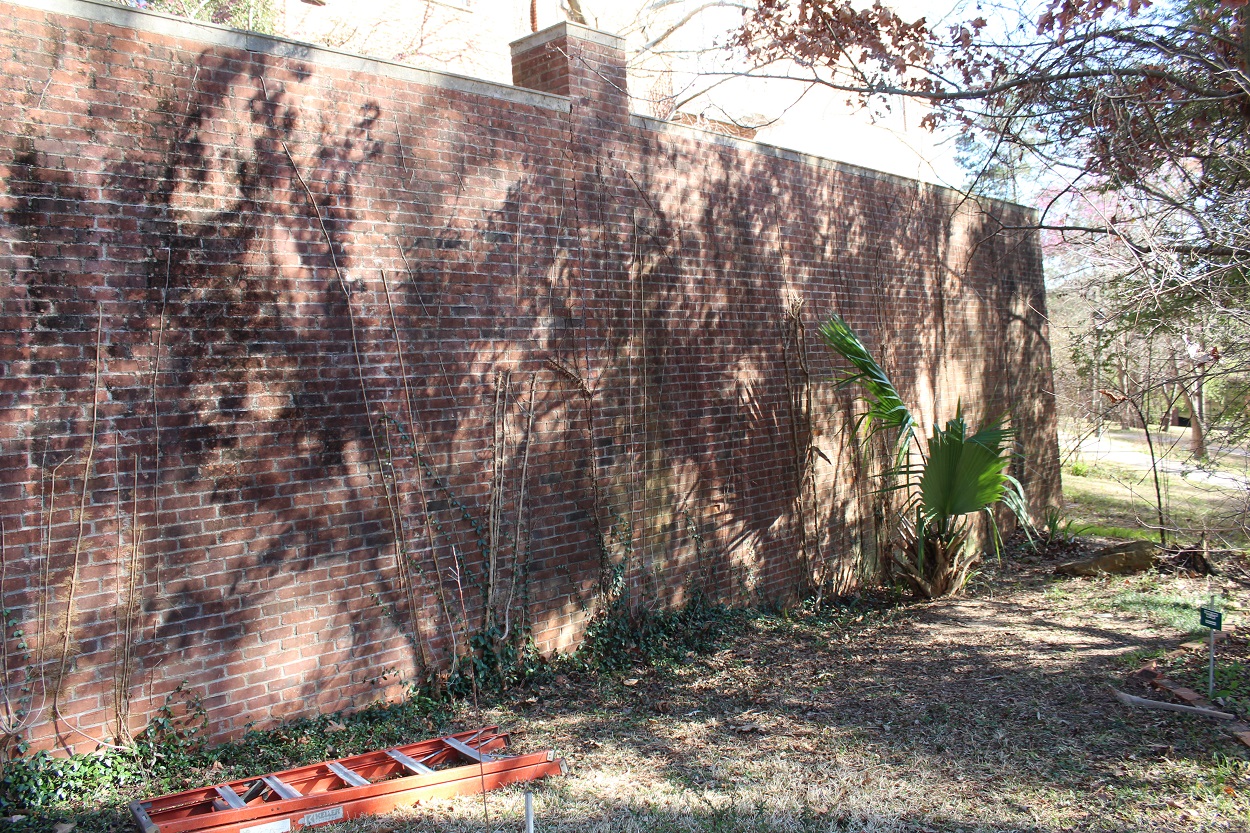
Retaining Wall Cleanup: Trumpet Creeper (Campsis radicans)


Here we can see a mix of vines which are properly attached to the wall, and some that have been detached and thrown over by the grounds crew. We'll finish the job by preserving as much as we can of the healthy vines while disposing of the clutter.


This aerial tangle is composed of dead vines, live vines, tree branches, and dead palmetto stalks.

Now it's all cleaned up!


Now the wall's cleaned up and will hopefully support some trumpet creeper flowers later in the year.

 
You've probably not recently seen a pile of vines this large.

Wednesday, February 22, 2023

Tree of the Week: Red Buckeye (Aesculus pavia)


The red buckeye (Aesculus pavia) thrives in the soil of the arboretrum. The original plantings are approximately 35-years-old and they produce an abundance of fruit that has successfully germinated, both as volunteers and intentional plantings. Below, we have pictures of a volunteer seedling and a three-year-old.


Do you see the bright red star shapes? Those are the first leaves of a red buckeye seedling. They stand out against the non-native green ground cover.


Here we see a volunteer red buckeye seedling that germinated near the original arboretum plantings. This past fall, the old copse again produced a bucket of buckeyes, and several volunteers have popped up in the grass and in the leaf litter.


This seedling germinated in a good location, far enough away from the original grouping, allowing for ample room to grow. It has been selected to officially join the arboretum collection


Interestingly, we can still see the seed! January was a very rainy month, and all of that precipitation  made it possible for this seed to germinate on top of the soil and produce a vigorous seedling.


The ground cover was trimmed back so that we could get a good look at the seed, which is firmly attached to the soil by the new roots. It will be quite interesting to see how long it takes for the seed to disintegrate and disappear. For our previous germination project, all seeds were covered in more than a couple of inches of soil, so we couldn't follow the progress of the seed itself, but in the case of this volunteer, the seed remains before us.

Our three-year-old red buckeyes, which were intentionally planted in a germination project, are leafing out right now. They are still small, and most of them are multi-stemmed. In this photo, we see two individuals, both multi-stemmed. Sadly, this season, one of the two ought to be removed so that the other will have plenty of room to grow.

Happily, our three-year-old red buckeyes are already trying to produce flowers. It's looking like an early spring. Hopefully it will also be a long spring.


Friday, February 17, 2023

Tree of the Week: Honey Locust (Gleditsia triacanthos)

This past spring, prompted by its display of tiny, fragrant flowers, we discussed the history of the arboretum's honey locust (Gleditsia triacanthos). In 2013, we collected seeds but incorrectly identified the source as a black locust. These were germinated in the campus greenhouse and one specimen was planted in the arboretum in April of 2015. It has now been a decade since the seeds were collected, and this year, we have our first fruits. 

During this past summer, we observed pods growing on the tree. They were high up, on the upper branches, far out of reach. This week, two fruits were incidentally discovered on the ground. One pod was found under a nearby groundsel bush, and then we picked up another pod directly under the honey locust, next to its trunk. What luck! These two fruits are shown in the photos below.

Honey locusts produce long, leguminous fruits. The two pods in the above photograph are ripe. They each measure between six inches to one foot in length. They are black, twisted, bumpy, hard and the seeds could be heard rattling inside their individual cells. It is said that honey locust pods have a sweet pulp, but nothing on the interior of these ripe fruits suggested sweetness; perhaps, in order to experience the honey of the honey locust, the fruits need to be collected before desiccation.


From two pods, 19 seeds were collected. The seeds are brown, with an oval shape, and measure more than ¼ inch in length.


So, within a decade, the honey locust has developed from a seed into a very tall tree that is now producing fruit. That's rapid development!

Wednesday, February 8, 2023

Tree of the Week: Red Bay (Persea borbonia)


Our tree of the week is one of our evergreen species, a red bay (Persea borbonia), more than 20 years old, perhaps nearing 30. We previously discussed this tree during October of 2017, highlighting its fruit production. You can read that post here. Below, we have pictures of the red bay in the winter landscape.

 
This specimen grows in the western floodplain, next to the long, wooden foot bridge that runs between the Student Union Building and the Fitness Center. Its neighbors include: Titi (Cyrilla racemiflora), Louisiana iris hybrids (Iris sp.), salt matrimony-vine (Lycium carolinianum), and ironwood (Carpinus caroliniana).
 
The red bay is pictured center. Its trunk casts a long shadow on the ground.


Red bays are especially nice this time of year because of the pretty green foliage. The leaves are also good for cooking; use them as you would a culinary bay leaf. Try them in gumbo, marinara sauce, or stews like borscht.

Unfortunately, the leaves on this particular red bay are unsuitable for any culinary uses. The leaves are speckled with yellow spots and the margins curl, suggesting that the tree suffers from a disease.

The most important disease afflicting red bays is Laurel Wilt, resulting from a fungus, Raffaelea lauricola. An invasive beetle, the ambrosia beetle, infects the tree with the fungus, which is studied due to its deleterious effects on avocado plantations in Florida. As red bay is prevalent across the Southeast, it is used to study the spread of Laurel Wilt. We're not sure this is a case of Laurel Wilt, but since the disease has been recorded in Northern and Central Louisiana, it would be a likely candidate. The prognosis is not good; some individual trees are resistant but most will eventually die if infected. We will have to track the leaves on this tree in the coming year to make a further determination.

According to this resource, the disease has not yet been found in Caddo Parish. You can read more about Laurel Wilt and its spread as an invasive species here.


Even though this red bay is not in the best health, it produces an abundance of fruit! Here, during the month of February, a few fruits are attached to the tree.


Pulling back the leaf litter, we see numerous red bay seedlings. Within a square foot, we have approximately 25 seedlings. Some animal is not doing its job. This fruit ought to be carried off and deposited elsewhere. Unlike its relation the avocado, we suspect no prehistoric sloth is at fault. On a serious note, if the arboretum's mature red bays are infected with Laurel Wilt, it may be necessary to collect some of these seedlings for replacements. The cut trunk of a red bay we lost in 2018 showed no signs of infection at that time. The disease is spread by beetle predation, so at this time these small trees will not be infected.


One intact drupe (the fleshy outer covering is visible) was conveniently found among the seedlings.


The seedlings are so plentiful, both under the tree and in the surrounding floodplain, that plucking a few for inspection is no problem. These seedlings are typically easy to pull up, and the wet soil made it even easier, allowing us to have a good look at its root structure.


We can see the fruit structure (the "stone" or "pit" inside the drupe) from which the stem and roots have grown.


Red bays are fantastic trees for the Louisiana landscape, and hopefully we will not find this population crippled by Laurel Wilt as has happened along the Atlantic coast. As seen from the photos, we happily have an abundance of seedlings in the arboretum. If you are interested in collecting any seedlings, please contact the arboretum curator.


Further resources on Laurel Wilt:

  1. https://www.nashvilletreeconservationcorps.org/treenews/sassafras-trees-face-deadly-foe
  2. https://www.fdacs.gov/Agriculture-Industry/Pests-and-Diseases/Plant-Pests-and-Diseases/Laurel-Wilt-Disease
  3. https://www.fdacs.gov/content/download/4639/file/laurel_wilt.pdf


Tuesday, March 1, 2022

Routine Maintenance

Gardeners, landscapers, and horticulturists know that managing plants is a never-ending project. Even if you're not intentionally adding new plants, you get volunteers that you end up keeping and taking care of. The inverse of that proposition is the removal of dead plants that you never wanted and didn't ask for.

Last year, several medium-sized shrubs on the northern edge of the arboretum (near Hamilton Hall's west-facing steps) died back to the ground. These were ornamental shrubs and doubtlessly foreign to the Southeastern United States. We know that they were victims of the unusually cold winter weather we experienced in February 2021. Other than that, we don't know what they were, when they were planted, or how old they were. Recently these eyesores started sprouting back from the base, indicating that although they were not dead, their trunks were no longer viable.


This was a clump of two shrubs growing closely together.

All gone!

This shrub had fairly vigorous regrowth.

Unfortunately that was not enough to save it.

This shrub was particularly obnoxious, as it was visible to anyone walking up or down the steps.

It won't trouble us anymore.

The larger trunk pieces were cut up and carried away.

Twigs and branches were piled up to be removed later.

The area is perhaps a bit bare, but the openness is inviting. We will spend this summer brainstorming on what to plant in this location. Due to the heavy shade cast by neighboring trees, the possibilities are limited to shade-tolerant species. We might choose to keep this space open rather than replanting.