Showing posts with label December. Show all posts

Tuesday, December 16, 2025

Black Oak (Quercus velutina) Removal

It's time to retire another specimen from the arboretum, again due to disease and being crowded out by the more successful. A 30-year-old black oak (Quercus velutina) was cut down this past weekend, making more room for its partner tree, a southern red oak (Quercus falcata). On the blog, we saw them first in a post from 2012, as photographed by Bonnie Bernard. Then in 2019, showing both trees healthy.


In our last photos before removal, we see the much thinner, leaning black oak trunk and the large, straight southern red oak trunk. Each tree has a sign near the base of the trunk, hopefully helping visitors understand that they are in fact looking at two separate trees―not a tree with two trunks. These two have served as a marvelous example of what competition can look like among trees.

The black oak was intentionally planted with care in 1996. Some time later, the southern red oak volunteered in the same spot and was allowed to grow. Over the years, the red oak has squeezed (strangled?) the black oak out of this location. Earlier this year the black oak finally gave up the fight―it dropped its foliage and the trunk quickly showed signs of deterioration.


On the trunk, just before its removal, we see obvious signs of decay, including bugs scurrying across the pitted, fungal bark. It could remain standing for years before falling in an ice storm or windy weather event. The major reason for removal is unsightliness, followed closely by health risks to the partner-tree. The southern red oak has grown into a very handsome tree.

With the black oak trunk on the ground, we see one long straight trunk with very few branches.

A small brush pile was made from the sparse branches. We broke up the trunk and removed it. Despite some rotting, especially around the bark, most of the trunk wood was solid and hard.

The fall landscape is altered with the removal of the black oak. Note: it's mid-December, and some of our maples are still changing colors; the chalk maples (Acer leucoderme) on the slope are turning yellow-orange and a red maple (Acer rubrum) in the background is a bright red-orange, even on such a cloudy day.


Ideally we want to remove this stump. It's like a dead tooth which provides a disease reservoir for the gums in which it sits. But this stump cannot be easily removed from the healthy trunk of the neighbor which has eclipsed and ultimately killed it.


We will leave the sign in place for a little while, to remind us of the spirited competition and also to remind us to check on the decaying process. Will the southern red oak trunk grow to completely encapsulate the decaying trunk, leaving no sign of the black oak's existence?


Monday, December 8, 2025

Pignut Hickory (Carya glabra)

Due to the extraordinary concentration of species diversity in the arboretum's relatively small space, we have a variety of fall foliage. Some of the trees have already changed color and dropped leaves, while others, most notably the maples and viburnums, are still in the process of showing us their fall colors. The evergreen palms and palmettoes will, of course, be best enjoyed next season, when the wintry landscape is bare and dreary.

But for now, the last two weeks of autumn, we must mention a tree that has gone too long without recognition. There is a handsome tree that produces a brilliant yellow display of leaves every autumn, but then for the rest of the year fades into the background; it requires zero maintenance and does not produce showy flowers or tasty fruits. It has no record in the arboretum catalogue, which means that this individual was not planted by either the current curator or the founder. Perhaps it is a volunteer. It may also have been intentionally planted prior to the founding of the arboretum. Examining its late-autumn guise, we can conclude that this tree is a pignut hickory (Carya glabra), and the below photos highlight its features. 


We first note a straight growth pattern. The trunk does not lean. The specimen is growing in rare full sun, next to a derelict lightpole. Classified as shade tolerant, this species would still prefer to get full sun. Its branches are horizontal or ascending, not drooping. We needed a ladder to collect leaves for identification.
Bark on the lower trunk is grey and textured. 


Detail; do you see a weaving or diamond pattern?

Long petioles alternate along the twig.


We see compound leaves, with 7 leaflets, measuring nearly a foot in length. Leaves are turning yellow. This species is recognized for its gorgeous fall foliage.

Leaflets vary in size, with the smallest leaflets at the base.

The terminal leaflet on this leaf measures nearly 5½ inches.

Leaflets have serrated margins. 


Underneath, we do not see the pretty yellow autumnal coloration. Leaflets and stem are pale and a little fuzzy.

Preliminary analysis points to Carya glabra, the pignut hickory. Let's officially start our list of 2026 goals: examine and make a digital record of spring leaves and flowers of this specimen, to strengthen our claim that this individual is a pignut hickory. Finding nuts belonging to this tree would help date it, as it takes more than 25 years of growth to reach maturity. Testing these nuts for edibility would also help, as they are particularly fatty and tasty, even among hickories. Although in the past this individual has produdced little to no fruit, 2026 is a new year with new surprises!


For more information about this species, please consult the following resources:

University of Florida 

Virginia Tech Dendrology 

Louisiana Plant Identification and Interactive Virtual Tours (LSUAgCenter) 

Thursday, December 19, 2024

Virginia Willow (Itea virginica)


There are several patches of Virginia willow (Itea virginica) in the arboretum collection. All are descended from two plants donated by Karen Boston's mother from the Beaumont area. The fall coloration is stunning; we really ought to spend more time cultivating this plant and hopefully increase the presence of this plant in the arboretum landscape.
 
These drooping leaves have a rich color palette.

The central rib remains a vivid green while the rest of the leaf turns varying shades of red.


Tulip Poplar (Liriodendron tulipifera)

 An uncommon tree in our area, let's check in with the tulip poplar....

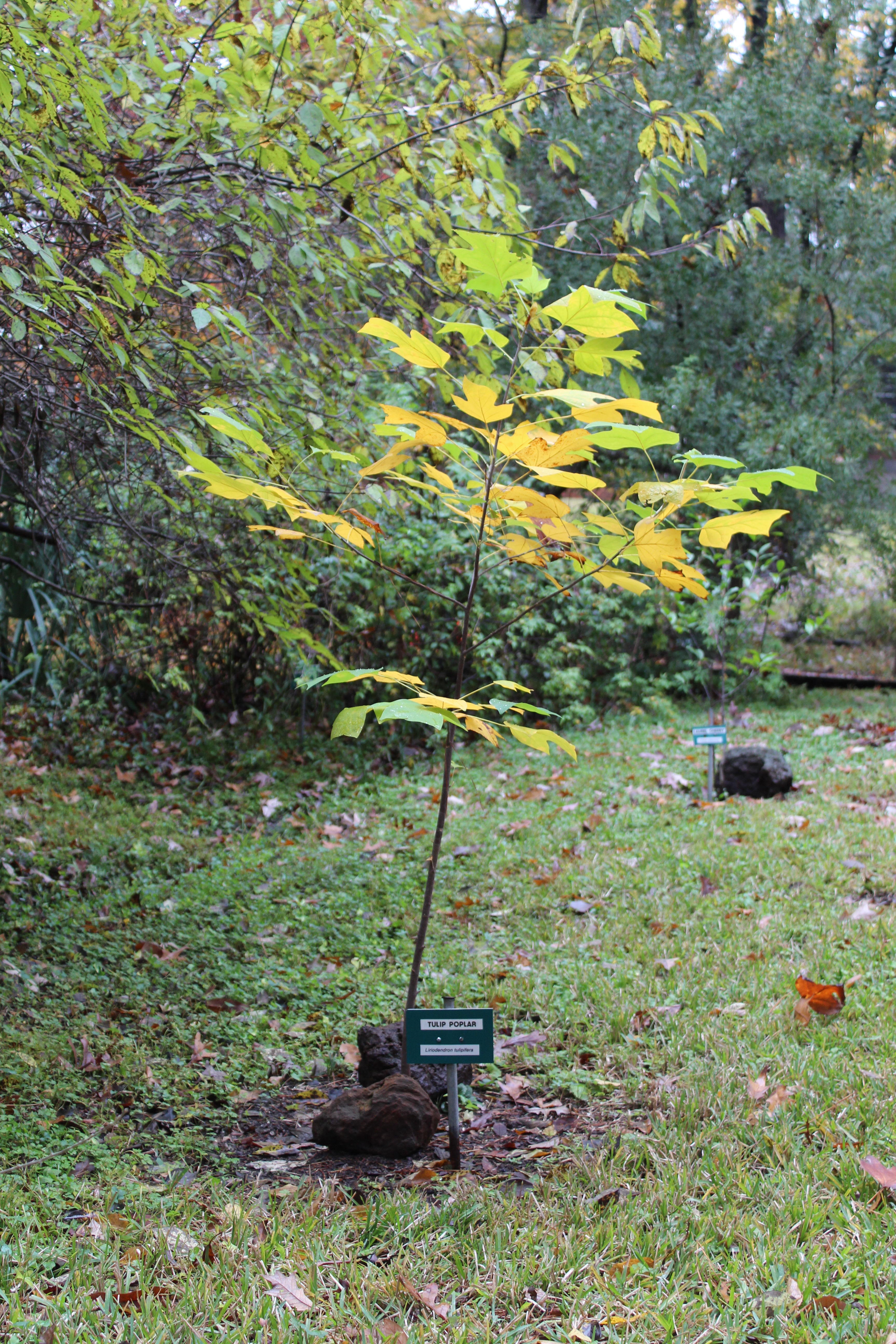
All the tulip poplars in the arboretum came from Jack Price. We are right on the edge of the natural growth zone for this species; it grows better further north and along the east coast.
 

In this photo, we see our youngest tulip poplar, a volunteer that germinated downhill from the trees donated by Price. This young tree needs to be staked―it is competing for sunlight, slightly leaning to the north, away from the nearby swamp dogwood (Cornus foemina).

What a bizarre shovel-shaped leaf.

Quite starkly yellow-and green, these have a certain charm.

It almost looks like someone took a bite out of these.

Or have a pair of scissors been at work?


Winged Elm (Ulmus alata)


This past week, the winged elm (Ulmus alata) at the southwest corner of Mickle Hall had bright yellow leaves.


The winged elm is pictured on the left side of the frame, converging in the middle with leaves from the red maples (Acer rubrum), which are mostly yellow this year, too.

These leaves will no doubt be falling soon, so enjoy them while they last.

Flowering Dogwood (Cornus florida)


Native residents of the southeastern woodlands may have heard the legend that the crucifixion of Jesus was accomplished using the lumber of a dogwood tree. This is perhaps worthy to note given the imminent Christmas season.

In mid-December, some leaves remain on the tree. In this photo, we see a dark red leaf drooping below a prominent flower bud. The flower buds remind us that spring-time is only a few months away.

More leaves can be found on the ground. The dogwood leaves are mixed together with leaves of the water oak (Quercus nigra).

Examined closely, we see the dogwood leaf has a rich red hue, speckled with a bit of black.


Red Maple (Acer rubrum)


The two older red maples located at the southwest corner of Mickle Hall turned yellow this year. The photos below were taken on December 15, 2024. Older blogposts tell us that color varies from year to year: we have stunning photos from November 2017, that show gorgeous orange hues. Compare the photos below with the older ones found here.


The four-way intersection is dominated by evergreens—yaupon holly and Louisiana palmettos. Plenty of insects and other critters must shelter here during the bare season of winter. Are they hibernating or enjoying the maples' display?

This concrete path, decorated with fallen leaves while the trees are not yet bare, lends a romantic feeling to the environment.

Freshly fallen leaves stand out in the litter like a yellow-brick road.


Red Maple (Acer rubrum)


All photos below are from a single red maple, growing in the west floodplain with a thick trumpet creeper vine stuck to its trunk. You can get a good look at the form of this tree on a previous post from February 2019, found here. In the above photo, we see squirrel teeth marks on our red maple sign. Several arboretum signs have the same markings, as well as our irrigation lids. Someone needs to do a microplastic awareness campaign for our squirrel population.
 

Maples are famous for their foliage. This photo succinctly shows why: each leaf contains a showy display from green to yellow to orange to red.

If you want a natural source of variation in color, these leaves would provide a great model.


Monday, December 16, 2024

Ashe's Viburnum (Viburnum ashei)

In December 1993, Professor Ed Leuck planted an Ashe's viburnum (Viburnum ashei) near Mickle Hall. Today, that shrub is very large. More evidence that it's been doing well: over the past few years, volunteers have been noticed elsewhere in the arboretum.

When it has its leaves, the large shrub conceals most of the arboretum shed. Soon the leaves will drop completely and the arboretum shed will be fully revealed until early spring. Interestingly, this shrub has grown very well in this spot, perhaps enjoying the extra moisture from the roof and concrete foundation of the shed. Due to the shed's presence, the shrub has had to endure regular pruning, and it has also suffered major storm damage.


The Ashe's viburnum seen from a slightly different angle

Ashe's viburnum has gorgeous fall foliage; leaves like this make you feel sorry for colorblind people.

Fruits remain on the shrub. Collect some for a germination project!

Not many leaves turn pink. What a treasure.

These purplish-black drupes contrast starkly against the foliage.

Enjoy these while they last!