Showing posts with label autumn. Show all posts

Tuesday, December 16, 2025

Black Oak (Quercus velutina) Removal

It's time to retire another specimen from the arboretum, again due to disease and being crowded out by the more successful. A 30-year-old black oak (Quercus velutina) was cut down this past weekend, making more room for its partner tree, a southern red oak (Quercus falcata). On the blog, we saw them first in a post from 2012, as photographed by Bonnie Bernard. Then in 2019, showing both trees healthy.


In our last photos before removal, we see the much thinner, leaning black oak trunk and the large, straight southern red oak trunk. Each tree has a sign near the base of the trunk, hopefully helping visitors understand that they are in fact looking at two separate trees―not a tree with two trunks. These two have served as a marvelous example of what competition can look like among trees.

The black oak was intentionally planted with care in 1996. Some time later, the southern red oak volunteered in the same spot and was allowed to grow. Over the years, the red oak has squeezed (strangled?) the black oak out of this location. Earlier this year the black oak finally gave up the fight―it dropped its foliage and the trunk quickly showed signs of deterioration.


On the trunk, just before its removal, we see obvious signs of decay, including bugs scurrying across the pitted, fungal bark. It could remain standing for years before falling in an ice storm or windy weather event. The major reason for removal is unsightliness, followed closely by health risks to the partner-tree. The southern red oak has grown into a very handsome tree.

With the black oak trunk on the ground, we see one long straight trunk with very few branches.

A small brush pile was made from the sparse branches. We broke up the trunk and removed it. Despite some rotting, especially around the bark, most of the trunk wood was solid and hard.

The fall landscape is altered with the removal of the black oak. Note: it's mid-December, and some of our maples are still changing colors; the chalk maples (Acer leucoderme) on the slope are turning yellow-orange and a red maple (Acer rubrum) in the background is a bright red-orange, even on such a cloudy day.


Ideally we want to remove this stump. It's like a dead tooth which provides a disease reservoir for the gums in which it sits. But this stump cannot be easily removed from the healthy trunk of the neighbor which has eclipsed and ultimately killed it.


We will leave the sign in place for a little while, to remind us of the spirited competition and also to remind us to check on the decaying process. Will the southern red oak trunk grow to completely encapsulate the decaying trunk, leaving no sign of the black oak's existence?


Wednesday, November 19, 2025

Bayberry (Myrica heterophylla) and Southern Wax Myrtle (Myrica cerifera)

The genus Myrica has a worldwide distribution that covers Eurasia and the Americas. Its ripened berries develop a protective coating of real wax that, in sufficient quantities, can be extracted and used to make candles and other items. Because true wax has historically been a prized commodity, it was previously worthwhile to collect and boil gallons of Myrica berries to skim off their modest wax coat. Now that petrochemicals have replaced the functions of innumerable plant and animal products, the cultural and economic value of this genus has been mostly forgotten. 

In the arboretum, we have two species of Myrica on display: bayberry (Myrica heterophylla) and southern wax myrtle (Myrica cerifera). 

This is our small patch of bayberry (M. heterophylla). It was purchased from Woodlanders Nursery (Aiken, South Carolina), and planted in February 1998. Currently, there aren't any fruits available for inspection. Our bayberry persists, but does not thrive.

On the other hand, southern wax myrtle (M. cerifera) grows happily in the arboretum. In 1985, eight pots of southern wax myrtle were purchased from Clyde Gorum's Nursery (Shreveport), and planted in the newly founded arboretum. Over the past three decades, these plants have launched numerous invasions of the wetland area, attempting total colonization. Today, three of the original plantings remain, the rest having been steadily cut back to make space for other species. The suitabillity of this species to our local environment thus appears to be significantly greater than its M. heterophylla cousin.

The genus name draws on a Greek word, Myrike, with a complicated history. It's associated with the Greek Tamarisk shrub Tamarix smyrnensis. That plant is fragrant and waxy, and is known in Greece as Almyrike. The southern wax myrtle's species name, cerifera, means "waxy." So you might think of this plant as "double-waxy" or even "Waxy waxy."

In this photo, we see one of the original 1985 plantings. This wax myrtle shrub is located on the north side of the arboretum, at the top of the arboretum drainage, where run-off water is funneled from up the hill at the bandshell, dormitories and cafeteria. This shrub has changed shape over the years, and intermittently suffered some damage. Several of our native vines must be periodically snipped from its branches, and the wax myrtle's branches must be pruned back from the railing, as it stretches toward the open sidewalk, vying for more sunlight. Overall, the shrub is well-suited to this spot and has required very little maintenance. 


Having this shrub next to the elevated sidewalk allows for easy inspection of the twigs. And look, we see fruits! Rustling the branches also provides a pleasing olfactory experience. Think "bay."

Sometime around 2010, a southern wax myrtle volunteered in the western drainage channel next to a wooden footbridge, which has recently been rebuilt. 

The footbridge was rebuilt just last month, in October. It looks great!

Two arboretum guests hang from the southern wax myrtle shrub. 

Getting up close and personal with the shrub allows us the opportunity to spy the tiny fruits, which will otherwise go unnoticed. In silhouette we see the shapes of the leaves (lanceolate) and the berries which sit along branchlets.


These berries are pale, grey-white, and wrinkled. That's normal.

Each of these berries has a tiny wax coating, like an apple from modern grocery stores, except it's natural wax, not a petrochemical. If you find a gigantic stand of this bush at the correct time of year, you might be able to collect enough berries to make some candles.

External Links

University of Florida IFAS blogpost on Wax Myrtle

National Park Service page on Wax Myrtle

Mississippi Wildlife & Fisheries Department data sheet on Wax Myrtle

Extremely helpful page on the practical extraction and use of northern Myrica species' wax 

Our southern wax myrtle (Myrica cerifera) has something of a confused taxonomic history, as it is related to M. caroliniensis (you can read about that in a paper by Robert Wilbur). 

Wednesday, November 5, 2025

Gulf Fritillary (Agraulis vanillae)

Now that it's the beginning of November, you can find quite a few Gulf fritillary caterpillars on the Maypop (Passiflora incarnata). Coincidentally or not, a couple of years ago in 2023, we photographed these critters on November 5th! How's that for consistency? This year, chilly, autumnal weather seems to be on the verge of freezing the Maypop vine, so hopefully the little caterpillars enjoy the green foliage while they can. 

You can find the Gulf fritillary caterpillars on the prosperous Maypop vine, growing around the trunk of the deceased red cedar, near the Fitness Center. If you want to study the caterpillars, you will need to turn over some leaves―this one sits on top just for the photoshoot.

The other caterpillars were hidden under the leaves.

 
A couple of caterpillars were briefly relocated for a closer examination.

Examining the whole vine reveals the different sizes of caterpillars. As they grow, they molt, shedding their skin and becoming larger. These developmental periods between moltings are called instars (that's Latin for image, likeness, or kind).

 
The large caterpillar is more than an inch in length, while the tiny caterpillar is more than ¼ of an inch. That little fella is likely a newborn!


How long does it take the Gulf fritillary caterpillars to mature? The answer is about a month, with two or three weeks growing in the caterpillar stage and another week or two developing in the chrysalis.


Helpful Links

LSU AG Center 12-2022 Publication with info on Gulf Fritillaries 

Short Article from Loyola University in New Orleans on the Gulf Fritillary 

Wednesday, September 24, 2025

Maypop (Passiflora incarnata)


A delightful seasonal treasure thrives at the base of an eastern red cedar trunk. See our previous post on this plant here.

These flowers, some wilting and some blooming, are awesome to behold. Note the sneaky anole, pictured center. That's a reptilian "photobomb."

What amazing colors and shapes are present here, part of a totally wild and unselected plant. And, looking closer, you can see a developing fruit.


And the 'great reward,' a green fruit shaped somewhat like a hen's egg, is hidden among the leaves.


The flesh of these fruits tastes tropical, sweet, and very light.


Visit the maypop before it gets gobbled up by the Gulf Fritillaries! We haven't seen any fritillaries in the arboretum yet, but they were spotted elsewhere in the Parish, presumably laying their eggs. We expect the spiky black-and-orange catepillars to eat these leaves.


Thursday, December 19, 2024

Virginia Willow (Itea virginica)


There are several patches of Virginia willow (Itea virginica) in the arboretum collection. All are descended from two plants donated by Karen Boston's mother from the Beaumont area. The fall coloration is stunning; we really ought to spend more time cultivating this plant and hopefully increase the presence of this plant in the arboretum landscape.
 
These drooping leaves have a rich color palette.

The central rib remains a vivid green while the rest of the leaf turns varying shades of red.


Tulip Poplar (Liriodendron tulipifera)

 An uncommon tree in our area, let's check in with the tulip poplar....

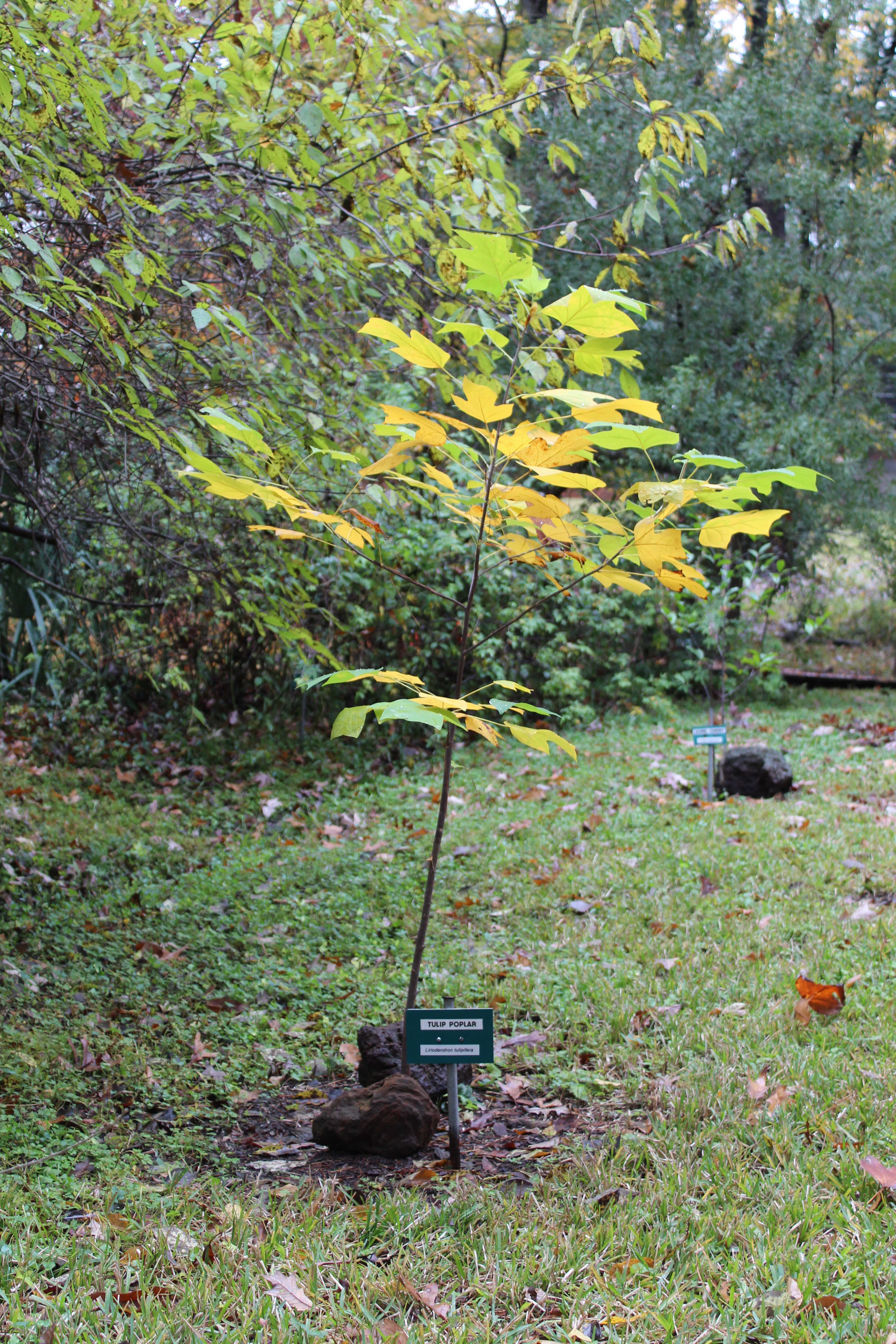
All the tulip poplars in the arboretum came from Jack Price. We are right on the edge of the natural growth zone for this species; it grows better further north and along the east coast.
 

In this photo, we see our youngest tulip poplar, a volunteer that germinated downhill from the trees donated by Price. This young tree needs to be staked―it is competing for sunlight, slightly leaning to the north, away from the nearby swamp dogwood (Cornus foemina).

What a bizarre shovel-shaped leaf.

Quite starkly yellow-and green, these have a certain charm.

It almost looks like someone took a bite out of these.

Or have a pair of scissors been at work?


Winged Elm (Ulmus alata)


This past week, the winged elm (Ulmus alata) at the southwest corner of Mickle Hall had bright yellow leaves.


The winged elm is pictured on the left side of the frame, converging in the middle with leaves from the red maples (Acer rubrum), which are mostly yellow this year, too.

These leaves will no doubt be falling soon, so enjoy them while they last.

Flowering Dogwood (Cornus florida)


Native residents of the southeastern woodlands may have heard the legend that the crucifixion of Jesus was accomplished using the lumber of a dogwood tree. This is perhaps worthy to note given the imminent Christmas season.

In mid-December, some leaves remain on the tree. In this photo, we see a dark red leaf drooping below a prominent flower bud. The flower buds remind us that spring-time is only a few months away.

More leaves can be found on the ground. The dogwood leaves are mixed together with leaves of the water oak (Quercus nigra).

Examined closely, we see the dogwood leaf has a rich red hue, speckled with a bit of black.


Red Maple (Acer rubrum)


The two older red maples located at the southwest corner of Mickle Hall turned yellow this year. The photos below were taken on December 15, 2024. Older blogposts tell us that color varies from year to year: we have stunning photos from November 2017, that show gorgeous orange hues. Compare the photos below with the older ones found here.


The four-way intersection is dominated by evergreens—yaupon holly and Louisiana palmettos. Plenty of insects and other critters must shelter here during the bare season of winter. Are they hibernating or enjoying the maples' display?

This concrete path, decorated with fallen leaves while the trees are not yet bare, lends a romantic feeling to the environment.

Freshly fallen leaves stand out in the litter like a yellow-brick road.