The Hercules' club (
Aralia spinosa), our tree of the week, is especially noteworthy right now: its large fruit clusters are providing local birds a late summer snack.
We have two groupings of Hercules' club in the arboretum. In 1989, Nick Leuck gathered Hercules' club seeds from Caney Lake, in Grant Parish. Those seeds were planted in the arboretum on the hill that slopes down from Hamilton Hall, where they successfully grew. A decade later, in the fall of 1999, two shoots were removed and replanted at the southwest corner of the lower pond. Today, only one young shoot remains at the original planting location, while approximately 20 shoots can be counted at the second location. Although the pond feature has since been removed, the area remains wet for a considerable part of the year, making it possible for the Hercules' club to thrive. In fact, it has been so successful there that overcrowding has become a problem over the past
several years; removal of new trees has been necessary.
 |
| The photo above was taken at noon on a mostly sunny day. Dappled sun is hitting the grass and sidewalk, but the area under the Hercules' clubs (pictured to the left of the sidewalk) is densely shaded. This is a low area that often stays wet; this species seems to love it and new trees sprout there each year. |
 |
| Of the approximately 20 individual trees, only a few of the tallest trees have fruit clusters, and they are out of arms' reach for humans. |
 |
| This is only a section of a very large, bipinnately compound leaf. |
 |
| This leaf was taken from one of the smaller Hercules' clubs. The leaf is approximately 26 inches in length. Leaves are much, much larger on the taller trees. |
 |
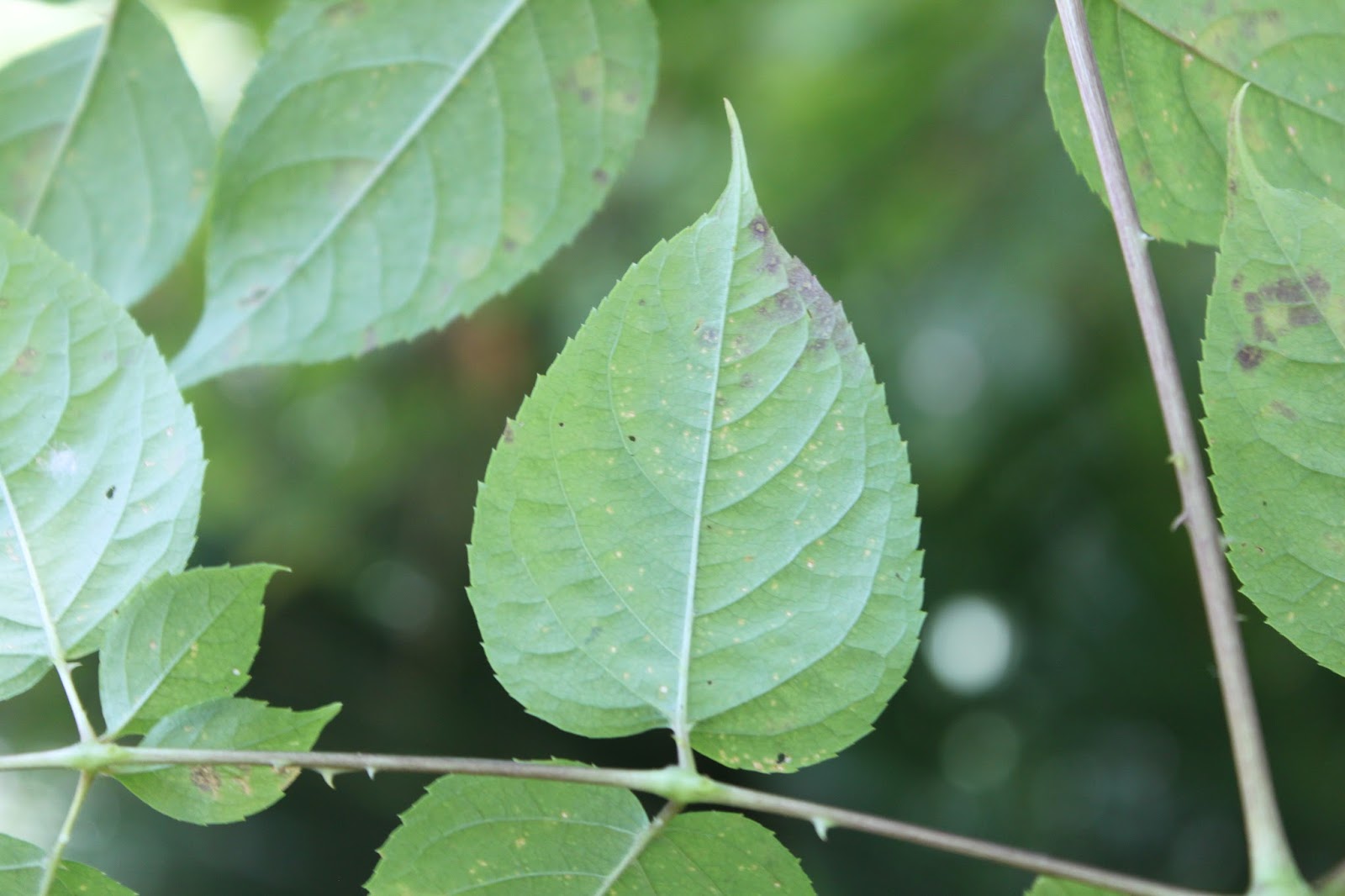
| Leaflets of the Hercules' club have serrated edges, and notice the little spines near the leaflet. |
 |
| A ladder is needed to closely observe the fruit clusters. |
 |
| Fruits of the Hercules' club are small, black drupes. |
 |
| Numerous spines can be seen (and felt) along the trunk of the tree, giving it a threatening appearance, hence the origin of the common name 'Hercules' club'. Should a hydra appear in the arboretum, we would be well equipped to subdue it. |
 |
| Detail of spines |
 |
| This is bark from one of the largest Hercules' clubs. The spines are less noticeable, but still painful. |
You can see additional pictures of the arboretum's Hercules' club
here.
Check out the following links for more information about this species:
United States Department of Agriculture
Louisiana Plant Identification and Interactive Virtual Tours (LSU AgCenter)
University of Florida
NC State University