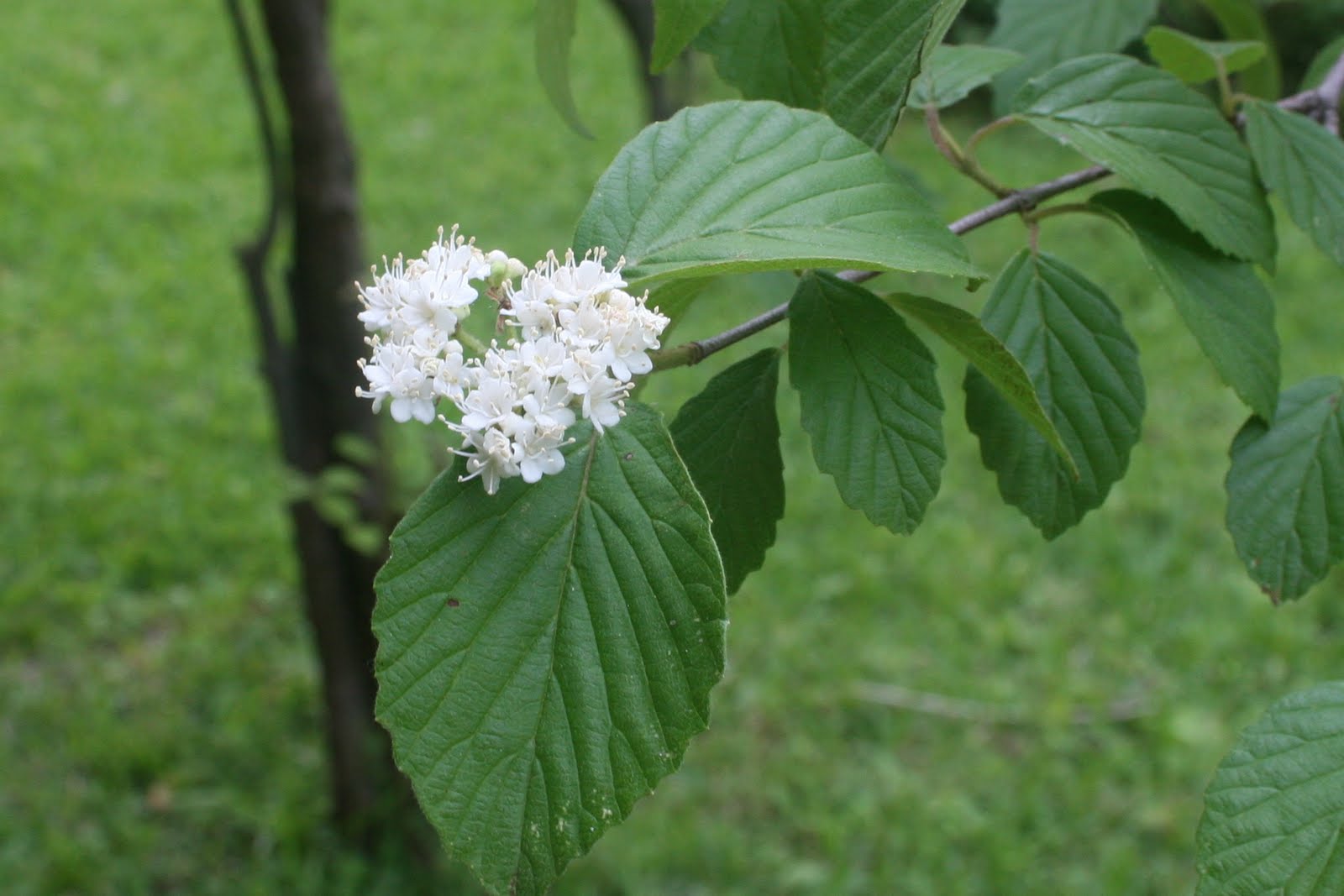
Our tree of the week is a rusty blackhaw (Viburnum rufidulum).
Its clusters of fragrant, white flowers have drawn our attention. You
can find this specimen in bloom in the arboretum, and this species is
also readily found in the many wild places of northwest Louisiana.
 |
| In 1996, Jack Price donated a large rusty blackhaw to the arboretum collection. Professor Ed Leuck planted it soon thereafter. Today we are looking at a plant that is nearly a quarter of a century old. |
 |
| For most of its tenure in the arboretum, this rusty blackhaw has been considered a large shrub. However, its sprawling growth over the past several years necessitated regular pruning to allow passage along the sidewalk. As a result, our once large shrub has taken on the appearance of a multi-stemmed small tree. |
 |
| The large flower clusters make the rusty blackhaw a standout specimen this week. From a distance you can appreciate the white pompoms covering the tree, and then up close you can delight in the pleasant fragrance. |
 |
| This flower cluster measures approximately 4 inches in diameter. |
 |
| The fresh new leaves are shiny and green above. The maroon leafstalk is 3/4 of an inch, and the leaf itself is nearly 4 inches. Leaf shape varies on the rusty blackhaw. This particular leaf has an elliptic shape; the leaf tip comes to a point. |
 |
| Underneath, leaves are pale green. On some leaves you might find tiny rust-colored specks. |
 |
| There is a fine serration on the wavy edges. |
 |
| Here we have an example of leaf-shape variation. This leaf is 3 inches in length and has a rounded tip. |
 |
| Rusty blackhaw twig with characteristic maroon leafstalks. |
 |
| The maroon color isn't as noticeable from below. |
 |
| But zooming in on the leafstalk, we see the characteristic rust-colored particles. |
 |
| Detail of rust-colored hairs on leafstalk |
 |
| Not all rusty blackhaws are multi-stemmed, but our tree of the week certainly is! |
 |
| New shoots (suckers) can be found around the base of the blackhaw. The mower does most of the work clearing the suckers. |
 |
| The asymmetrical growth of the multiple stems produces interesting outcomes. |
 |
| Rusty blackhaw bark is rough and gray with an orange hue. |
 |
| Other portions of the trunk have a clear block pattern. |
 |
| Younger, smaller portions of the trunk have smooth, gray bark. |
You can see older images of this specimen
here.
For more information about this species consult the following:
United States Department of Agriculture (zoom-in on distribution map)
Texas A&M University (Aggie Horticulture)
University of Florida (IFAS Extension)