The sun is shining in Shreveport this weekend. The remnants of Hurricane Harvey brought heavy cloud coverage in the early part of last week and steady rain on Wednesday. Thursday, things cleared up, and on Friday the sun steamed everything up. If you're outside enjoying the late summer weather, you might also be looking for a spot of shade.
There are many beautiful shady spots on Centenary's campus, and if you're in the arboretum, take time to appreciate the water tupelo (
Nyssa aquatica), shading the long white wooden bridge. It was purchased from Woodlanders nursery (Aiken, S.C.) and added to the arboretum collection in October 1988, making it more than 30-years-old. Currently, it is doing very well, despite competition, and littering the wooden bridge with its fruits.
 |
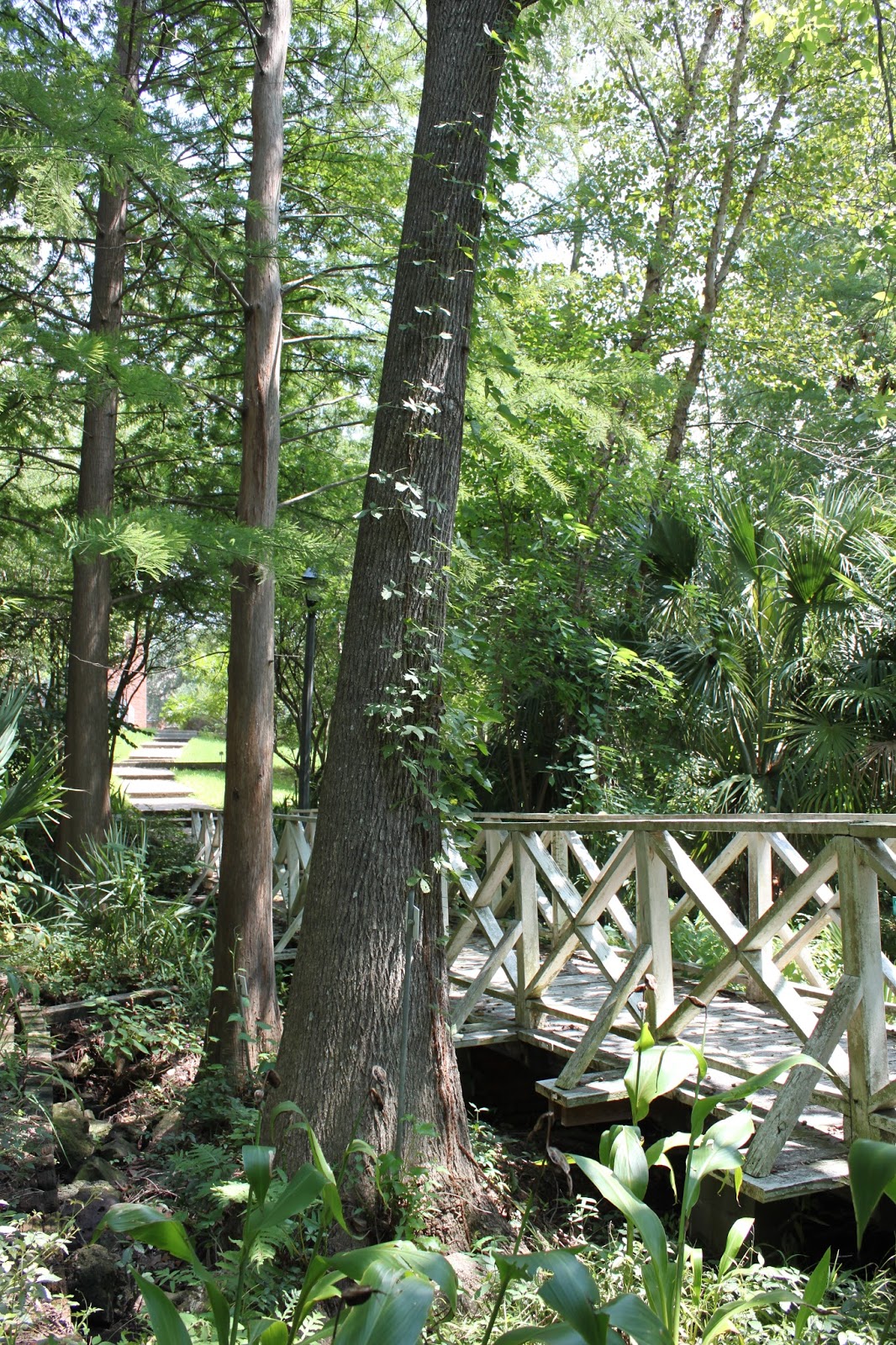
| The long white wooden bridge in the arboretum is mostly shaded, with only some dappled sunlight hitting the planks. In this picture, we are looking east, and our tree of the week is pictured to the left of the bridge, growing on its north side. |
 |
| The water tupelo (the center-most tree in the above photograph) grows in a very wet area. It is in competition with other water-loving trees. Immediately to the left of the water tupelo, we have a pond cypress (Taxodium ascendens). In the background, at the far left, we have a bald cypress (Taxodium distichum). |
 |
| This water tupelo is competing for sunlight. Its primary competitor is the pond cypress (Taxodium ascendens), planted a year after the tupelo. The competition might explain the crook in the tupelo's trunk. |
 |
| There are a lot of fruits on the tree this year. |
 |
| The elliptic leaf has smooth, wavy edges and a pointed tip. |
 |
| The numerous speckled drupes blend in with the worn wooden planks. |
 |
| The off-white background offers a better look at the oblong shape of the fruit. |
 |
| There are significant accumulations of green fruits on the ground under the tree, and some of the fruits appear to have been gnawed on (lets blame the squirrels). There are also a few patches of sensitive fern (Onoclea sensibilis) growing in the shade of this water tupelo. The fern, which was originally collected from the Caroline Dormon Nature Preserve, is pictured in the bottom left hand corner. |
 |
| The bark of this tree, which is more than 30-years-old, is deeply furrowed. The trunk shows some characteristic swelling. |
For more information about this species consult the following:
Arkansas Agriculture Department (Great picture of old water tupelo!)
Louisiana Plant Identification and Interactive Virtual Tours (LSU AgCenter)
USDA Forest Service