Showing posts with label Family: Hippocastaneaceae. Show all posts

Sunday, July 15, 2018

Tree of the Week: Scarlet Buckeye (Aesculus splendens) [& bonus Peppervine {Ampelopsis arborea}]

There is one scarlet buckeye (Aesculus splendens) in the arboretum collection. It is a small ornamental tree, but don't let its diminutive size fool you. It's older than most of our undergraduates. In 1988, this specimen was purchased from Woodlanders Nursery (Aiken, SC), making the tree more than 30 years old. One reasonable explanation for its small size would be environmental competition. Since 1996, another native plant, peppervine (Ampelopsis arborea), has been allowed to grow with the buckeye. This means that the two species are in competition for sunlight, water and nutrients. The vine is terribly aggressive; it must be routinely cut back to give the buckeye room to grow.  
The scarlet buckeye is pictured center. Peppervine is growing with it, using the branches of the buckeye as a trellis. This photo was snapped just as a cloud passed overhead.
The little tree and its peppervine provide shade along the concrete and gravel sidewalks.
The light-colored buckeye trunk is partially obscured by the brown, ropy vines. A large loblolly (Pinus taeda) is pictured directly behind the buckeye.
The specimen was originally described as 'the tree form of our red buckeye', and it does indeed have a well-defined single trunk, as compared with the multi-trunk form of the red buckeyes (Aesculus pavia).
The scarlet buckeye has light gray bark.
Scarlet buckeye branch
Leaves appear in pairs, opposite from one another along the twig.
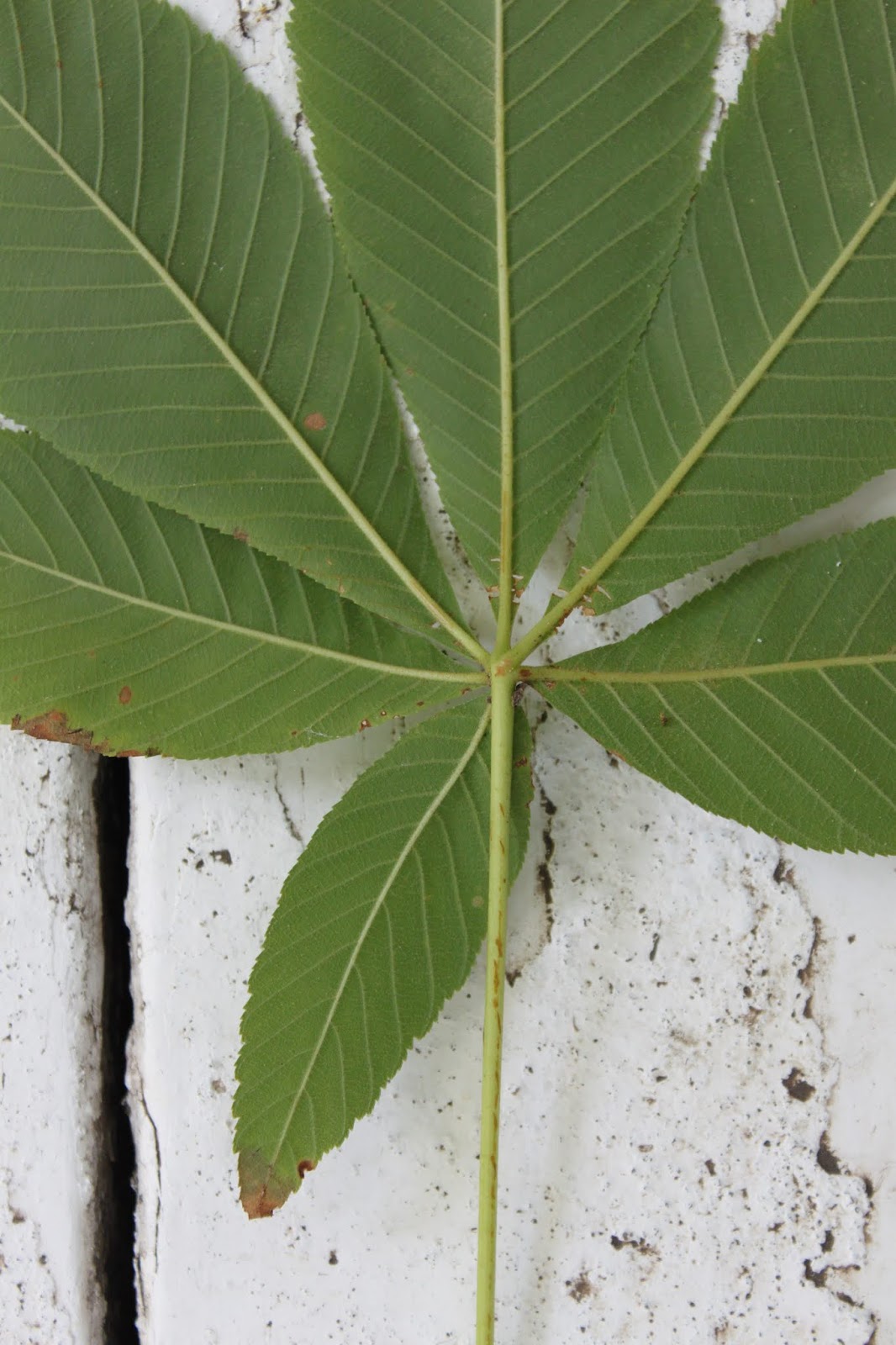
Scarlet buckeyes have large, palmately compound leaves. In this picture we have one large leaf composed of six dark-green leaflets. Leaf and petiole together measure almost a foot in length.
Leaflets vary in size, measuring less than 6 inches.
Leaflets have finely serrated margins.
Underneath, leaflets are a lighter shade of green.
They are also a little fuzzy underneath.
This week we see peppervine fruits hanging from the buckeye branches. The fruits turn from white to red to black.
Like the scarlet buckeye, peppervine has dark-green compound leaves that might remind one of parsley fronds.
Peppervine has twice compound leaves. This particular leaf has approximately 21 leaflets.
Leaf and petiole together measure less than 7 inches.
Peppervine leaflets are dark-green with toothed margins. The small, globular fruits turn black upon ripening; they are perfectly edible but most will find their flavor less than satisfying; The fruit is slightly sweet, a little peppery, and contains several seeds.

You can find more pictures of the arboretum's peppervines here.

A picture of the scarlet buckeye flower can be found here.

Thursday, April 12, 2018

Spring Flowers

The red buckeyes (Aesculus pavia) are flowering. This species does very well in the arboretum. Each year we find new volunteers.


Thursday, March 9, 2017

Tree of the Week: The Red Buckeye (Aesculus pavia)

Today we're excited to introduce a new program for the arboretum, Tree of the Week. Our goal is to showcase trees native to the southeast, noting their special characteristics as the seasons change. Some trees are known particularly for their flowers, and so we begin with the red buckeye.

 Tree of the Week: The Red Buckeye (Aesculus pavia)

Although its rich green foliage can be appreciated during the spring and summer, the best time to view this plant is during late winter and earliest spring, when it is flowering. The following photos were taken during the latter part of an exceptionally mild (warm) winter.

The arboretum's original specimens were grown from seeds collected by Ed Leuck at two locations. The first seeds were collected in 1986, at the Caroline Dormon Nature Preserve in Bienville Parish. In 1991, he collected additional seeds from Albany Avenue in Shreveport, adding the seedlings in with the original specimens. This copse is doing well today, producing many beautiful blooms. Seedlings from this group have popped up all over the arboretum.

Original specimens
4-year-old volunteer

You can see additional photos of the arboretum's red buckeyes here.


For more information about this species consult the following:
United States Department of Agriculture
University of Florida IFAS 
University of Kentucky Department of Horticulture

Tuesday, August 21, 2012

Aesculus pavia

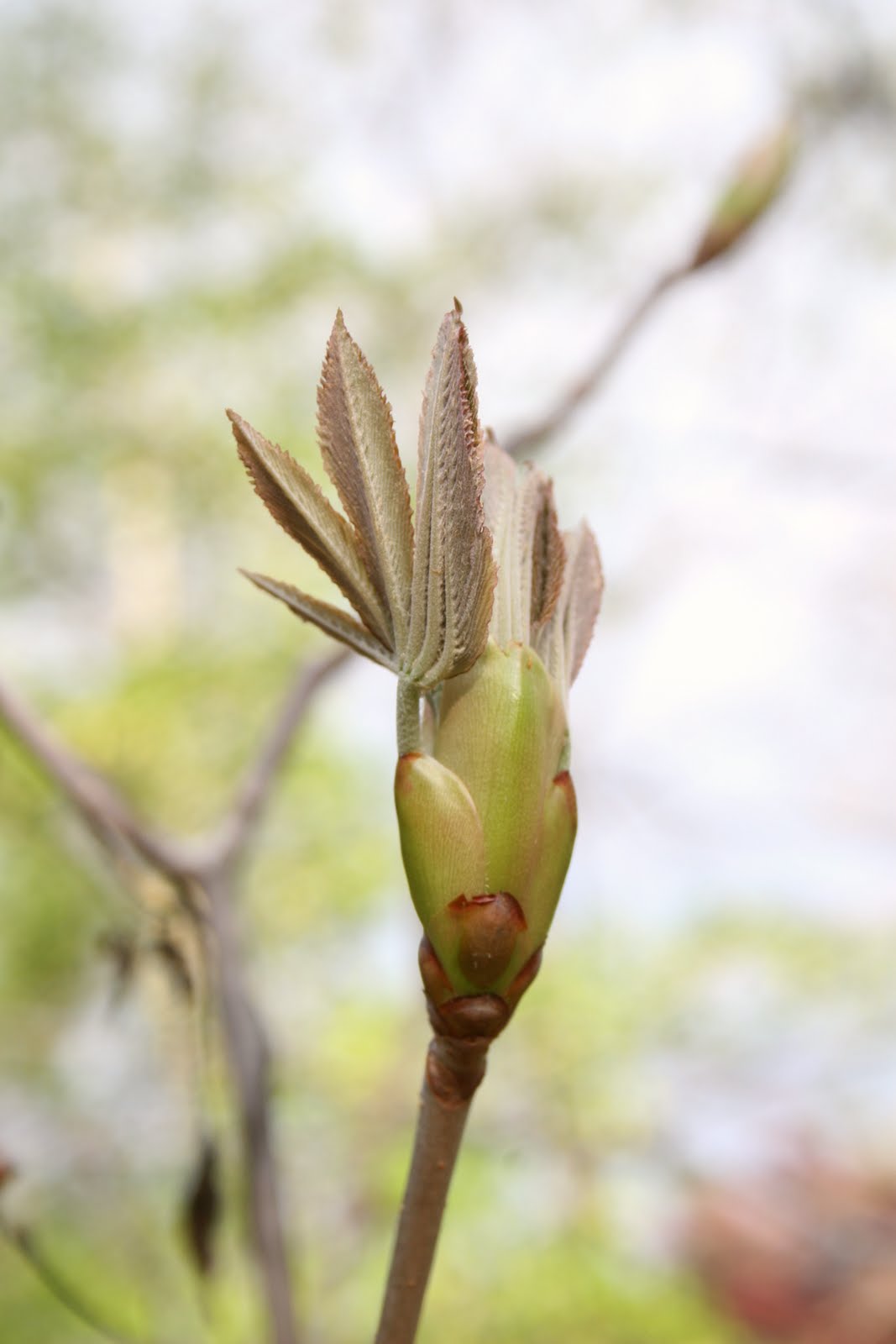
 Newly sprouted foliage.


Aesculus pavia leaves are characteristically palmately-compound.


Bark detail of a mature Aesculus pavia.