Showing posts with label heat wave. Show all posts

Monday, September 25, 2023

Tree of the Week: Sweetbay Magnolia (Magnolia virginiana var. australis)

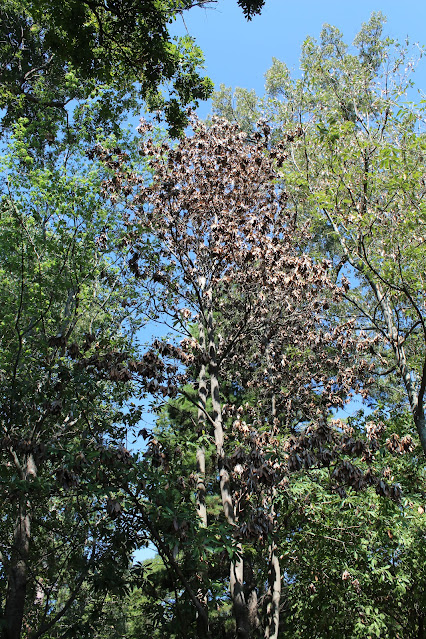
Thankfully the brutally hot weather has passed: high temperatures are now around 90℉. This past week, northwest Louisiana has received scattered rain showers, some of which have been heavy. Interestingly, the vegetation in the arboretum, especially the grass, has recovered quickly. The landscape is mostly green, especially since the mower has chopped up the majority of the fallen leaves. Unfortunately, there are lingering signs of the damage caused by the August heat wave. Below, we have pictures of one such case: an evergreen sweet bay magnolia with an alarming number of brown leaves.

Our tree of the week is an evergreen sweetbay magnolia (Magnolia virginiana var. australis). This tree was purchased and planted in 1997, making it at minimum 26 years old. It has grown happily in the arboretum and lived true to its 'evergreen' designation. You can read more about its history on an older blog post, found here.

At this time, the brown crown of the sweetbay is conspicuous in the mostly green, or yellow-green, landscape.


Approaching the sweetbay, we see brown leaves up above and green leaves at eye level.


Browned, withered twig of Magnolia virginiana var. australis, photographed September 23, 2023


Healthy twig of Magnolia virginiana var. australis, photographed September 23, 2023


Looking at the multi-stemmed base, we see plenty of green leaves. So, we know that this tree is very much alive, although we cannot say what kind of condition it is in. It will be interesting to see what happens to the upper parts of the trunks.

Thursday, August 31, 2023

August Heat Wave: Black Walnut (Juglans nigra)


The arboretum's lone black walnut (Juglans nigra) has visibly suffered from the August heat wave and lack of rain. However, this isn't much of a surprise: our black walnut has a history of drought/heat intolerance. It was originally collected from Marion County, Texas, and planted in the arboretum during the spring of 2000. Eleven years later, during the 2011 drought, it died back to the ground, and then resprouted the following year.

The black walnut grows in full sun, toward the top of the grassy slope north of Cline Hall dormitory. As seen in the above photograph, this individual has lost most of its leaflets, and of the remaining leaflets, we mostly see yellow rather than pretty green coloration. And, looking closely at the thin trunk, we see significant scaring. Overall, this tree is unhappy in its location. It has plenty of sunlight, but not the desired soil mixture. You wouldn't think this specimen was almost 25 years old.

Happily, the twigs look okay. So, we expect this black walnut to leaf-out during the spring of 2024. Although this individual isn't the prettiest tree, we are thankful to have it in the collection as an example of its species.


Tuesday, August 29, 2023

August Heat Wave: Mockernut Hickory (Carya tomentosa)


A mockernut hickory (Carya tomentosa) shows signs of suffering from the summer heat wave.


It grows on the grassy slope near Cline Hall, in full sun, near prominent sidewalk intersections. This is the most open area of the arboretum, with plenty of room for more plantings. The current residents of the slope do not compete for sun light, as there is no short supply. However, at this time of year, the trees and shrubs (and non-native grass) would prefer more water.

The mockernut, with its orangish-brown leaves, is pictured center. Directly behind it, there are two hawthorns that are showing signs of distress as well. By contrast, the largest trees in the picture have green crowns: pictured from left to right we see an aged white oak (Quercus alba), a mature overcup oak (Quercus lyrata), and a very tall loblolly pine (Pinus taeda).

The leaves of the mockernut aren't completely brown at this time. We see some green and some yellow as well.

Brown, crispy leaves of the mockernut hickory, pictured August 26, 2023

And can you see the large fruits hidden among the leaves?


The mockernut has prematurely dropped a bucketful of fruit. In this photo only a small collection of the total fruits, which litter the ground, is displayed. In 2020, ripening fruits were still attached to this individual in the middle of November; you can see the blog post here.

This twig looks healthy enough. Since the irrigation system is currently operating, we will do our best to keep this individual from drying out much more. Although, fingers crossed, hopefully the temperatures will stay below 100℉.


Monday, August 28, 2023

August Heat Wave: Blackjack Oak (Quercus marilandica)

At the beginning of fall term, leaves litter the ground in the arboretum. Some trees look vibrant, while others look suspiciously withered, like the end might be near. More than a month of dry, hot weather has resulted in alarmingly crispy leaves in our native trees. Shouldn't our Louisiana natives be able to withstand an August heatwave? Perhaps, but the trees in the arboretum catalogue have grown up in a human-dependent environment, with a sprinkler system and routine lawn maintenance, so we cannot make generalizations based on the well-fare of the individuals on display in the Centenary arboretum. But, it's sad to see! 


A blackjack oak (Quercus marilandica), located on the grassy slope near Cline Hall, is one such pitiful specimen. As remarked on previous blog posts (here and here), this is a tree with a special history: it resprouted after vandals broke the trunk at its base.


The blackjack oak is pictured center. It's a small tree, growing in full sun. Typically during the summer months this grassy slope is irrigated. Unfortunately for these individuals, the irrigation system has not been working properly during the past several weeks, when the irrigation was needed most.

Leaves of the blackjack oak are turning brown. This it not 'fall coloration'! We are three months too early for that. This tree has been featured on the blog for its remarkable autumnal color—check out the photos here.


During this stressful period, the tree holds fast to its developing acorns!