Showing posts with label herbaceous. Show all posts

Tuesday, May 30, 2023

Giant Coneflower (Rudbeckia maxima)

In the spring of 2021, a small herbaceous bed was established using young plants collected from rural Caddo parish. Four different species were collected: giant coneflower (Rudbeckia maxima), purple cone-flower (Echinacea sp.), bee balm (Monarda sp.), and boneset (Eupatorium sp.). They were planted near the brick retaining wall that separates the arboretum from Hamilton Hall. This spot is at the top of a gradual slope. It's shaded in the morning and evening, but full sun during the hottest part of the day, and like most of the arboretum, this area is irrigated. One woody plant, a short golden St. John's wort (Hypericum frondosum), was planted along with the herbaceous wildflowers.


Within the two-year time frame, none of the original plantings died and none of them have threatened to 'take over' the allotted space. Today, the giant coneflower and golden St. John's wort are both showcasing beautiful yellow flowers. All photos below are of the giant coneflower.

 
Here we see three giant coneflower flowers with the brick retaining wall serving as a backdrop. These flowers are supported by tall, sturdy stalks.

Note the angle of the photograph: we see underneath the flower because the photographer is only 5'3'', and a stepladder was not used for the photoshoot.

 
Rudbeckia maxima, flower, photographed late May


Rudbeckia maxima, flower, photographed late May


The flower stalks have a few leaves.

Giant coneflower plants have large, blue-green leaves.

Here we see the giant coneflower foliage: big, floppy, cabbage-like leaves.


Rudbeckia maxima, leaves, photographed late May
 

Rudbeckia maxima, leaf, photographed late May


This leaf was snipped from the ground, not from the flower stalk. The leaves forming the base of the plant are long, and the leafstalks are long, too.


This leaf measures approximately 9 inches in length. Margins are wavy.


Tuesday, May 16, 2017

What's in Bloom?

In the middle of May, the arboretum collection is displaying a variety of creamy white flowers. The oak-leaf hydrangea bushes (Hydrangea quercifolia) and sweetbay magnolias (Magnolia virginiana) have been in flower for several weeks now. You can't miss the hydrangeas, but you'll need to go looking for the sweetbay flowers. The flowering magnolias (Magnolia grandiflora) have been in bloom all over town, but the trees in the arboretum collection have just now started blooming. On the slopes of the arboretum the viburnums are producing clusters of white flowers, and in the wet areas along the drainage the lizard-tail flowers can be seen. The large leadplant bush (Amorpha paniculata) breaks with the color scheme, showing us its purple and orange flowers in a wild display of racemes.

Oak-leaf hydrangea (Hydrangea quercifolia) flower
Evergreen Sweetbay (Magnolia virginiana var. australis)
Flowering Magnolia (Magnolia grandiflora)
Ashe's viburnum (Viburnum ashei) is a large bush covered in white flowers, located near Mickle Hall.
Lizard-tail (Saururus cernuus) flower and leaves
There are several substantial patches of lizard-tail in the arboretum, along the main drainage that runs north to south.
The purple and orange flowers of the Amorpha paniculata bush add a dash of extra color to the arboretum this month. 
Amorpha paniculata racemes and leaves

Thursday, April 20, 2017

What's in Bloom?

Spring, she is in full force. The red buckeyes (Aesculus pavia) have been blooming for over a month. Magnolias are just getting started.
The arboretum's fetter-bush (Agarista populifolia) is secluded; you will find it in an out-of-the-way location.
The red buckeyes (Aesculus pavia) continue to shine.
The oak-leaf hydrangea bush (Hydrangea quercifolia) is producing many large white flowers.
Japanese honeysuckle (Lonicera japonica) smells divine. This non-native plant volunteered its way into the arboretum. It remains confined to a French mulberry tree at this time.
The sweet bay magnolia (Magnolia virginiana) is very fragrant.
Sweet bay magnolia interior
 The delicate pink color of the Carolina rose (Rosa carolina) has unfortunately been washed out in this photo. Stop to smell the roses and see it for yourself. You won't be disappointed.
The flowers of the eastern prickly-pear (Opuntia humifusa), while impressive, do not last long. Try to catch them at their best.

Friday, April 7, 2017

What's in Bloom?

Last week we had to say goodbye to the wildest of the wildflowers, as the arboretum was in need of a good mowing. So long daisy fleabane! We'll see you next year! But there are still plenty of beautiful blooms this week. Below are a few highlights from the irises, vines, shrubs and trees adding dashes of spectacular color to the grounds of the arboretum.

Purple Louisiana iris hybrids growing in the floodplain. The arboretum's iris collection is comprised of plants collected from across the state of Louisiana, including at the Caroline Dormon Nature Preserve.
Iris flower detail
Our native wisteria (Wisteria frutescens) has been flowering for a few weeks now.
These flowers are from a large Carolina allspice bush (Calycanthus floridus), growing alongside the arboretum drainage. The shrub is highly decorated in blooms this year.
Virginia willow (Itea virginica) located on the northeast corner of the main bridge running through the arboretum.
Little-leaf snowbell (Styrax americana) flowers are lightly fragrant.
The dewberry vines (Rubus trivialis) are now producing fruit.

Monday, March 20, 2017

What's in Bloom?

It's the first day of spring. Trees are blooming. Vines are blooming. Wildflowers are blooming. Flowers are easy to find this time of year. Some flowers are large and hard to miss, attracting the eye with brilliant hues. Other flowers are subtle, small and white. And other flowers don't look like flowers at all; they look like 'weeds'. Below we have a small selection of the great variety of plants in bloom.
The red buckeye (Aesculus pavia) is still in bloom, with even more flowers this week. The red flowers contrast with the green foliage, forcing us to notice them.
The bees notice them, too
In contrast to the red buckeye, the silverbell (Halesia diptera) produces a small, inconspicuous flower. We used a clipboard for a backdrop to more easily see the flowers.
Looking up, the silverbell flowers are more obvious.
The crossvine (Bignonia capreolata) produces red-orange flowers, in the shape of a trumpet.
Even though they are brilliantly colored, crossvine flowers are easy to miss because the vine climbs up high. This vine has grown happily with a loblolly pine (Pinus taeda).
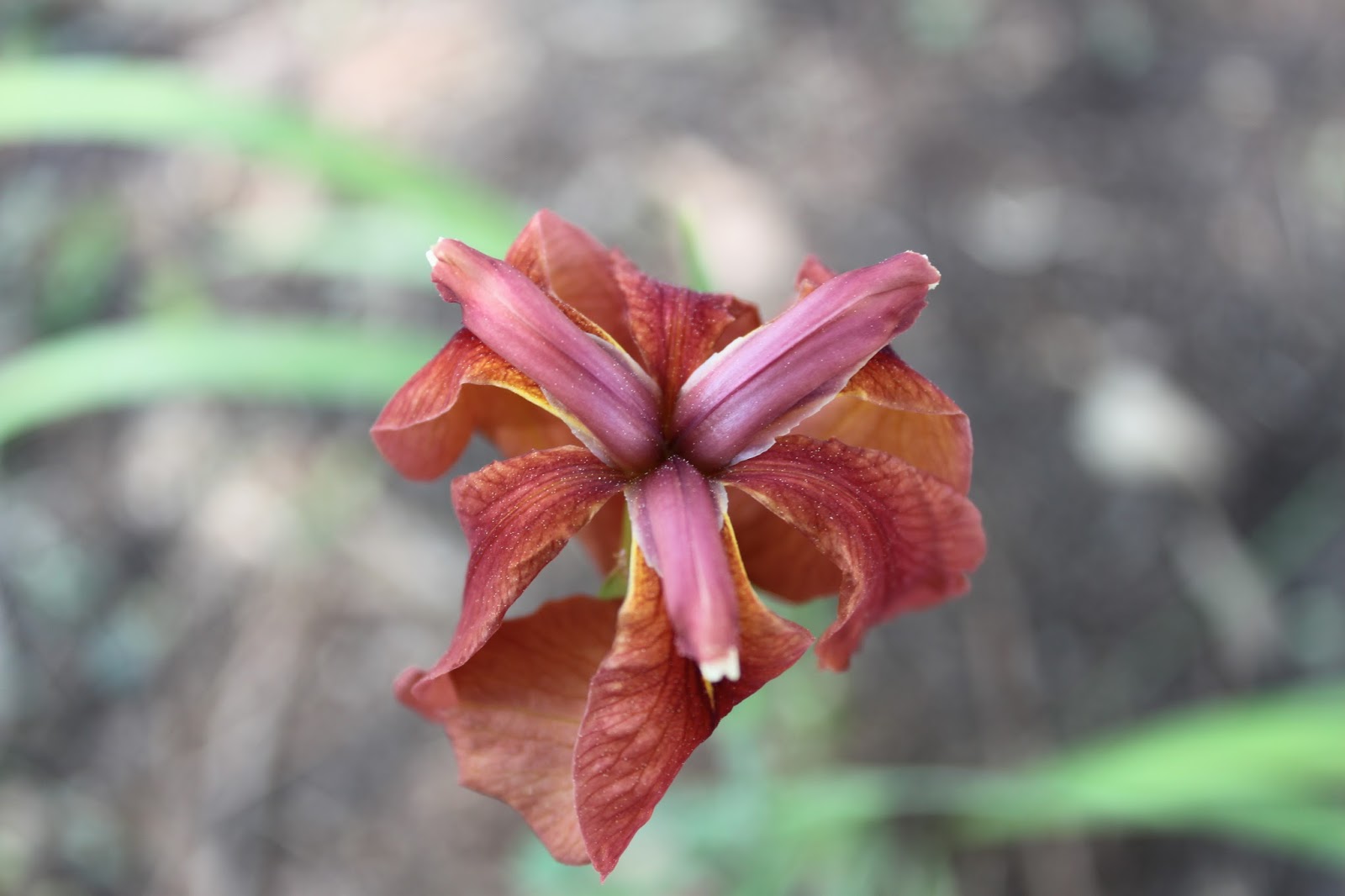
This is the first iris bloom of the season in the arboretum. This particular plant (Iris fulva) is a volunteer, growing in a drier spot than it should be, suggesting that the sprinklers have been doing a good job in this part of the arboretum.
Iris fulva detail
Additional Louisiana irises have opened up in the wetland.
Senecio glabellus is one of those 'weedy' looking wildflowers. It grows happily in wet areas. The flower smells like honey.
We are holding off on mowing the grass in the arboretum because of plants like the daisy fleabane (Erigeron sp.). They are truly wild, growing wherever they please. There are several healthy patches in the arboretum. And, like the Senecio, they have a pleasant smell. Enjoy them while you can!


Friday, March 10, 2017

What's in Bloom?

A variety of trees, vines, and herbaceous plants have been blooming for several weeks now. The redbuds, mayhaws, and Mexican plums have put on a great show this year in the arboretum. Other species, like spiderwort and daisy fleabane, have just started to bloom, while the Louisiana irises have barely begun to produce flower stalks. A few of the arboretum's offerings are highlighted below.
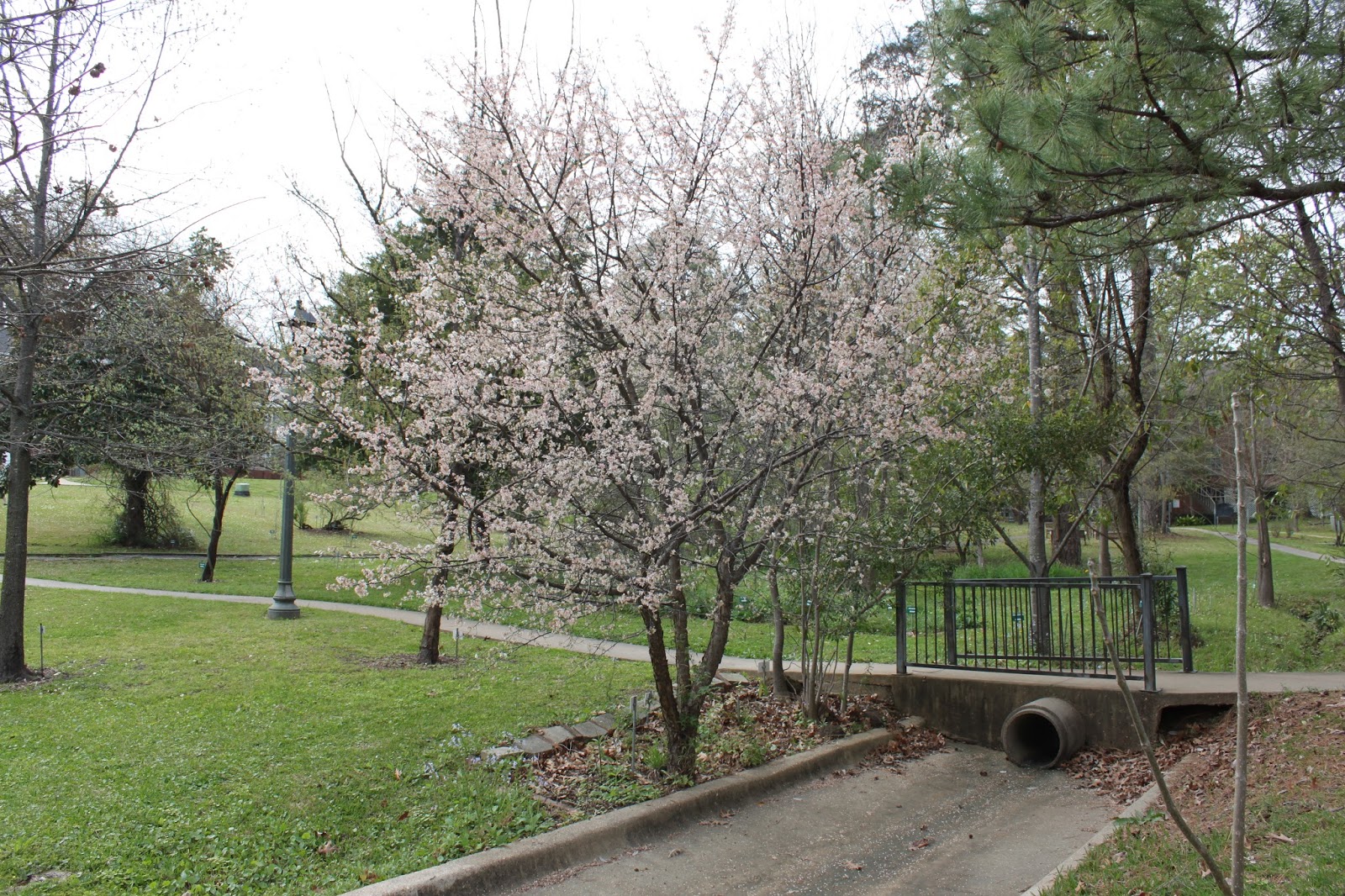
The brilliant white flowers of the Mexican plum (Prunus mexicana) have turned a pale white, tinged with pink.
This is a successful bunch of Atamasco Lily (Zephyranthes atamasco) growing under a cedar elm (Ulmus crassifolia).
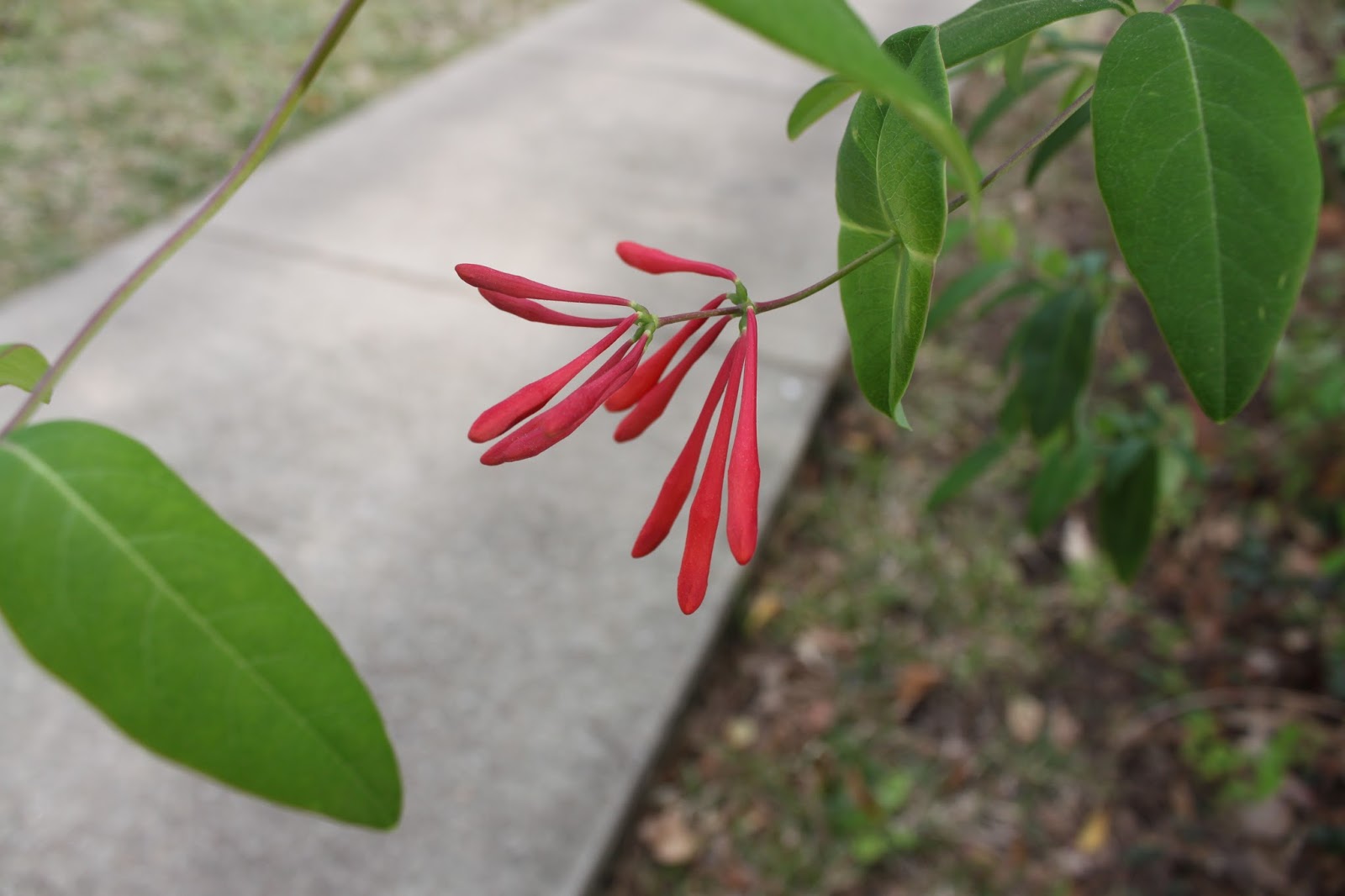
Flower bud of the coral honeysuckle vine (Lonicera sempervirens)
The coral honeysuckle grows with the oak leaf hydrangea (Hydrangea quercifolia).
Flowers of the wild crabapple tree (Malus angustifolia) are very fragrant.
Dewberry (Rubus trivialis) is prolific in the arboretum. It desires to take over, but we allow it only a few patches in which to thrive. This patch is located under a flowering magnolia (Magnolia grandiflora), near the fitness center.
Flowering Dogwood (Cornus florida)
The Green-and-Gold plant (Chrysogonum virginianum) grows low to the ground and spreads out, producing bright yellow flowers. This patch grows under the smooth sumac (Rhus glabra).
The blue phlox (Phlox divaricata) is beautiful and fragrant.
A healthy patch of Trillium