Showing posts with label berries. Show all posts

Wednesday, April 29, 2026

Dewberry Picking in the Arboretum

Fruits on the dewberry vines have been ripening over the past two weeks. 


The large dewberry patch near the Student Union Building is the easiest place to find and pick berries.
It isn't necessary to walk through the tall, overgrown areas—just walking the perimeter you can easily pick a handful of berries.

The fruits do not all ripen at once, so check back every few days to pick a few more.

Ripe berries are dark purple or black. Yum!

Saturday, April 20, 2024

Mulberries and Dewberries

In the arboretum, you can find several large patches of dewberry (Rubus trivialis). This is such a weedy plant; it volunteers across campus. Only a few patches are officially in the arboretum catalogue.


Dewberries turn black when they are ready to eat. They aren't sweet, but they are wonderful in fruit smoothies.

The little black fruits are numerous, just be careful when picking them, as the vine is covered in prickles. Ouch!


In the arboretum, you can find mulberries (Morus rubra) in one location: on the grassy slope north of Cline Hall dormitory. There are three trees currently producing fruit. Like the dewberry, the mulberry turns black when it ripens.


Saturday, April 28, 2018

Tree of the Week: Red Mulberry (Morus rubra)

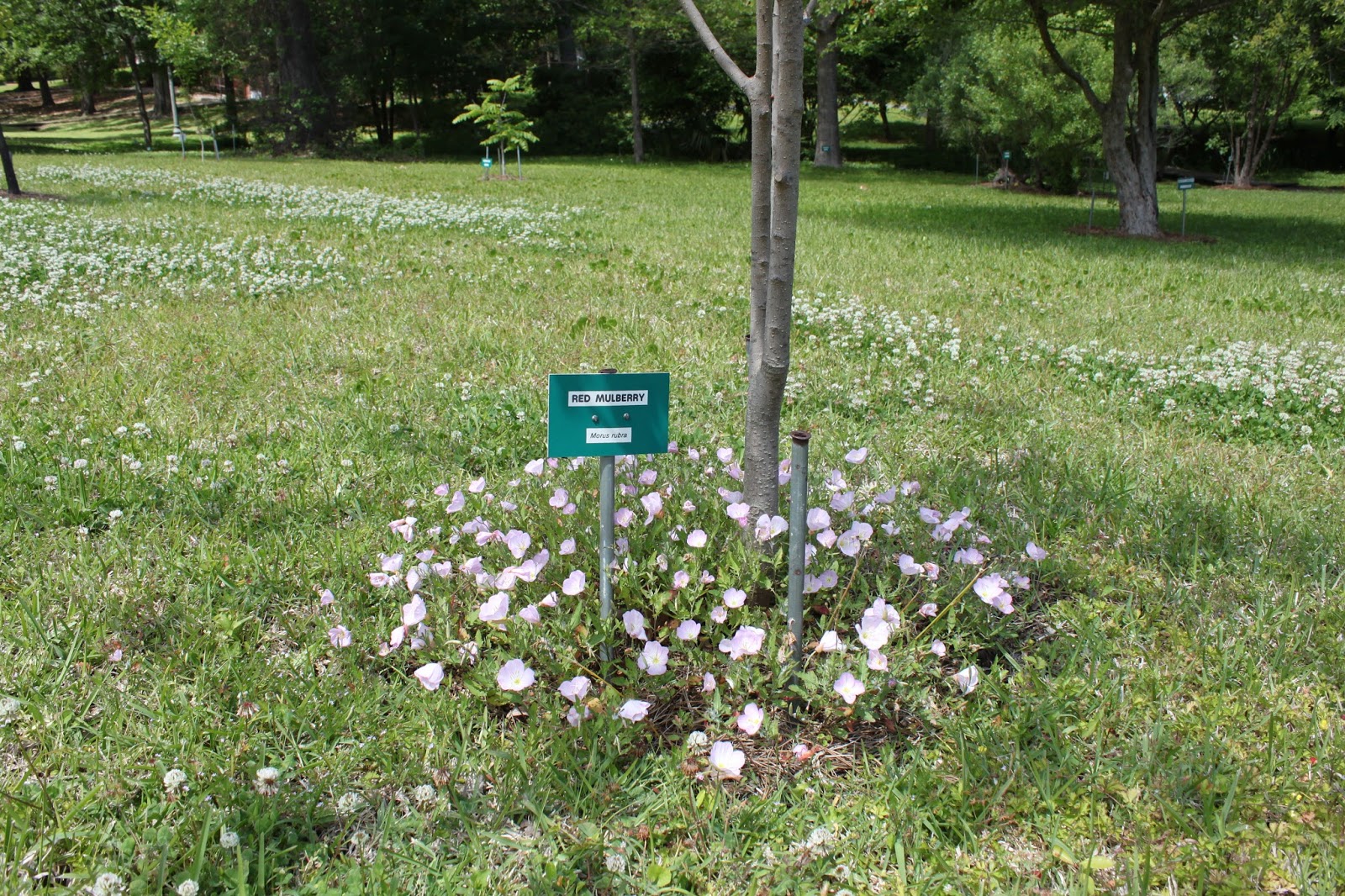
We have a young red mulberry (Morus rubra) that deserves a mention this week. It's a small tree with slender, waving branches, and this week, all of the branches are covered in little berries. The tree was planted as a bare root sapling in the spring of 2013, making the tree at least 6 years old. For such a young tree, it is producing a lot of berries! You can find this specimen on the sunny, grassy slope north of Cline Hall. Help yourself to a few berries, but make sure you get the ripe (black) ones!

This fruiting red mulberry is growing in full sun, on a gradual slope, in clay soil. Thus far, no fertilizers have been used. During the long, hot summers, this area is soaked at least once a week by way of the in-ground irrigation system.
The primrose volunteered here, and we have been cultivating it around the trunk of the red mulberry.
The ripening berries appear alongside the new, yellow-green leaves.
We are seeing a lot of berries!
These berries aren't quite ripe yet. Wait until they turn black.
The berries are approximately half an inch long. They are similar to the blackberries you find in the grocery store and also the wild, native dewberry. The red mulberry is the queen of our native fruits.
The ripening dewberries are almost indistinguishable from the mulberries. The berry on the far left was collected from a dewberry patch, while the three berries on the right are mulberries. If you have the space, plant a a morus rubra and enjoy!

Friday, April 14, 2017

Tree of the Week: Red Mulberry (Morus rubra)

Berry production is underway on the grassy slope north of Cline Hall. The arboretum's two red mulberry trees are producing tasty black berries, and the branches of the two young trees are still low enough to the ground to make for an easy harvest. These two trees were purchased in the spring of 2013, at the Sabine Soil and Water Conservation District tree sale in Ringgold, Louisiana, and were planted directly in the ground the same season. Both trees are healthy, but one is clearly outshining the other, growing taller and producing more berries. The more successful tree has less competition for sun and water.
The more successful of the two trees has less competition, planted away from any big trees and near a good sprinkler.
The root system of this mulberry is competing with an elderly white oak (Quercus alba).
Ripening fruit
The ripe berry resembles a blackberry
Cluster of berries on the more successful tree
While documenting the progress of these two red mulberries, the arboretum's older mulberry tree was examined. Approximately 10 years ago a mulberry volunteered in the drainage of the arboretum, becoming a very healthy shade tree. This tree is also fruiting, but unlike the specimens shown above, these berries are white. This suggests that our volunteer is a white mulberry (Morus alba) or a hybrid, which is an invasive non-native species. If further research shows this specimen to be an invasive white mulberry, the tree will be removed.

White berries on the volunteer mulberry tree (possibly Morus alba or mulberry hybrid)

For more information about the red mulberry consult the following:
United States Department of Agriculture
The Morton Arboretum
Louisiana Plant Identification and Interactive Virtual Tours (LSU AgCenter)

Friday, April 7, 2017

What's in Bloom?

Last week we had to say goodbye to the wildest of the wildflowers, as the arboretum was in need of a good mowing. So long daisy fleabane! We'll see you next year! But there are still plenty of beautiful blooms this week. Below are a few highlights from the irises, vines, shrubs and trees adding dashes of spectacular color to the grounds of the arboretum.

Purple Louisiana iris hybrids growing in the floodplain. The arboretum's iris collection is comprised of plants collected from across the state of Louisiana, including at the Caroline Dormon Nature Preserve.
Iris flower detail
Our native wisteria (Wisteria frutescens) has been flowering for a few weeks now.
These flowers are from a large Carolina allspice bush (Calycanthus floridus), growing alongside the arboretum drainage. The shrub is highly decorated in blooms this year.
Virginia willow (Itea virginica) located on the northeast corner of the main bridge running through the arboretum.
Little-leaf snowbell (Styrax americana) flowers are lightly fragrant.
The dewberry vines (Rubus trivialis) are now producing fruit.