Showing posts with label Family: Magnoliaceae. Show all posts

Saturday, May 15, 2021

Tree of the Week: Tulip Poplar (Liriodendron tulipifera)

This week we are celebrating the tulip poplar (Liriodendron tulipifera). This celebration is wholly due to Dr. Katie Bearden, whose eagle eye caught a glimpse of orange on high. This led to the discovery that a tulip poplar was blooming. Quite a find, considering that these flowers are located far above eye level and largely obscured by big, floppy leaves.

Tulip poplars are not native to northwest Louisiana, so it's unlikely that you would observe one in the wilds of Caddo, Bossier, DeSoto, or Webster parishes. However, tulip poplars grow natively in other areas of Louisiana and the southeastern United States. 

 If you visit the Centenary College campus, you can view five individual tulip poplars. All reside outside of the arboretum proper. Two are located between the arboretum and the cafeteria, and there are three between Crumley Gardens and Rotary Hall. Information on the source and age of these specimens is unavailable; we cannot say how old they were when they were planted, but we do know that they were planted in the late '90s. Today, all five trees are very tall, with no lower branches, and appear healthy.


Dr. Bearden first noticed the tulip poplar near the cafeteria. As noted above, the orange flower caught her eye. Since it was far out of reach, she enlisted the services of Eddie Walker, Chief of Public Safety, who used a drone to capture images of the flowers. The light orange flowers only just stand out against the green foliage.


Chief Walker's expertise operating a drone made it possible for us to see the flowers up close. Do you see a resemblance to our flowering magnolia? Tulip poplar and flowering magnolia are in the same family, Magnoliaceae.


In the hope of finding a flower within arm's reach, we examined the four other tulip poplars for a candidate. One tree in particular was thoroughly examined with the aid of a step ladder. All photos below are of a single tulip poplar, located near Crumley Gardens.


Our tree of the week is pictured center. It's a tall, narrow tree, whose form resembles that of our eastern cottonwood (Populus deltoides), and like the eastern cottonwood, tulip poplars are known to be fast-growing trees. Based on the height of the young woman pictured, this tree is more than forty feet tall. Champion specimens may reach heights in excess of 160 feet.


The tulip poplars on campus have straight trunks, and all lower limbs are absent, making leaves and flowers out of reach.


Using a step ladder to examine the lowest branches, we could only find remaining cones, vestiges of past glories.


Plenty of leaves were willing to be photographed. What a peculiar shape! Does it resemble a duck's foot with extra toes?


A branchlet was snipped for closer examination. Unfortunately there isn't a flower located at the twig apex.


Leaf stalks alternate along the twig.


Tulip Poplar Twig with Leaves


Large, boxy leaves are attached to long leaf stalks. Leaf and leafstalk together measure approximately one foot in length.


Tulip poplar leaves are symmetrically lobed. The leaf tip is inverted, or "notched". Leaf margins are smooth.


Underneath, leaves are pale green.


The tiny white dots are aphids. These were found on all the leaves that were closely examined. This level of infestation does not appear to be doing any harm to the tree.


In the photo above, the leaf appears particularly shiny and it feels sticky. According to Joe Boggs from Ohio State University's Buckeye Yard & Garden onLine, the stickiness is a byproduct of the aphids feeding on the tree. The "honeydew" attracts other insects and mold, which could harm the tree.


The gray trunk bark is rough and furrowed.


In a few spots we see the ridges crossed into a diamond pattern.


Grass was removed from around the base of the trunk so that we could get a good look at the root structure and also to keep the weed-eaters away from the bark. We will use mulch to replace the grass.


A few surface roots were identified in the grass, but nothing problematic for lawn maintenance.


For more information about this species, please consult the following online sources:

Louisiana Plant Identification and Interactive Virtual Tours (LSU AgCenter) 

Buckeye Yard & Garden onLine (The Ohio State University) 

NC State Extension 

US Forest Service

Thursday, June 14, 2018

Tree of the Week: Flowering Magnolia (Magnolia grandiflora)


It's the middle of June. The air is hot. The ground is dry. The first day of summer is still a week away. And for over a month we have had delightfully fragrant magnolia flowers perfuming the air. 

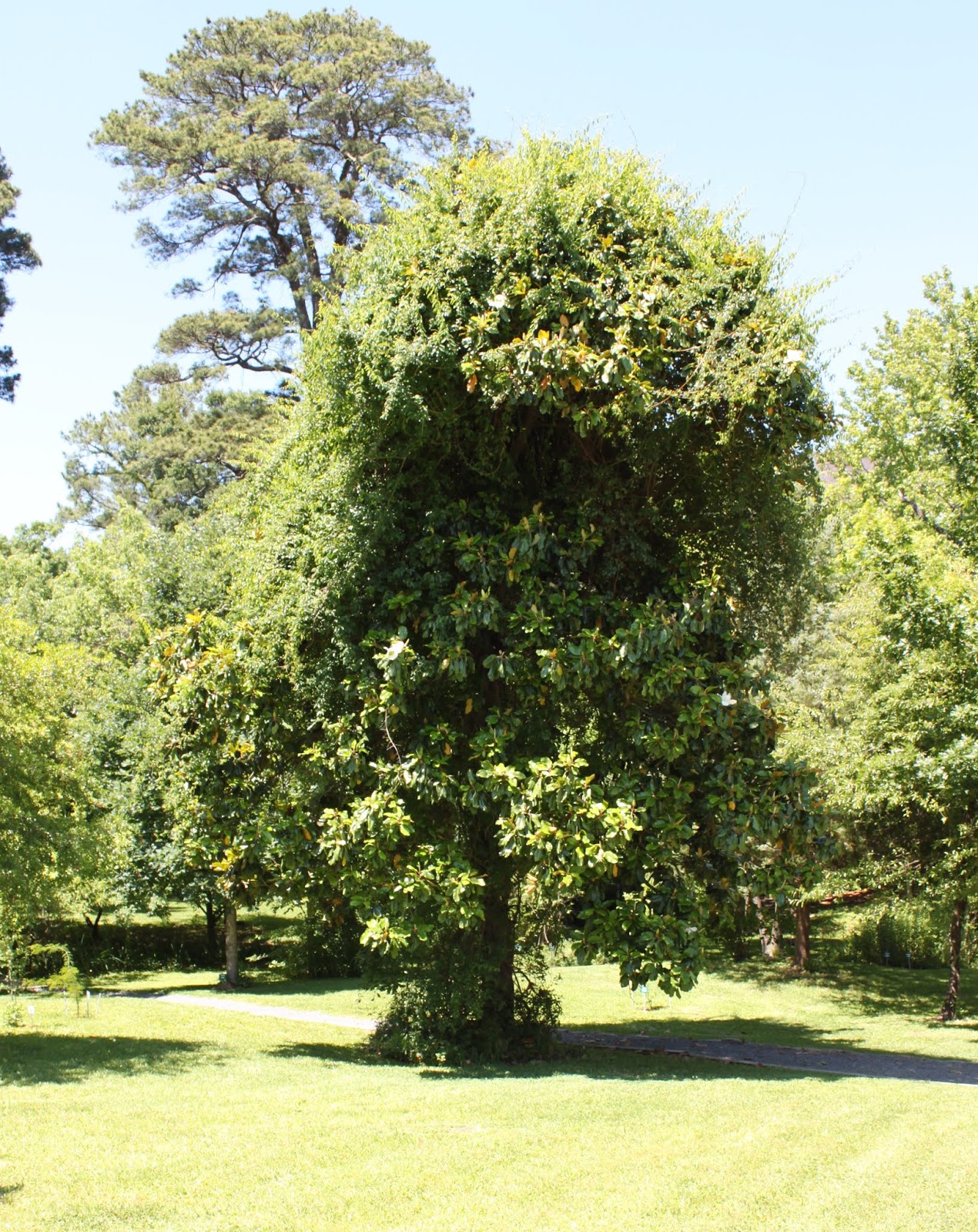
Of the four flowering magnolias (Magnolia grandiflora) in the arboretum collection, one individual draws the most attention, for a few different reasons. First, it's located in a high-traffic area, near the Fitness Center, so a lot of people routinely walk by it. Second, this magnolia has low-hanging branches, making the iconic flowers conspicuous and easy to appreciate. Finally, this tree is over-topped with a very healthy species of vine, giving the tree a wild appearance. For these three reasons, we must make it our tree of the week, again. 

Below, we have pictures of the pretty flowers and leaves, and we also have comparative photos illustrating the maintenance of the unruly rattan-vine.

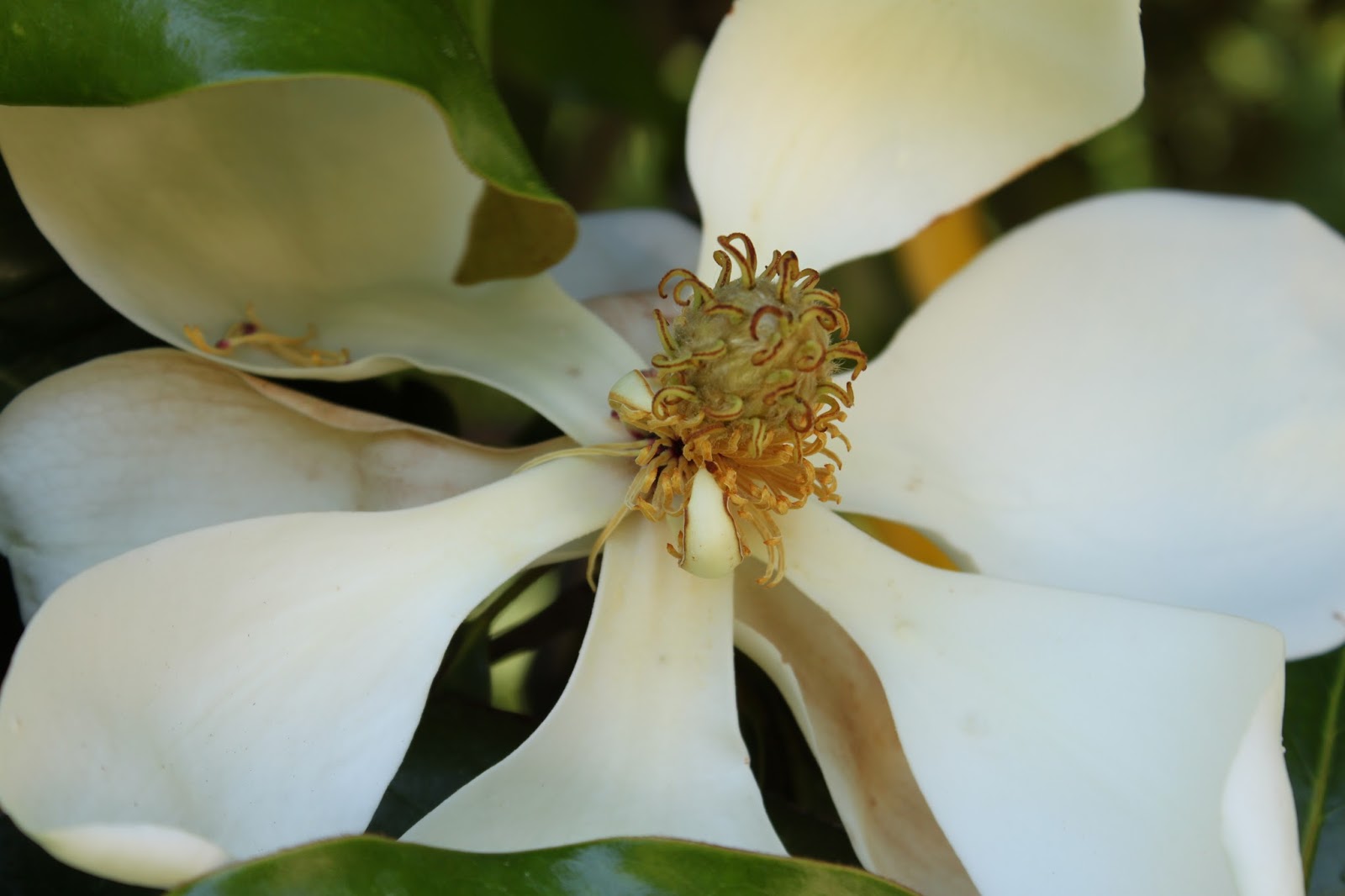
This large, white flower was photographed on the mature magnolia near the Fitness Center.
We have evidence of past glory: the petals are gone but the fruit remains.
These large flower buds assure us that the show isn't yet over. If you're on campus, be sure to look for them!
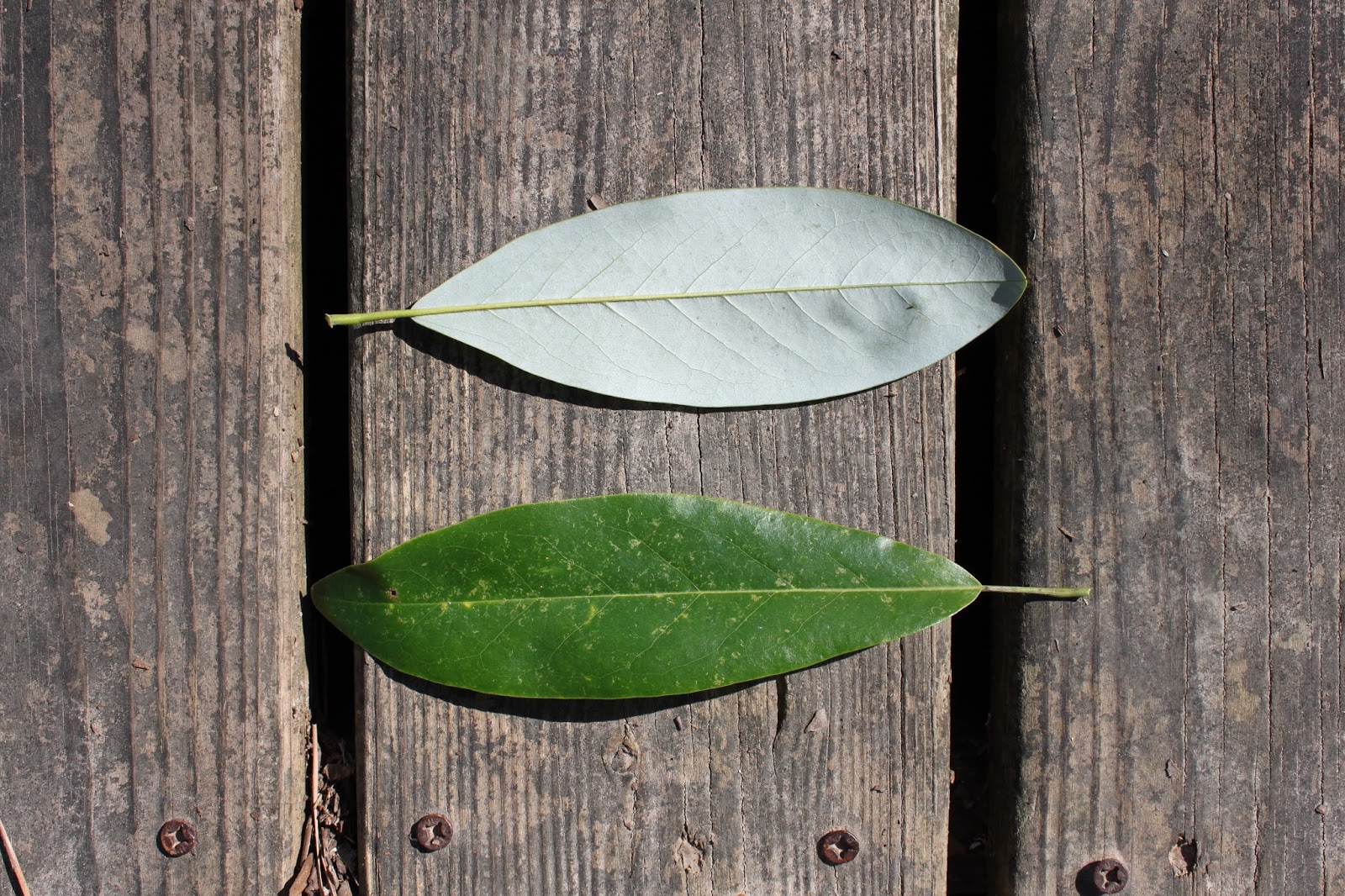
The flowers always steal the show, but magnolias also have big, beautiful, waxy leaves. Here we have an old leaf and a new leaf. The old leaf is dark green and a little longer. The new leaf is pictured at the bottom, next to the ruler; it's smaller and more yellow-green.
Underneath, the leaves are two different shades of brown. The younger leaf is pictured at the top: it's an even shade of light brown. The older leaf is a rusty, brown. Both leaves feel fuzzy.
Zooming in on the older leaf we can see the fuzziness.

Since 1997, this magnolia has served as a trellis for rattan-vine (Berchemia scandens), and in recent years the vine has gotten a little out of hand. Last year a decision was made to undercut the vine's competitive strength. We want to keep the vine but reduce stress on the magnolia. Since then, several different cuttings have been made, resulting in noticeable changes. Below, we compare photos from today (6/14/18) to photos taken last year (5/15/17).

Last year, in May, the rattan-vines were thick and green, obscuring the magnolia trunk. Towards the top of the photo, you can see the vine wrapping around the trunk.
Over the past year, several of the vines were cut, but not removed. The brown vines are dead. A couple of thick, green vines remain (for now).
This photo was taken May 15, 2017, on a cloudless day. The vine and tree are indistinguishable, and together they are casting a large shadow.
This photo was taken today, June 14, 2018, on a partly cloudy day. Cutting back the vine at the base of the tree reveals how successful the vine was: there is a large, brown mass of dead vines toward the top of the tree. 
This is another look at the tree from May 15, 2017. The tree is all green, and we can see the vine over-topping the magnolia. The trunk is difficult to identify, as it is encircled by both rattan-vine and dewberry.

Today, we can see both dead and alive vines. There is a mass of dead rattan vines clinging to the limbs toward the top of the tree, and there are healthy vines growing over the top. In this photo, the trunk is more visible. The dewberry bush has been removed from around the trunk to make the living and dead rattan-vines more noticeable.


You can find more photos of this particular tree here.

Tuesday, March 20, 2018

Big-Leaf Magnolia Leaf Bud

This is the top of a big-leaf magnolia tree (Magnolia macrophylla). The tree is still young, so it has the appearance of simply being a stick, stuck in the ground, but then at the top of the stick, there is a very large, velvety, whitish end bud, not quite opening.

Friday, January 26, 2018

Magnolia virginiana var. australis

The evergreen sweetbay magnolia lives up to its name. The following three photos were taken over the course of 12 days in January. Despite the unusually cold and snowy weather, this variety of sweetbay hasn't lost its leaves. The five regular sweetbays are bare.

January 15, 2018
January 16, 2018
January 26, 2018


Tuesday, January 16, 2018

Tree of the Week: Evergreen Sweetbay Magnolia (Magnolia virginiana var. australis)

Yesterday in Caddo parish we had sunny, 60-degree-weather. It was a pleasant day for taking pictures of our tree of the week, the evergreen sweetbay magnolia (Magnolia virginiana var. australis). This tree is very much like any other sweetbay, but it keeps its leaves during the winter months. So, in the middle of January, the dark green leaves remain on the tree.

There are two evergreen sweetbays in the arboretum collection. Ed Leuck acquired these two trees from John Mayronne at a meeting of the Louisiana Native Plant Society. The meeting was held January 26, 1997, and the trees were planted the following November, making them over 20 years old. The photos below show that one of the two trees is significantly shorter than the other. The shorter tree is growing on the north side of its companion, which means that it gets less sun. This explains some of the difference in height. But another explanation is that the shorter tree was crushed by a falling Pinus taeda on April Fool's Day in 2000. Amazingly, the sweetbay recovered, and both trees are in good condition today.

After such a beautiful day, the weather quickly changed. The rain started in the evening and transitioned from sleet to snow by midnight. Waking up this morning, we had a Louisiana-style winter wonderland. The rare event necessitated a photography expedition. So, we also have a few pictures of the evergreen sweetbays in the snow.

The grass isn't green anymore, and the old oak trees are looming overhead without any leaves on their branches. Meanwhile, this variety of sweetbay magnolia remains green, as if it's still summer.
There is a narrow drainage channel, or "creek", that runs west to east through the arboretum. One sweetbay was planted on the north side of the creek, the other on the south side. Although the two trees are the same age, one tree is clearly shorter than the other, suggesting a competition for resources. In this photo, we are looking eastward.
The tree on the north side of the creek has a single trunk, while the other tree has a multi-trunk form.
The multi-trunk form is common for sweetbays. Surface roots aren't a problem with these two trees.
The elliptic leaves are dark green in the middle of January.
Sweetbay leaves are white underneath. On a sunny, windy day the leaves have a silvery appearance, making the tree identifiable from a distance.  
After a beautiful, sunny, 60-degree day, the weather rapidly turned cold. Approximately 2 inches of snow fell during the night. 
The weather was cold enough to allow the snow to accumulate.
Snow remained on the evergreen leaves during the following day.


For more information about this species consult the following:
LSU AgCenter
United States Department of Agriculture
Louisiana Plant Identification and Interactive Virtual Tours (LSU AgCenter)
University of Florida IFAS Extension
NC State Extension

Thursday, May 18, 2017

Tree of the Week: Flowering Magnolia (Magnolia grandiflora)

Our tree of the week is the Magnolia grandiflora located near the Fitness Center. This is an older, healthy tree that predates the establishment of the arboretum, so its history is unwritten. As the borders of the arboretum expanded, the tree became part of the collection. In November 1997, several gallon-sized pots of rattan vine (Berchemia scandens) were planted under the tree. Today the tree and vines appear to be in strong competition, with the vines growing over-top the tree. You can also find a successful patch of dewberry (Rubus trivialis) growing at the base.

The Magnolia grandiflora flower is the state flower of Louisiana.
Flower tucked behind the rich, green foliage.
In the lower right-hand corner of the photo, note the characteristic rusty color of the underside of the leaf.
This week you will find several low hanging branches with flower buds.
Flower bud detail
The rattan vine (Berchemia scandens) snakes around the trunk of this Magnolia grandiflora.
This photo from late winter (March 9, 2017) shows how successful the rattan vine has been in its competition with the magnolia. The dewberry vine (Rubus trivialis) is in flower at the base of the tree.
The tree seems healthy enough despite the overwhelming success of the vine, but this summer the vine will be trimmed.

You can see additional photos of the arboretum's flowering magnolias here.

For more information about this species consult the following:
United States Department of Agriculture
University of Florida IFAS Extension
Louisiana Plant Identification and Interactive Virtual Tours (LSU AgCenter)