Another exhausting session of work on the disturbed slope, with temperatures in the 35 to 45 degree range. The clay is thankfully drying out, which makes it easier to manipulate.
Things are looking better, but it will probably be a year or two before nature heals. Since the ground has been so thoroughly disturbed, we ought to have a multitude of volunteers germinate in this spot. It will be interesting to see what comes up.
Going further down the slope, we see that the new bridge is complete! Wahoo! In the arboretum catalogue, this is referred to as 'the long white wooden bridge that runs from Mickle to the Student Union Building'. It's not white anymore.
Ought we paint the bridge white? Another color? Or is the bare look of treated lumber pleasing?
The large pile of materials is gone; craftsmen have used it up.
Here we can see the under-structure of the new bridge, along with some new pylons made of concrete block and treated lumber.
Although Winter officially began two weeks ago on midnight of December 21st, it is only today that we have experienced a real Blue Norther. Until now we have had warm weather. After a strong rainstorm and a stiff wind, temperatures have dropped forty degrees in twelve hours. Since the native species of the arboretum expect and even require cold temperatures for germination and other necessary biological processes, this is as it should be.
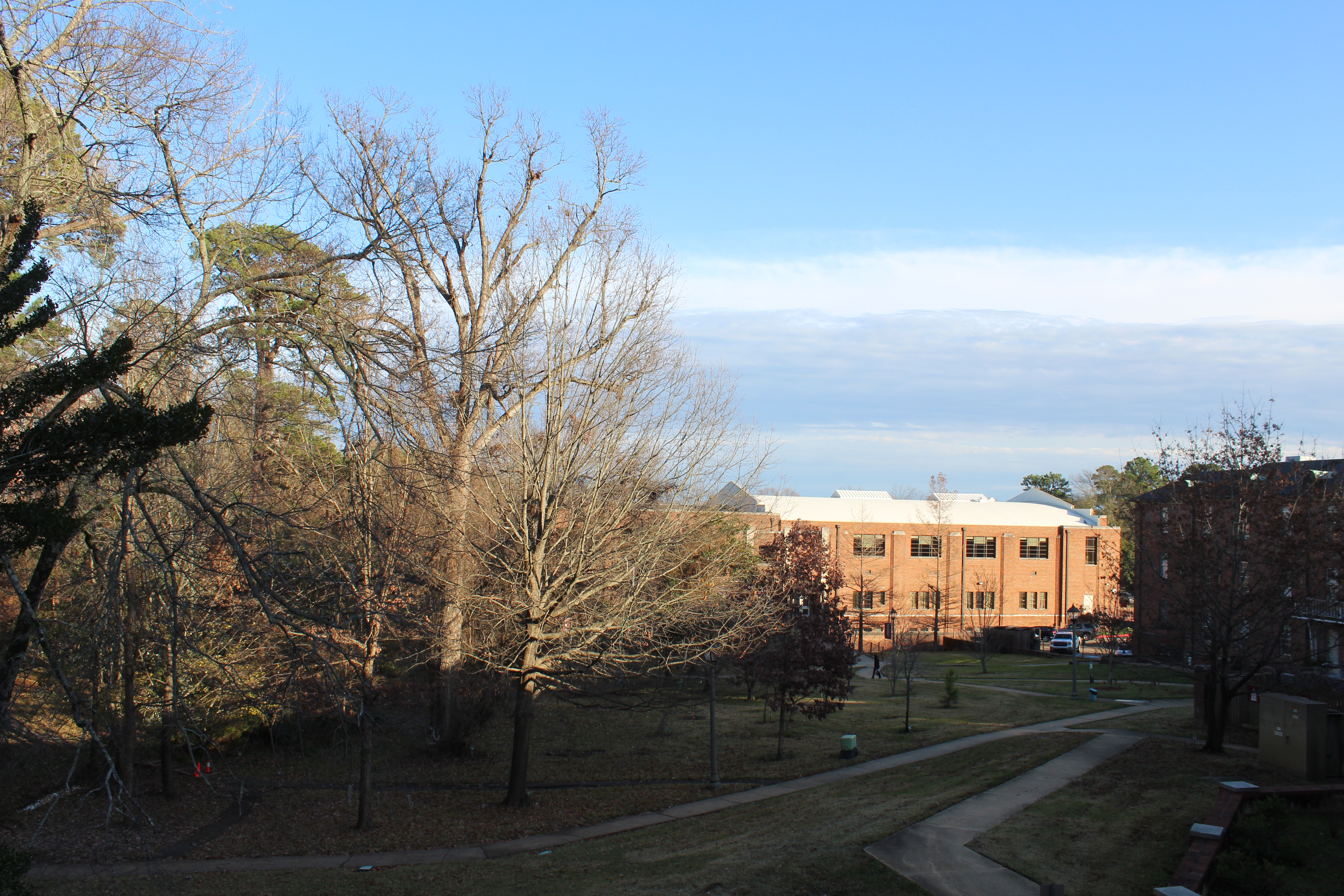
The arboretum is at a seasonal crossroads. Autumn leaves are still on the ground while temperatures are dropping into the 20s, and snow is predicted for the coming week.
This was a good afternoon for a walk before the weather turns cold and inhospitable.
Here
we can see that we've probably had our final fall of leaves for the
year. The tardily deciduous trees will keep their leaves until the new leaves force the old ones to drop.
Under
these leafless (less-leafed?) conditions, you can see much more trunk
and branch. Winter is the season to study and compare the different growth habits of trees and trunk
bark.
Evergreen species stand out this time of year. In this photograph, we see big, green, cumbersome leaves of a Louisiana palmetto (Sabal louisiana).
Palmettos are numerous in the arboretum, and they are particularly thick in the arboretum drainage.
A redwood (Sequoia sempervirens) stands tall next to the Student Union Building. This evergreen species isn't native to Louisiana―it's an 'exotic'. In the summer of 2023, this tree was cause for concern because the top looked dead (blog post here). If you look at this photo closely, you can see that the top is still dead. Luckily the rest of the tree looks green and healthy!
In this photo, we see the the southwestern corner of the arboretum, which is the youngest area of the arboretum―the trees are smaller and there is more grass. During January and February, much work will take place here. We have many, many young trees to plant in this space, and winter is the time to do it!
It is a rainy day in the Centenary College arboretum, and we expect to have a rainy week ahead of us. So, what does that look like? If you are out for an exploratory walk, dressed in an appropriate slicker and boots, it can be quite agreeable to splash around in the puddles and listen to the flow of water and chirping birds. However, if your schedule doesn't allow for such leisure, the surroundings can feel quite dreary.
Below, we have a video that captures a look at water flowing through the arboretum. Centenary College does not have a flat campus; we have both gradual and steep slopes. On the western side of the arboretum, the slope is comparatively gradual, and in the video, we are standing towards the bottom of a hill where the water is collected in a narrow channel.
The laurel cherry (Prunus caroliniana) was selected as the focal point because last week we discussed this individual's small stature. We cannot say why it is so short. It grows in full sun, which might be too much sun, and sometimes it gets a lot of water, while at other times its location can be quite dry. As we see in the video, during rainy weather, a great deal of water flows past the laurel cherry. After the rain stops, this area might be wet for 24 hours and then quickly dry out, given hot weather conditions.
Toward the end of January, in northwest Louisiana, most of our deciduous trees have dropped their leaves. It's that time of year when the evergreen species are tasked with enlivening our oft-times dreary landscapes. In Louisiana, we are fortunate to have the laurel cherry (Prunus caroliniana).
In February of 2018, we collected four laurel cherry seedling volunteers from the lower pond and transplanted them to the south side of the arboretum. Today two (presumably the hardier specimens) remain. They are each appoximately 5 years old, but have reached considerably different sizes.
Pictured center, we see a laurel cherry. For comparison, a 6-foot ladder is standing next to it. This laurel cherry currently grows in full sun; however, for the first several years, this laurel cherry grew in the shade of an eastern red cedar. We removed that cedar in 2021. Today, the laurel cherry grows in full sun, toward the bottom of a gradual slope, a little up hill from the western flood plain.
Leaves are beautifully green in mid-January. No signs of reproduction on this young tree.
By contrast, this laurel cherry, also approximately 5 years of age, stands only about two and a half feet. Rather than developing a straight trunk, this laurel cherry is taking on the appearance of a small shrub, with four stems. We transplanted this young tree into full sun, where it has grown *up* in full sun, and when it rains, standing water is closer to its roots.
Like people, some trees are easy going while others require more maintenance. The eastern cottonwood (Populus deltoides) is particularly high maintenance. When growing in a wild setting, it is irksome because it sends its 'cotton' outward into nearby civilized areas, covering window screens, clogging ducts, and making a general nuisance. And when growing in a maintained landscape, it stands out from its peers as being a problem case. See below for more details.
Our tree of the week is approximately 25 years old. It grows between Rotary dormitory and the Student Union Building. It was one of two eastern cottonwoods planted at approximately the same time: one seedling was from Walter B. Jacobs Memorial Nature Park, and one seedling was a volunteer from the campus greenhouse. We cannot say which of the two trees remains, but we have before us a very tall, imposing, troublesome tree.
In January, there are plenty of leaves to cover the ground. Leaves do not all fall at once, so there are several opportunities for outdoor fun, if you like raking (or blowing) leaves. And, it must be noted, eastern cottonwoods do not only drop their leaves during the autumn and winter months. This specimen in particular has been known to drop piles of leaves during dry summer months. But why waste your time raking leaves? Why not just mulch them with a lawn mower?
Extensive surface roots make it nearly impossible to mulch these leaves with a mower. Looking at the above picture, we see lawn mower damage that these roots have sustained.
Using a blower might save you some time; however, depending on what you intend to do with the collected leaves, you might need to sort through your leaf piles for the numerous twigs and branchlets. The above wheelbarrow is full of twigs collected from under the cottonwood.
Twigs tend to be at minimum a foot in length.
Eastern cottonwood twigs are characteristically knobby.
Examining the roots and base of the trunk, we see young stems growing from the root structure.
Looking closer, we see that this is not the first time that a shoot has grown in this spot. This area has previously been trimmed. For the sake of aesthetics, these stems will also be cut.
Oh, hey there ladybug. Whatcha doin'?
Leaves have been raked away from surface roots and the collected twigs were hauled off to the dumpster. In maintaining the grounds of the arboretum, we try to retain as much organic matter as possible, so all leaves are mulched and stay on the lawn. This provides a recycling of natural resources and minimizes waste.
There are still leaves on the ground, but not under the eastern cottonwood!
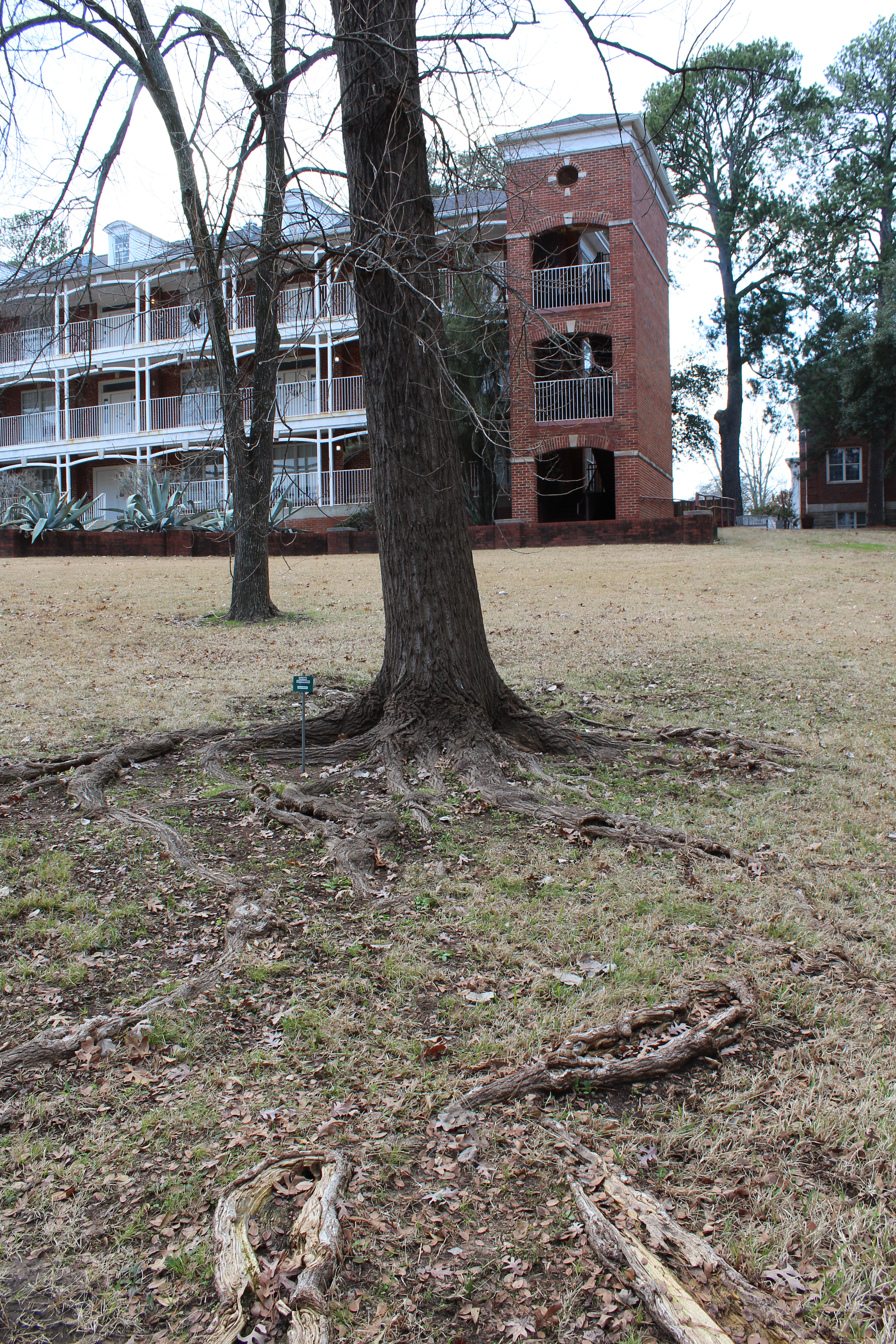
With the leaves removed, we can really appreciate the surface roots. In all seriousness, the above ground root structure appears to undulate, suggesting the movement of water, calling to mind the banks of a stream or river—the cottonwood's natural habitat. It's unfortunate that the roots have sustained so much damage from the mowers.
The Centenary College arboretum is home to two very large Louisiana palmettos (Sabal minor). They are more than 30 years old and have each developed substantial trunks. You can read more about them in a previous blog post, found here. This week we were fortunate to have an arboretum guest pose with the trunks. In the photo above, the young man, who measures just under three feet tall (34.5"), stands on a landscaping rock in the shade of the two palmettos.
Both trunks were recently cleaned up; dead leaves and stalks were removed to call attention to the thick trunks. Even with the dead and decaying material removed, the two palmettos retain an unkempt appearance.
Both palmettos are approximately 35 years old, but one is noticeably wider and taller. Perhaps the difference in size is simply explained by its proximity to the drainage channel.
Our arboretum intern showed great interest in the palmetto leaves. Using one trimmed specimen, we can have the intern assist in displaying the mature leaf's size. It is about eight feet!
These are large, unwieldy leaves, with stout, long petioles. If leaf and petiole were trimmed, we see fan-bearer potential.
This past week, an old post oak (Quercus stellata) was removed from the arboretum catalogue. In the spring, it produced clusters of leaves, but overall its limbs were bare throughout the summer. Then, in the early fall, those leaves were quick to turn brown. This post oak was officially marked for removal in November, and then a few short weeks later, bark began popping off the trunk and upper limbs. The Director of Facilities scheduled its removal during winter break, while the campus was relatively quiet. Unfortunately, we were unable to document the process, examine the interior or count the rings.
Our tree of interest was located at the southwest corner of Mickle Hall, next to the basement entrance. This photograph was taken July 15, 2021.
The post oak is gone. Since there weren't any surface roots, the ground is markedly flat and there is very little evidence that such a stately specimen stood here. Photograph taken January 6, 2022.
A late December drive in rural Bossier Parish afforded us the opportunity to collect seeds for dispersal in the arboretum. The purpose of the expedition was to examine a 40 acre timber lot that had been clear cut and replanted with loblolly pine seedlings approximately 12 years ago. While driving through the timber tracts, we noticed that the red dirt roads were lined with thick stands of buttonbush (Cephalanthus occidentalis); numerous dark orbs hanging from the spindly woody branches caught our attention. To the loggers and hunters, this may appear to be trash. To your arboretum curator, it represents valuable local germplasm.
These buttonbush
fruits were collected from shrubs growing in a ditch lining a worn-down
gravel road surrounded by an apocalyptic clear-cut landscape. The area was cut sometime in 2021; the road
showed heavy use by big trucks and the shrubs were either growing in
full sun or partial sun.
During the wamer months, buttonbush produces rounded flower heads composed of tiny white flowers. In the photo above, we see nine desiccated heads. Hopefully each head contains numerous viable seeds.
Cephalanthus occidentalis fruits collected in rural Bossier Parish, December 30, 2021
The dark orbs measure between a half inch and an inch in diameter.
The buttonbush fruiting heads are similar to sycamore balls (Platanus occidentalis): the spherical fruiting structures break apart into the fruits themselves.
Individual fruits are more than a ¼ inch in length.
Currently there is only one buttonbush in the arboretum collection. It
is nearly 30 years old. You can find it growing in full shade directly next to the long white
wooden bridge that runs between the Student Union Building and Mickle
Hall. It has developed into a small
tree, and it flowers, but the flowers appear without fanfare because,
of the few flowers that appear, they are up above, out of sight. So, for this new collection of seeds, we
ought to select locations in the arboretum that would be better suited
to flowering--the online literature suggests that we should choose a wet
location that receives full or partial sun.
Our tree of the week is pictured center. It's a sabal palm (Sabal palmetto). This is an evergreen species with wonderfully large palm leaves. You can find our particular sabal palm on the west edge of the large vernal pool (formally known as the upper pond), near the Student Union Building.
This sabal palm is a little more than 20 years old. On January 8, 2001, Professor Leuck purchased it from Woodlanders Nursery (Aiken, SC). He then nurtured it for several years in a pot, before planting it in the ground during the spring of 2004. He chose a very wet location―the west edge of the upper pond. Today, this area is still wet, but it no longer retains water throughout the year; it's a vernal pool that typically dries up completely during the long hot days of August.
This specimen is of special interest this week because nearly all of its leaves are drooping. Several weeks ago the leaf tips were upright, stretching out for the sun rays. On January 10th, northwest Louisiana experienced a rare snow event, and snowfall accumulated on these large leaves, weighing them down. The leaves never perked up.
So, today, for the purpose of increasing visibility, the sabal palm was trimmed.
Seven leaves were removed, making the trunk visible, and also allowing for a clearer view of the vernal pool, which will have blooming irises in the near future. Unfortunately, the palm looks nearly bare―only four leaves remain, and two are drooping.
The significance of visibility for an arboretum could perhaps be conveyed with a photo. The following photo was taken during the height of summer vegetation. This photo is of the same location, and if you look closely, you might be able to identify the sabal palm trunk.
This is the large vernal pool near the Student Union Building, photographed on June 7, 2020. In such an overgrown jungle, it's difficult to identify any one specimen, which undermines the purpose of the arboretum.
Visibility increases during the winter because deciduous trees lose
their leaves, but several changes were made to this area thanks to the
work of Hurricane Laura and the folks that cleared the damage after
the fact. You can read about that weather event on another blog post,
found here.
In northwest Louisiana, sycamore fruits are ripe this time of year. Numerous fruits hang from the upper twigs of the arboretum's only sycamore tree. The fruits are way up top, out of reach. Luckily, for the purpose of documentation, a single sycamore ball was found on the ground, among the several scattered branchlets.
The arboretum's sycamore is located near the Student Union Building. You
can read about its history on an old blog post, found here.
This specimen has a very noticeable lean in its trunk. The sycamore has grown in response to the competition for sunrays: it's leaning away from two southern red oaks (Quercus falcata), one of which is a very large, on-site native.
The bark at the base of the trunk is dark brown and very rough.
Looking up, we see the characteristic light-colored bark, a few crinkled brown leaves, and the globose fruiting structures.
The sycamore ball, not quite as ignominious as the sweetgum ball, is an aggregate of tiny fruits, tightly bound together in a globose shape. Only one sycamore ball could be found in the leaf-litter for inspection.
When the fruits are ripe, sycamore balls are light brown, round, and large, measuring more than 1½ inches across. They are known to create a litter problem.
With a little agitation, this globose fruiting structure breaks apart into a mound of fluff.
Soft, lightweight, fluffy fibers are attached to sycamore seeds. The fibers aid seed dispersal: the lightweight fibers float on wind and water.
A few fruits were picked out of the mound of fluff. The fruits themselves are a type of achene. They aren't showy: they are narrow and measure less than a half inch in length.
You can see leafy, spring-time photos of this specimen on an old blog post, found here.