Showing posts with label Family: Rosaceae. Show all posts

Sunday, January 26, 2020

Tree of the Week: Laurel Cherry (Prunus caroliniana)


Our senior laurel cherry (Prunus caroliniana) is pictured center. This same tree was featured two years ago at this time of the year. You can read about it here. At that time, it was the sole laurel cherry in the collection. Over the past two years, we added seven more. All new additions are volunteers found growing in the ground of the arboretum. It is quite probable that these volunteers were born from the fruits of the senior individual. This week, we'll look at pictures of those fruits.
Looking up, we can see more than a few of the black fruits mixed in with the evergreen leaves.
Up close, the fruits are dark blue, almost black.
Developing flowers can also be found this week.
The round (poisonous!) fruits are a ½ inch in diameter.
These fruits are drupes: each fruit is composed of a leathery skin, a juicy inner layer, and one large, tough seed. If you have a notion to grow your own laurel cherry, pick a few and take them home for a germination project. But keep in mind that the literature roundly agrees that these fruits are poisonous!

Sunday, April 21, 2019

Tree of the Week: Black Cherry (Prunus serotina)

Let's celebrate! This week, we're adding a black cherry (Prunus serotina) to the catalogue. Fair warning: it's not the ideal time to plant a tree in northwest Louisiana. It's getting too hot and the forecast could turn dry at any time. However, a rule of thumb is only as good as the conditions you're dealing with. Recently we've had several ground-soaking rains, and due to the passing of a toothache tree (Zanthoxylum clava-herculis), we had an opening in the landscape. Since it's in a high-traffic area, it pays to fill the void. We found our black cherry on the bench and it's time to hit the court. But one thing's for sure: this rookie will need a garden hose this summer. Will it make it?

This young black cherry is six years old. On November 4, 2013, it was transplanted from the soil of the arboretum into a container. At that time it was a very small seedling. Today, it's a little less than 2 feet in height.
A few of the lower branches were removed to reveal a crooked trunk, which is perhaps the result of growing in crowded, shady conditions. Over the next several years we will work on correcting this crookedness.
The removed lower branches were studied for the characteristics of the species. Simple, elliptic leaves alternate along the twig.
Underneath, the leaves are pale green. These fresh leaves lack the characteristic orange particles; you can find an example of that feature here.
Black cherry leaves are smooth on top with serrated edges. The largest leaves on this young specimen measure more than 3 inches in length.
This past fall, one of our toothache trees died, leaving open a sunny spot. The location isn't completely free, though. The toothache tree had a close friend: a Carolina moonseed vine. The vine was co-habitating with the toothache tree, partially using the tree as a trellis. After the removal of the toothache tree, several pieces of the vine remain.
In making way for the black cherry, the pine straw mulch was pulled back and much of the moonseed vine was cleared.
A portion of the vine is allowed to cling to its designated pole and sign.
Removing the mound of moonseed vine revealed the toothache tree stump.
A shovel and a handsaw were used to remove the toothache tree stump. When it died, this tree was more than 30 years old. This individual never really thrived and cause of death has not been determined. Sometimes you just never know.
Removing the stump loosened the soil and adequately prepared a spot for the new black cherry. No extra digging was needed.
Because no soil amendments were necessary, planting the tree took no time.
Although not planted at the best time of year, we still expect big things from this little tree. First, we count on its trunk straightening, resulting in a relatively upright, pleasing posture; second, in a few years it ought to provide shade to the two nearby sidewalks; third, if the moonseed remains in its present location, the black cherry will then provide a sturdy trellis for the vine to climb; and finally, we expect fruits!

Sunday, March 3, 2019

Tree of the Week: Mexican Plum (Prunus mexicana)


We are in the first week of March. Looking around the arboretum, a few individual trees pop out of the landscape with some just-about-spring showiness. Above, we see an amorphous white splotch of color in an otherwise dreary winter landscape, under our cloudy sky.
There are several plums blooming in the arboretum right now, but this particular Mexican plum (Prunus mexicana) will no doubt draw the most attention. It's one of the larger plum trees and its flowers have appeared suddenly, covering its bare limbs at once.
This Mexican plum is more than 25 years old. It was purchased from Woodlanders Nursery (Aiken, SC) in 1994 and then planted in January 1996. As the pictures illustrate, this plum grows towards the bottom of a steep slope. Although this specimen was purchased from out-of-state, you can find similar Mexican plums growing in the wilds of north Louisiana. Look around while the trees are still bare and see if you can find one. In any wild area, you stand a good chance of succeeding. This is a drought tolerant tree that doesn't mind clay soils.
During the winter months, in the absence of leaves, we can appreciate its interesting, twisting trunk.
The shape of the tree is perhaps even more attractive when dusted with a layer of snow. Last January we experienced unusually cold weather, and the Mexican plum, like our other southeastern natives, didn't have a problem with it. This photo was taken January 16, 2018.
Winter is the best time to appreciate the ornamental quality of the Mexican plum bark. The dark, handsome bark flakes and peels, creating irregular rough ridges.
Mexican plum bark (detail)
At the end of winter, the flowers steal the show. Mexican plum flowers are terribly pretty and dainty. Unfortunately, their fragrance is not the most appetizing. It's not bad, but it's not a good one either. Let's say it's somewhere between crab apple flowers (delightful) and parsley hawthorne flowers (ghastly).
Mexican plum flowers are not found singly, but in thick clusters, at the tips of spindly, knobby twigs.
Mexican plum flower cluster


You can find more photos of this particular tree here.

Sunday, January 13, 2019

Tree of the Week: Laurel Cherry (Prunus caroliniana)

Today, we welcomed a new member into the arboretum collection: a laurel cherry (Prunus caroliniana). This specimen had its beginning in the arboretum. In the fall of 2013, it was found growing along the brick retaining-wall west of Hamilton Hall. At the time, the little laurel cherry was only a very small seedling, so transplanting it to a plastic container was easy. For the past five years it has been living in a series of progressively larger containers, nurtured by the current arboretum curator. Today it was transplanted back into the arboretum.

Measuring from the base of the trunk, this laurel cherry is 4 feet, 8 inches tall.
The container is less than a foot in diameter.
The container is less than 9 inches tall.  Not much digging is needed.
Not much information is available on the laurel cherry, even from the best sources. Some describe it as preferring upland sites, some postulate lowlands. Some sources say it will tolerate anything from full sun to full shade. In the arboretum, we have recently noticed a cluster of volunteer laurel cherries that are doing quite well in full shade. Consequently, we have selected a shady spot for this specimen. In the summer this area is heavily shaded by a large Nuttall oak (Quercus texana) and a large pumpkin ash (Fraxinus profunda).
The laurel cherry will be growing at the bottom of a slope, on the west side of the stream.

After the location was chosen, it took no time to dig a hole.
This part of the arboretum has rich black dirt. It was so easy to dig in this spot that the digger got carried away and the hole turned out to be too deep.
The new addition to the arboretum fits naturally into the landscape. It perhaps blends in too much, which means that we will need to put stakes or big rocks around it to save it from the mowers this summer.

Sunday, August 26, 2018

Tree of the Week: Mexican Plum (Prunus mexicana)

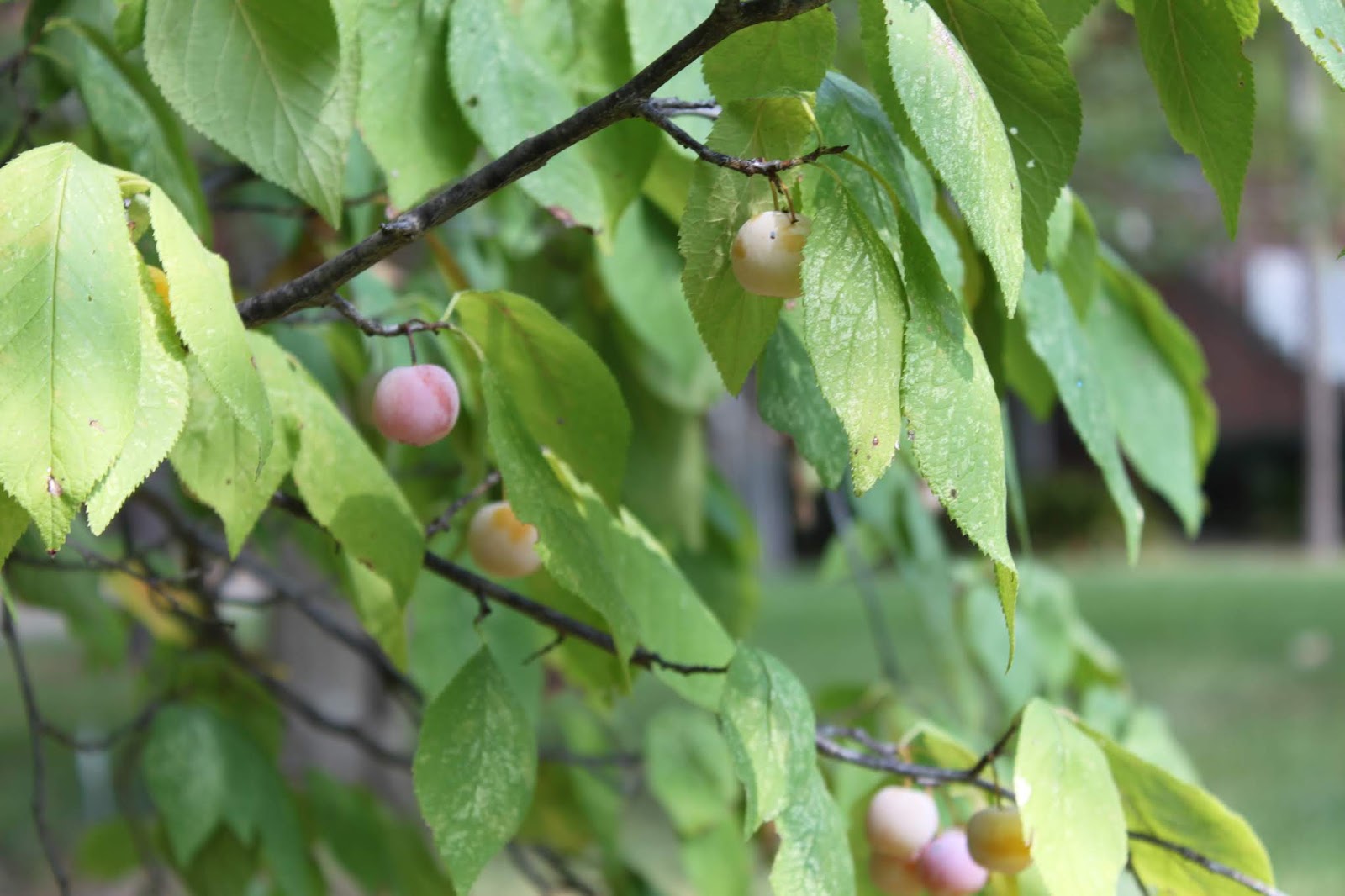
Mexican plums (Prunus mexicana) are some of the showiest trees in our arboretum. In honor of this, they've been featured more than once on the blog. This week they are delighting us with a demonstration of color. The Mexican plums are loaded with a multitude of fruits at all stages of ripening. The transition includes many beautiful hues of orange and red. The pictures below depict the copse of trees located near the Student Union Building. You can read more about this grouping on a previous post.
Unripe plums are green or pale yellow, thus blending in with the surrounding foliage. These fruits have started to ripen, taking on a golden-colored hue.
These pink-colored plums still need more time to ripen.
The red-orange color of the plums are more conspicuous against the greenness of the foliage.
These fruits look good enough to eat. They are very firm and tart. Allow more time for the finest flavor.
Much of the fruit has dropped early, littering the ground with pastel-colored orbs.

Friday, June 1, 2018

Tree of the Week: Black Cherry (Prunus serotina)

This week, we must appreciate the robust black cherry (Prunus serotina). This specimen has gone above and beyond what we could ask of any tree; it's been a real self-starter. Without any assistance from the arboretum staff, this black cherry germinated in the perfect spot, next to the long, white wooden bridge. In 2004, its efforts were first noticed, and it was included in the arboretum collection, as a volunteer for the native-plant-cause. Furthermore, after the tree established itself, it began to serve as a trellis for a native wistera vine (Wisteria frutescens). Anyone who has cultivated wisteria vines understands that this is not for the faint of heart, given the aggressive nature of the vine. Finally, despite the sweltering conditions of the season, this very special black cherry provides tasty victuals, in the form of its famous black fruit to arboretum guests, mostly birds.
When standing in the full sun during the heat of the day, everything is a blur.  Our tree of the week is pictured center, but it is almost indistinguishable from its surroundings. 
Stepping into the shade of a maple, we have a better view: the black cherry is pictured center, to the left of the white bridge and to the right of a laurel oak (Quercus hemisphaerica). This is a nice, comparatively comfortable spot, and the black cherry is contributing to the shadiness.
Covered in thick, woody vines, the black cherry leans westward, perhaps vying for extra sunlight, as this is considered a shade-intolerant species.
Native wisteria (Wisteria frutescens) is the only official climber.
Thick, gray wisteria vines are twisting around the black cherry trunk. Several other vine species have volunteered here and are routinely cut back. 
This is maturing black cherry bark: smooth and beautifully ringed immature bark appears to be flaking off, revealing rough, dark blocks of bark.
Black cherry leaves are simple. They are narrow with an elliptic shape that tapers off to a point. They alternate along the branchlet.
The upper surface of the leaf is glossy and green. Leaves are approximately 4 inches in length, but leaf-length can vary by 2 inches.
The lower surface of the leaf is light-green. Little orange particles line the midrib. This picture also shows the serrated edges.
Fruits are hanging from the branches this week. They are going fast. The birds don't allow the fruits to fully ripen; most are plucked and disappear down the bird gullet before they turn black.
New leaves and fruits are pictured on the same twig.
These ripening fruits measure under half an inch. When fully matured and at peak flavor, they will be black.

There are three other black cherries in the arboretum collection. Last year, in late May, we disussed one such speciman. You can read about that individual here. It's an older tree, but its bark looks less mature.

For more information about this species consult the following:
Virginia Tech Dendrology
NC State Extension