Now that it's the beginning of November, you can find quite a few Gulf fritillary caterpillars on the Maypop (Passiflora incarnata). Coincidentally or not, a couple of years ago in 2023, we photographed these critters on November 5th! How's that for consistency? This year, chilly, autumnal weather seems to be on the verge of freezing the Maypop vine, so hopefully the little caterpillars enjoy the green foliage while they can.
You can find the Gulf fritillary caterpillars on the prosperous Maypop vine, growing around the trunk of the deceased red cedar, near the Fitness Center. If you want to study the caterpillars, you will need to turn over some leaves―this one sits on top just for the photoshoot.
The other caterpillars were hidden under the leaves.
A couple of caterpillars were briefly relocated for a closer examination.
Examining the whole vine reveals the different sizes of caterpillars. As they grow, they molt, shedding their skin and becoming larger. These developmental periods between moltings are called instars (that's Latin for image, likeness, or kind).
The large caterpillar is more than an inch in length, while the tiny caterpillar is more than ¼ of an inch. That little fella is likely a newborn!
How long does it take the Gulf fritillary caterpillars to mature? The answer is about a month, with two or three weeks growing in the caterpillar stage and another week or two developing in the chrysalis.
In October, Dr. Rachel Johnson arranged tours of the arboretum for two classes of first-year students. The tours occurred on October 25th, a little more than a month ago. During both tours, students collected red buckeye (Aesculus pavia) seeds. At the conclusion of each tour, each group of students was encouraged to plant five seeds in two separate sunny spots on the grassy slope near Cline Hall. After planting, students hammered stakes in the ground to protect their germination projects and watered the seeds. The ground has remained damp since then. Now that we are at the end of November, seedlings are emerging!
Each planting location has its own sign. This one is for the seeds planted by students in the 8 o'clock class.
The planting sites are small, just big enough for five buckeye seeds. Two stakes protect the space. At first glance, it doesn't look like much is happening here.
If we stoop down to closely examine the soil surface, we can see our first seedling is up and on the verge of unfurling. It's already 4 inches tall! There are two other seedlings in this spot, just beginning to emerge from the dirt.
Not far from the 8 a.m. planting, the seeds planted by students in the 12 o'clock class have a space marked.
Interestingly, as of November 28th, this spot doesn't show any activity. The same planting procedures were followed for both classes, with only four hours separating their activity, so why would one planting of seeds germinate in advance of another? Of course, it could simply be the result of random seed variation. However, it should be noted that the two classes collected seeds from two different groupings of red buckeyes. The 8 a.m. class collected their seeds from the buckeyes planted in 1997; these small trees had fruits still attached, so the seeds were removed directly from the trees. By contrast, students in the 12 p.m. class collected seeds from the older, original grouping of buckeyes, planted in 1986. These seeds were picked up off the ground. So, while the planting procedures were nearly the same, the collection procedures were a little different. The seeds from the two different sources looked the same, so perhaps age has something to do with viability. Only time will tell.
Leaves and fruit clusters of the rattan-vine (Berchemia scandens) can be found in the leaf litter this week. The leaves in this photo still have their summer hue. Although several rattan-vines grow wildly in the arboretum, we have a collection of vines that were intentionally planted in 1997, at the base of a flowering magnolia (Magnolia grandiflora), located near the Fitness Center. All of the photos on this post are from that collection of vines, already made famous by previous blog posts (here and here).
From one cluster, we have 27 fruits. They aren't uniformly colored. The ripe fruits are blue.
Fruits are small. These measure approximately ¼ inch in length.
This pretty yellow leaf was also found in the leaf-litter. In 2017, these vines were showing their best fall coloration at the very beginning of December. You can find that photo here.
We spotted an all-white moth on the exterior of the Science Building, Mickle Hall, resting on a concrete window ledge near the arboretum shed. It's small, measuring less than an inch in length, and it is mostly inconspicuous against the gray cement.
Surprisingly, the proximity of the camera didn't seem to bother the moth―hence it was subjected to some close-up photography. The wings look very soft and legs carry black markings. This delicate creature is very neat! Which species of moth might we be looking at? Consulting our most popular search engine for 'white moth' results in immediate & sheer terror: the white satin moth (Leucoma salicis), an invasive species known for large-scale defoliation.
After extensive combing through online image catalogs, notably the Pacific Northwest Moths hosted by Western Washington University, another possibility
arises: it's simply a native nuisance, the fall webworm (Hyphantria cunea). Zooming in on the photo, we see a yellowish color on the front legs, which is a
characteristic of our fall webworm. A more thorough examination was not
conducted, i.e., the moth would essentially have to be killed and autopsied, so we cannot give a firm identification of this
individual. But we must note that fall webworm caterpillars were
previously hard at work in the arboretum, feasting on a young sweetgum; you can read that blog post here.
Can you see the feline? The arboretum is full of creatures, some native and some invasive. Cats are invasive. They are known to keep the rodent population in check, which is good for maintaining sanitary living conditions, but cats are also known to be bad for native bird, lizard and snake populations.
While stylish, a bright orange coat is better suited to camouflage in pine straw than green grass. In any case, this individual seems to be doing just fine in the arboretum. It was pictured on the blog more than two years ago; you can find that post here. What has it been eating all of this time? A few single-serving cat food containers have been found in the arboretum, so maybe it's receiving all of its caloric intake from a generous student or employee of the college.
After being spotted, this animal is making a break for it.
This orange tabby is typically found in the old part of the arboretum, near the brick retaining wall that separates the arboretum from Hamilton Hall. The drainage infrastructure offers several quick getaway spots.
Since we have been studying the caterpillar of the giant swallowtail (Papilio cresphontes), we might as well look at another interesting caterpillar, this time an arboretum favorite. The Gulf fritillary has appeared on the arboretum blog more than once (here and here). Summertime brings an abundance of yellow passionflower (Passiflora lutea) to the arboretum and every summer the fritillary comes back to enjoy it.
Here we see the Gulf fritillary eating a leaf of the yellow passionflower. Currently, this is the only species of passionflower in the arboretum collection. We ought to make it a priority to plant purple passionflower (Passiflora incarnata) in the spring.
We briefly removed the caterpillar from its vine so that we could take a measurement. At the moment, it's less than an inch long.
It's small, but looks scary! Aren't those spikes marvelous? Never fear; it's all for show. Presumably this is to dissuade any would-be predators. This type of defense color pattern is a different tactic than the one exhibited by the caterpillar of the giant swallowtail.
By contrast, the caterpillar of the giant swallowtail is inconspicuous: it both blends in with its environment and looks like something you want to avoid eating or even touching: a waste product.
Autumnal weather has arrived in northwest Louisiana. This week we experienced low temperatures in the 30s, and over the next several days we expect high temperatures above 80℉. Although the mosquitoes are still buzzing about, the overall drop in temperature means that we can start moving plants around without fretting too much about survival rate. Today, a young, volunteer toothache tree (Zanthoxylum clava-herculis) was transplanted to a better location and officially added to the arboretum catalogue.
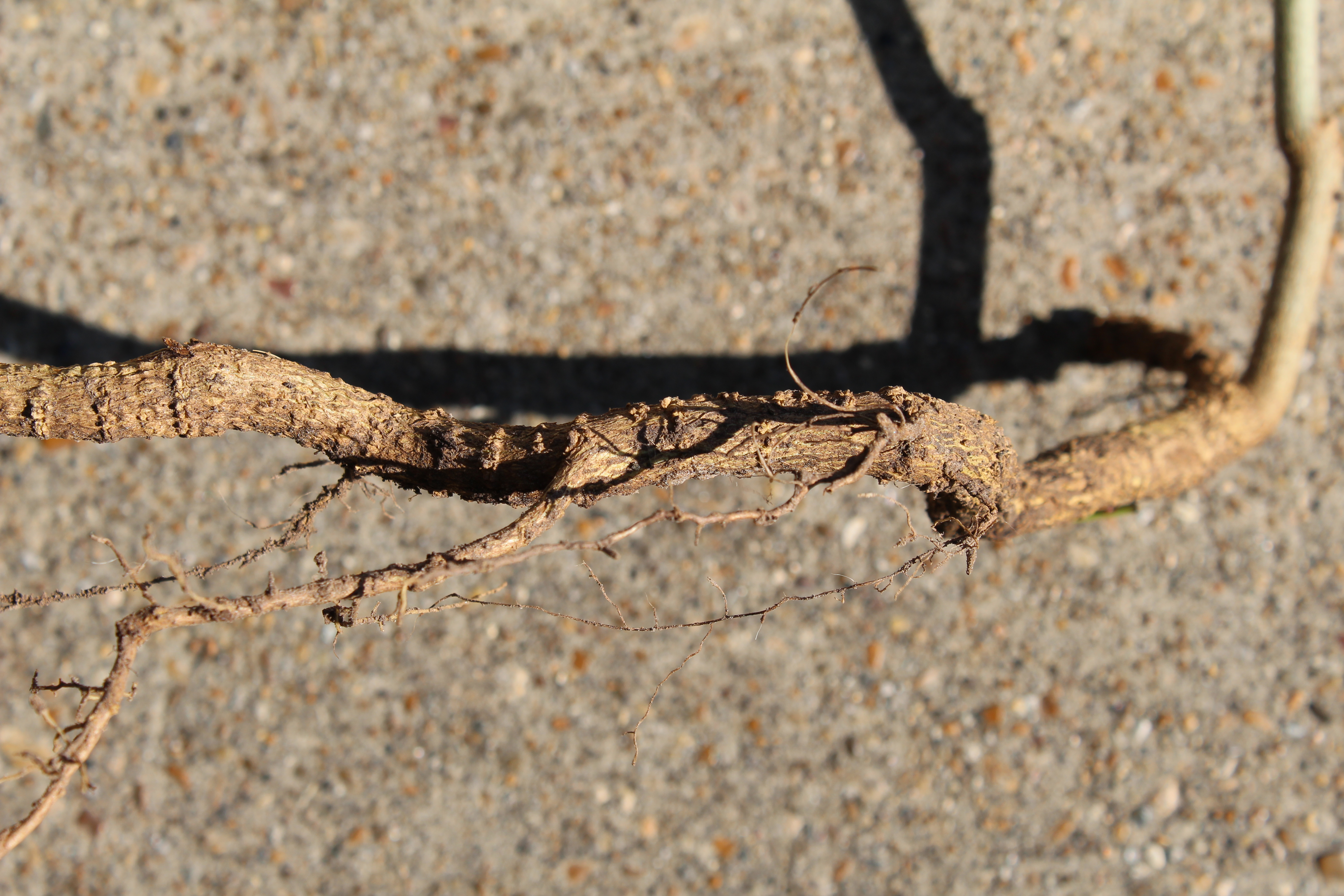
The volunteer toothache tree is pictured center. Some time within the past few years it germinated in the patch of dewberry (Rubus trivialis) on the west side of Mickle Hall, not far from the mature toothache tree. After the dewberry and yellow passion flower vines were pulled away from it, we could see the form of the young toothache tree: it is a little less than 2 feet tall, and it has a very long surface root.
This is a detail image of the toothache tree's long surface root. The little tree isn't connected to the soil at the base of its trunk, and it seems that the vines that had grown up around it were doing much of the work of holding it up straight.
Examining the volunteer toothache tree gave us another look at the giant swallowtail caterpillar (Papilio cresphontes). We talked about this species on our previous blog post.
In this video we can see the caterpillar eating part of a toothache leaf. (The video also shows how windy it was today!) When humans chew on the leaves of this tree, we experience a tingling sensation in the mouth, and if we chew on enough of the leaves, we experience a numbing effect.
This large, chunky caterpillar with a very interesting color scheme was relocated to the nearby mature toothache tree.
This toothache tree only has shallow roots, with one particularly long surface root. Not much digging was required to remove the tree from the dewberry patch.
The root system is surprisingly sparse, especially considering how healthy the trunk looks.
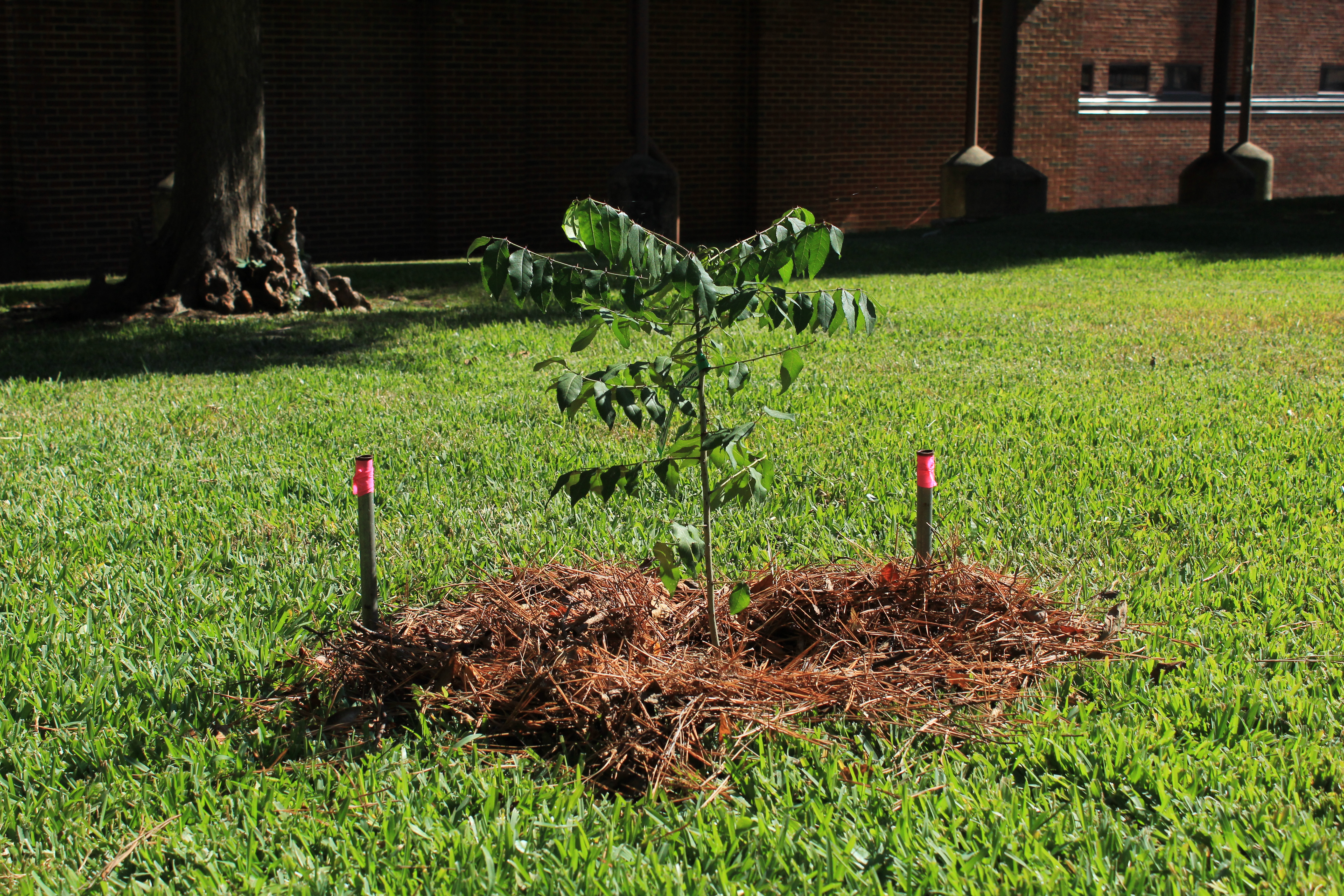
The toothache tree was transplanted from the top of a hill to the bottom of a hill in the hopes that it will have access to more water. It appears to be all by its lonesome on the Fitness Center lawn. A black oak (Quercus velutina) and black willow (Salix nigra) are growing nearby.
Two metal stakes flagged with pink tape serve as protection against lawn mower damage, and the pine straw mulch will help the soil retain moisture. This individual was thoroughly watered after planting was complete, and the soil moisture will need to be monitored until the tree enters dormancy.
Leaves at the very top already started to droop from the stress of relocation. They will hopefully perk back up soon. This same thing happened to the two other toothache trees that were transplanted this past spring. You can read about them here. Both of those young trees survived the summer.
We have more post oak (Quercus stellata) acorns to add to our on-going germination project. These acorns were collected this past week in the Piney Woods region of East Texas, south of Jacksonville. They've since been potted, so now we wait to see who sprouts and who doesn't.
These water oak (Quercus nigra) acorns were collected at the same time from the same property. They have been potted as well. The arboretum is currently home to seven mature, on-site native water oaks, but we do not currently have any young water oaks in the collection.
This past week, we found both ripe and ripening acorns in the leaf litter under our large swamp white oak (Quercus michauxii). There weren't many fruits―only these five. In hindsight, it would have been worthwhile to count the empty caps.
The ripening acorns are very pretty―the caps are pink!
In the middle of November, our younger white oaks (Quercus alba) have ripening fruits. In this photo, the leaves are still mostly green, while the acorns are a light pink.
On the same tree, on the same day, we see a little autumnal red on these leaves.
Our time has come round at last―post oaks are dropping their acorns!
A year ago, our old, on-site native post oaks showed no signs of acorn production. Campus trees were inspected, as well as two large stands in Caddo parish. This was troublesome because the continued diminution of the campus post oak population necessitates a germination project. Back in September, our sights were set on the two old post oaks near the Sam Peters Building, simply because acorn clusters were identified. Pictured below are the first participants for our germination project.
Two mature, on-site native post oaks are pictured center, in the above cluster of trees. They stand at the top of a hill near the Sam Peters Building. A mature, on-site native southern red oak, also pictured, has been growing alongside these post oaks for a very, very long time.
A total of 16 post oak acorns were collected, but only 10 were selected to be planted. The chosen 10 are shown in the above photo. More acorns will hopefully drop; these are just some of the first ones to hit the ground. Keep in mind that the Centenary campus squirrel population is vigorous and mostly uncontrolled, so the arboretum curator has fierce competition for these gems.
One acorn already started to sprout! Hopefully we found it at the right time. These 10 acorns are in the dirt and watered in. Let's see what happens!
Our tree of the week is a 25-year-old black hickory (Carya texana). Last year at this time, this same tree was featured as our tree of the week. You can find that post here. This year, we have a few more photographs, snapped under a sunny sky, allowing us to appreciate the striking fall coloration of this species.
Our tree of the week is located in the center of the arboretum, near the basement entrance to the Student Union Building. It grows in full sun at the top of a gradual slope.
With the sun hitting its leaves, our black hickory shows
varying shades of gold, bronze, yellow and orange. In the photo above, sunrays directly hit
the left (southern) side of the tree, resulting in bright yellow leaves. Dark orange leaves appear on the right (northern) side of the tree.
From another angle, we can appreciate the pleasant pyramidal form of the black hickory.
The clear blue sky contrasts with the yellow-orange triangular apex of the black hickory. The effect is similar to that of the Great Pyramid at Giza,the apex of which was originally plated with gold to catch the sun's fire. The hickory certainly achieves its beauty with much less work.