Showing posts with label October. Show all posts

Friday, November 8, 2024

Education & Outreach

An academic arboretum has two purposes. In its fundamental and most basic role, such an institution serves as a repository for living specimens and the germplasm of plant species. If this goal has been accomplished, a secondary role can be achieved: showcasing these specimens to students and the public, with the intention of increasing knowledge about those trees, shrubs, and herbs. Because they exist in physical space and not as a description in a book or on a computer, the arboretum's cataloged specimens can be seen year-round and from 360 degrees. You can "zoom in" and look as close as you want. Can't find just the right photo of a tree? Go snap one yourself at the arboretum. If you like the organism enough, you may be able to collect some seed and start your own. Short of cutting the specimen down or doing permanent damage, every plant in the arboretum is part of an interactive experience; no screens involved.

In support of this ideal, today we'll show some photos of a recent arboretum tour that Centenary College's Visual Identity and Publications Manager Sherry Heflin was kind enough to photograph. Normally, photos of tours given at the arboretum are not available, since the curator cannot photograph herself while thinking, walking, and speaking. Perhaps the arboretum needs a very expensive autonomous drone with a nice lens for such occasions. Then again, Skynet drones might disrupt the ambience for a group that is supposed to be experiencing nature. 

 All photos below were taken by Sherry Heflin, on October 21, 2024.

The tour began in the oldest part of the arboretum, between Hamilton Hall and the Student Union Building. One of the four black metal arboretum signs marks the northern edge of the arboretum.


For a tour during the fall, fruits are a great topic. The arboretum has many different species of oaks growing in a small area, so it's easy to find acorns and compare them. These small acorns were collected under a water oak (Quercus nigra).

This big acorn was snipped from a Burr oak (Quercus macrocarpa).

Persimmons are ripe this time of year! Here, the arboretum curator holds an example of a perfectly ripe persimmon (Diospyros virginiana).


French mulberry fruits are also edible, but not recommended. These pretty purple fruits weren't as numerous in late October.

The arboretum curator displays the very small seeds of the redbud (Cercis canadensis).


In the arboretum, there are plenty of opportunities to play the game: 'Where's the tree? Where's the vine?'. Here, the arboretum curator points out bright red fruits hanging from a black cherry (Prunus serotina). The bright red fruits actually belong to a vine, Carolina moonseed (Cocculus carolinus).


Ouch! These spiny fruits were produced by the American chestnut hybrid, Dunstan (Castanea dentata).


The arboretum has numerous red buckeyes trees (Aesculus pavia). Here, a Centenary students opens a buckeye fruit, looking for the large seeds.


Buckeye seeds are shiny and look oily. What do you think they smell like?


Competition over resources wasn't the focus of this tour, but a few examples were pointed out. Here we have an interesting example. Two trees are shown here. Their trunks have grown together. The slender trunk, leaning toward the left, belongs to a black oak (Quercus velutina). It was intentionally planted. The big trunk, growing straight up, belongs to a southern red oak (Quercus falcata). The red oak volunteered a few years after the black oak was planted, and the red oak has out-competed the black oak for sunshine, water and nutrients.

Even what looks like a bare stick is worth talking about. At the beginning of the tour, the arboretum curator explains that these is the arboretum's original patch of Hercules-club (Aralia spinosa), planted in the old part of the arboretum, circa 1990. Only three spindly plants remain.
Later in the tour, the arboretum curator points out a thriving grouping of Hercules-club. Here, the curator stands among the Hercules-clubs, holding two trunks. These plants are younger, and yet they are significantly larger. Viewing these plants in person and walking through the landscape, we can easily start to formulate hypotheses.


There is always something to talk about in the arboretum. The landscape is always changing!


Sunday, October 27, 2024

Chinese Tallow Tree (Triadica sebifera)

In this post we'll discuss the Chinese tallow tree (Triadica sebifera), a "spurge" in the family Euphorbiaceae. Spurge is a funny-sounding word, but is merely an archaic English word related to "purge" or "expurgate," referring to the latex that many spurges, including the Rubber tree (Hevea brasiliensis), contain. Do not mistake the Chinese tallow tree for the Chinaberry tree (Melia azedarach), a member of the mahogany/neem family. If you did so, you would easily be forgiven since they have many similar characteristics:

  • Both trees are native to East Asia, although the Chinaberry tree has a much wider distribution from India to China to the Indonesian archipelago.
  • Both trees were brought to the American Southeast around two hundred years ago, where they quickly went feral.
  • Both trees have some ornamental applications and some productive uses, but these positives are outweighed by the toxicity and sheer weediness of the plants.

The arboretum does not contain Chinaberry trees, as far as we know. We do have volunteer Chinese tallow saplings. They germinated in one of our wild areas and had the opportunity to grow unhindered for more than two years. This past week, the tallest and most conspicuous individuals were removed.

There is a small, overgrown area of the arboretum at the southwest corner of Mickle Hall. It was mowed only once within the past three years.

This area slopes down toward the arboretum drainage channel. The groundcover was badly damaged and the topsoil was washed away during the Mickle Hall rennovations that occured in 2011. The groundcover never recovered and consequently the area was progressively eroded, so we decided to stop cutting this area in the hopes that something would take root and keep the soil in place.
Chinese tallow tree (Triadica sebifera) was one of many voluteers that unexpectedly took root in this difficult space. In this photo, the Chinese tallow tree has grown up above the surrounding grasses and is leaning toward the sidewalk, stretching for more sunlight.

Chinese tallow tree has a very distinctive leaf shape. It looks like a Christmas decoration!


The tip of the leaf comes to a point.


This is a small bundle of young Chinese tallow trees. They were all removed from the same area. Since there aren't any mature Chinese tallow trees in the arboretum, it would be interesting to know where the nearest mature specimen is located.


This is the slender trunk of one sapling. The leaf petioles alternate up the trunk.

Chinese tallow leaves are very pretty. A fly photobombed the picture, giving us a great size-comparison photo.

External links:

USDA page on Chinese Tallow Tree

LSU AG Center page on Chinese Tallow Tree 

LSU AG Center page on Chinaberry Tree

N.C. Cooperative Extension page on Chinese Tallow Tree

Wednesday, October 23, 2024

Poison Ivy (Toxicodendron radicans)

Poison ivy (Toxicodendron radicans) is robust, shade-tolerant, and manifests in multiple distinct growth-patterns. It's found almost everywhere in the Eastern woodlands and offers food for birds with its berries, although it can also spread asexually. These traits make it an important and resilient plant species, adding to its reputation as a fearsome nuisance.

The most salient aspect of poison ivy is the resin found in its leaves: urushiol. This term derives from the Japanese name for a related species, Toxicodendron vernicifluum, the Chinese lacquer tree. Not confined to poison ivy, urushiol resin can be found in many members of the family Anacardiaceae, which also contains the sumacs (genus Rhus) and the cashews (genus Anacardium). Despite its traditional use in East Asian arts and crafts as the primary ingredient for lacquerware decoration in woodworking, urushiol is a potentially dangerous poison. Contact with the resin leads to an immune-response whereby the skin is attacked by the afflicted's own T-cells. Rash, blisters, scarring, and even necrosis in severe cases results, and a prolonged healing period is generally required before the affected skin returns to normal.

Thankfully, not everyone experiences an allergic reaction after exposure. Even within nuclear families, one member will be allergic and another may be immune or only slightly allergic. For those who do "take poison ivy rash," knowing how to identify this plant is extremely important if you like to be outside. This plant isn't just found in the woods; it grows readily in town, and it frequently germinates in the arboretum as a volunteer; thanks, birds. Although it isn't welcome in the landscape, we never get rid of all of it.


This is one of the arboretum's less-cultivated areas. It's a small wedge-shaped zone located near the southwest corner of Mickle Hall. Due to a serious problem of erosion in this section, we have allowed some extra undergrowth to accumulate that would not be tolerated elsewhere. Over the last approximately three years it has only been mowed once.


A couple of poison ivy plants were spotted this week. Two vines were growing straight up, and they had grown taller than the surrounding plants, making themselves conspicuous. The Japanese proverb Derukui Wautareru (The nail that stands up gets hammered down) is appropriate here, given the urushiol. Let the rest of the arboretum's denizens be thus warned.


This is the tallest vine that was snipped. Several additional pieces were carefully cut, photographed and then discarded.
 
This is a detail image of the vine. Here we see light green leaf stems alternating along a light-brown vine.


Poison ivy has compound leaves. In this photo, we see one leaf. Each leaf has three leaflets. Some people find the saying "Leaves of three, let it be" helpful; other people find such expressions confusing.

 
This is another leaf. There are three leaflets, and one leaflet shows signs of predation. Who out there is bold enough to chow down on poison ivy?


USDA page on Poison Ivy

LSUAgCenter page on Poison Ivy ID 

Urushiol and lacquerware 

Wednesday, October 16, 2024

Toad's World


What secrets do these sprinkler boxes hold?

Amphibians! To the novice, these may appear to be "frogs" or even "toad-frogs." In fact, they are true toads of the family Bufonidae. This is either eastern toad (Anaxyrus americanus), southern toad (Anaxyrus terrestris), or Fowler's toad (Anaxyrus fowleri), three closely related species occuring in our region. We'll call this a medium-sized specimen.

Now for the itty bitty, insy winsy variety: this little fellow looks like he was born yesterday. But give him some credit; he is probably the sole survivor of a clutch of thousands of eggs. Given these odds, we should award these little fellers some credit. Like the medium-sized specimen above, we can't tell if this is an American, Southern, or Fowler's toad.


Seen in profile, this small toad has good posture.

A comparison is a nice way to round out this post. Clearly we have enough bugs and creepy crawlies to go around.

These toads come in red, black, brown, tan, "Mossy Oak," and all the shades in-between. Examination of the links below has led us to believe that this is a Fowler's toad (Anaxyrus fowleri). Identification mostly depends on the presence and form of ridges between the eye socket and neck glands, as well as the relative size of leg warts. In this case, the specimen lacks a prominent post-orbital ridge and has more-or-less uniformly sized warts. Let's also take a moment to mention that toads are not only gorgeous creatures, they are seasonally appropriate.


Do you remember the line "Double, double toil and trouble; Fire burn, and cauldron bubble" from Macbeth? You may have forgotten that in the long list of ingredients, TOADS were the first reagent to be added:

Round about the cauldron go;

In the poisoned entrails throw.

Toad, that under cold stone 

Days and nights has thirty-one 

Sweltered venom sleeping got, 

Boil thou first i’ th’ charmèd pot.

Fillet of a fenny snake

In the cauldron boil and bake.

Eye of newt and toe of frog,

Wool of bat and tongue of dog,

Adder’s fork and blindworm’s sting,

Lizard’s leg and howlet’s wing,

For a charm of powerful trouble,

Like a hell-broth boil and bubble.

Scale of dragon, tooth of wolf,

Witch’s mummy, maw and gulf

Of the ravined salt-sea shark,

Root of hemlock digged i’ th’ dark,

Liver of blaspheming Jew,

Gall of goat and slips of yew

Slivered in the moon’s eclipse,

Nose of Turk and Tartar’s lips, 

Finger of birth-strangled babe

Ditch-delivered by a drab,

Make the gruel thick and slab.

Add thereto a tiger’s chaudron

For th’ ingredience of our cauldron.


External links from Gonefroggin':
Fowler's Toad
Southern Toad

Photos of Fowler's toad from UC Berkley

Photos of Southern toad from UC Berkley

A helpful youtube video on toad identification 

Thursday, October 3, 2024

Volunteers in the Arboretum

As we continue to clean up the volunteer recruitment area and make it more accessible, we also document the species that have taken root in this green space. Since the volunteers are by necessity an unmanaged population, this is an interesting sample of what survives the struggle for existence.


This week we are clearing a path around a looming specimen: our only large, on-site native southern red oak (Quercus falcata). It is the large trunk pictured center. Most of its upper branches are out of the frame.


Seen from another vantage, the same mature southern red oak (Quercus falcata), and the red bricks of the Student Union Building are seen in the background.

Over the past few years, we haven't had a path around the base of this trunk.


Until today, the tree sign was hidden by the undergrowth. The area is thick with vegetation. Numerous volunteers are present with several different species represented.

Now, things have changed. First, the area was carefully surveyed for possible recruitments to the arboretum catalogue. This process involved weeding by hand―pulling up dewberry and snipping little trees. A few individuals, currrently very short in stature, were identified as candidates (we will let them grow up a little more before making it official). Then, this area was cut with a lawnmower to make a clear path.

Now, you can clearly see the sign.


Most of the volunteers around the southern red oak were removed or cut back to the ground. Only a few were left unharmed, and they are not visible in this photo. 

The photos below showcase the most conspicuous volunteers that were removed. These individuals were quick to colonize a new territory and were winning in the competition for survival. Unfortunately, they didn't germinate in a space deemed suitable by the arboretum curator.

chittamwood (Bumelia lanuginosa) REMOVED.... Although another chittamwood nearby will most likely be added to the arboretum's collection; it is located further away from the red oak's trunk.

oak (Quercus sp.) REMOVED

trident-leaf maple (Acer buergerianum) REMOVED

goldenrod (Solidago sp.) REMOVED

trumpet creeper (Campsis radicans) REMOVED

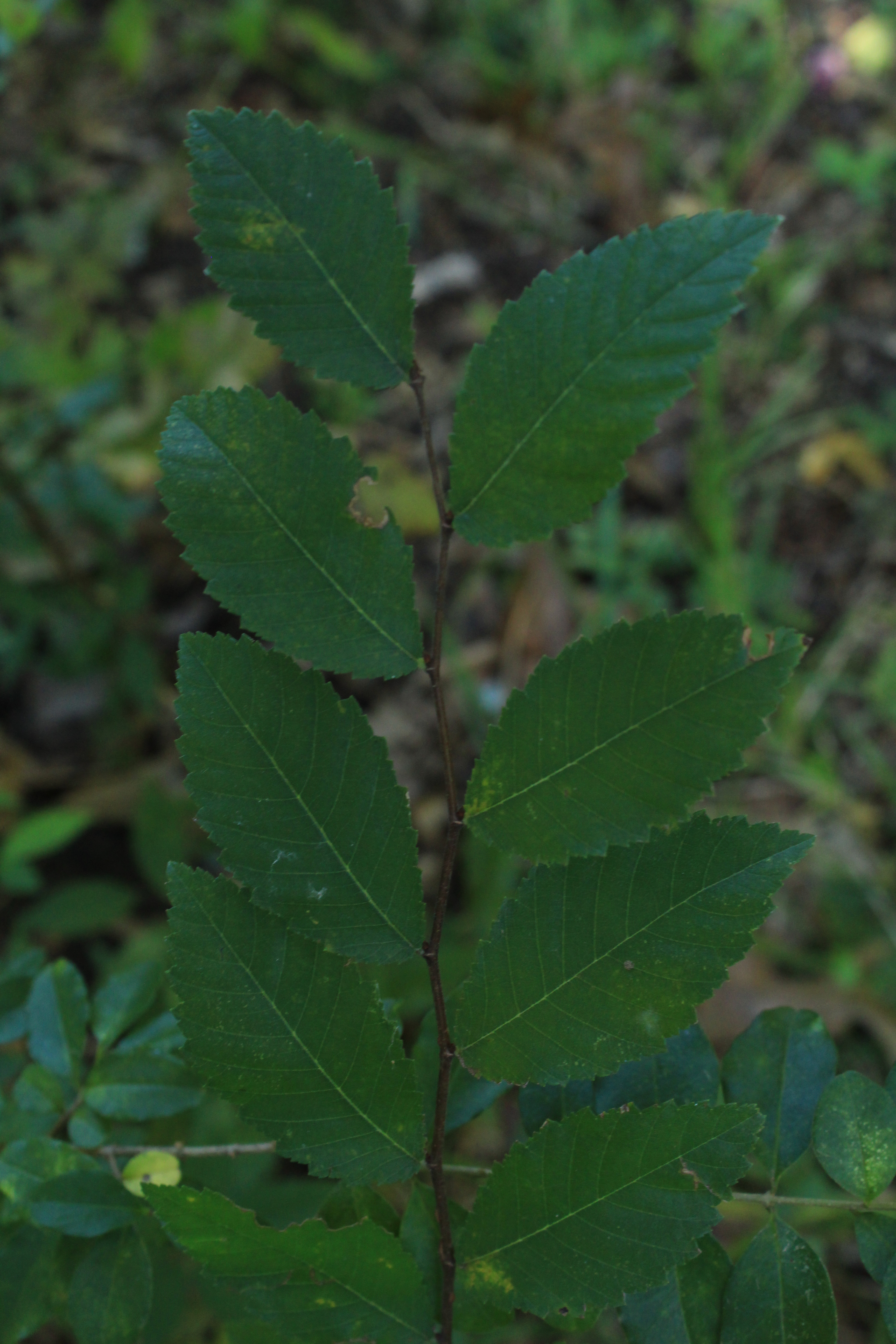
elm (Ulmus sp.) REMOVED

redbud (Cercis canadensis) REMOVED

nandina (Nandina domestica) REMOVED

non-native holly (Ilex sp.) REMOVED

red mulberry (Morus rubra) REMOVED

Mexican plum (Prunus mexicana) REMOVED

non-native privet REMOVED

Virginia creeper (Parthenocissus quinquefolia) REMOVED

dewberry (Rubus trivalis) REMOVED This species was heavily represented around the base of the red oak trunk; the ground was thick with dewberry. This species is very successful in the ground of the arboretum.