Showing posts with label maintenance. Show all posts

Saturday, January 25, 2025

Slope Maintenance and Bridge Replacement


Another exhausting session of work on the disturbed slope, with temperatures in the 35 to 45 degree range. The clay is thankfully drying out, which makes it easier to manipulate.


Things are looking better, but it will probably be a year or two before nature heals. Since the ground has been so thoroughly disturbed, we ought to have a multitude of volunteers germinate in this spot. It will be interesting to see what comes up.


Going further down the slope, we see that the new bridge is complete! Wahoo! In the arboretum catalogue, this is referred to as 'the long white wooden bridge that runs from Mickle to the Student Union Building'. It's not white anymore.


Ought we paint the bridge white? Another color? Or is the bare look of treated lumber pleasing?


The large pile of materials is gone; craftsmen have used it up.


Here we can see the under-structure of the new bridge, along with some new pylons made of concrete block and treated lumber.


The new bridge also makes use of the old pylons.


Wednesday, January 15, 2025

Slope Maintenance and Bridge Replacement (Part II)

This area is still a mess since the last time we worked on it. Projects like this must be repaired slowly, as the big chunks of clay are not easily moved, shaped, or broken up when they have any appreciable moisture content. Weather, uncontrollable and unpredictable as it is, can be a major inhibiting factor.
 
Leaves, on top and mixed into clods of clay, make for a very difficult work environment. It's hard to see what needs to be done since leaves can cover a gaping hole or simulate a mound of earth.


Leaves of the swamp white oak (Quercus michauxii) comprise the bulk of the leaf litter.

With the heavy leaf layer removed, we can see what needs to be done. Much of the gravel has been washed down slope, exposing roots.


Looks can be deceiving; it may not appear much different, but a lot of work went into leveling off these mounds of clay, smoothing out the slope, and generally re-sculpting the damaged terrain. Hopefully we have a few more days before another good rain soaks the ground, making the clay unmanageable.

In other news, a construction project is underway in the middle of the arboretum.

The long white wooden bridge that runs between Mickel Hall and the Student Union Building was completely removed, and carpenters are now in the process of building a new structure. See pictures of the old bridge here.


It takes a lot of material to build even the simplest infrastructure. Plenty of treated lumber is stacked nearby, waiting to be used.


The bridge spans the arboretum's drainage channel. Currently there is standing water in the stream, but this area dries out during the summer.

Some of the bridge's pylons are made of heritage brick. The rest are economical cinderblock.


This treated lumber will need to withstand quite a range of weather conditions: hot, cold, wet, and dry. The previous bridge lasted more than two decades.


We wish the workers a safe project and look forward to having a new bridge.

Friday, December 6, 2024

Clay Cleanup and Local Masonry Relics

In this post from November, we showed an arboretum eyesore. Recent service-work on a water leak resulted in major dirtwork. The excavator destroyed the topsoil, tore roots, and covered a gravel path. With work on the underlying infrastructure *possibly* completed, we can start restoring the landscape. The photos below show the clean-up operation in progress.


This photo is from our November 12th blog post. We see the aftermath of the service work. Large mounds of muddy clay were left on the surface of the ground after a large root ball was extracted from a clogged drain. It was a substantial water leak so the soil was saturated.


As the soil slowly dried, clods of clay were broken up and distributed. In this photo, we see that the ground is still an uneven, rough mess with tripping hazards.

Thankfully most of the clay clods have dried and can be picked up and moved. This was impossible a week ago.

The excavator timbers used to create a terrace and protect our path were run over and their structural rebar supports were bent out of shape. This whole area had to be dug up and rebuilt by hand.


After reshaping the path, the landscape looks much more inviting.
After several hours of work, the path is more-or-less clear and somewhat level.
 

Restructuring the path brought our attention to a collection of vintage bricks used to line the lower portion of the path. J. E. Whiteselle opened a construction business in 1875. This was carried on until its eventual closure some time in the 1980s. During the course of its existence, tens of millions of bricks like the one below were produced in Corsicana, Texas. Today many of them rest beneath the asphalt of small Texas towns' streets, in fields, in old homes, and yes, even in the Centenary College arboretum. This is made of a red clay mined in Corsicana, and many people find this brick evocative and attractive.

This photo was taken before the major clean-up operation. We see that bricks line the lower portion of the path.


Upon closer examination, we see an example of the Corsicana 'cherry red', a piece of east Texas history.


There are a few online sources regarding the Whiteselle 'cherry red':

https://txnavarr.genealogyvillage.com/transportation/saving_transportation_history.htm

https://www.facebook.com/corsicanapreservationfoundation/posts/pfbid02XkS6NhywUDWuDBFCXSovtR12rG1WZUuoFFUAZSVdQTPtgBvsRtGJpULBERPqY2dzl

https://www.newspapers.com/article/corsicana-daily-sun-whiteselle-brick-l/34251027/?locale=en-US

Wednesday, September 11, 2024

Cleanup Operations

Today, more than four months since it fell, we decided to complete the water locust (Gleditsia aquatica) clean-up operation. Most of the mess was cleared away during the month of May. Over the summer, a very large section of the trunk remained wedged inside the yaupon holly on which the water locust had collapsed.


A section of the water locust trunk is pictured on the far right of the photograph. It had been resting in the yaupon holly shrub for several months.


As this tree trunk was suspended off the ground, we are "stumped" as to its current rotted condition. There are numerous mushrooms growing on it. Why would a rot-resistant tree have rotted so quickly?


A chainsaw was required to reduce the trunk to movable pieces.

All cleaned up! The water locust is gone, which is sad, but the good news is that we have a young water locust to plant this winter.

Sunday, September 8, 2024

Arboretum Cleanup: Catalpa (Catalpa bignonioides)

Maintaining trees in an urban landscape often requires pruning. Removing lower branches from trees allows for more foot traffic in proximity to the trees, and it also increases visibility, which is a safety concern. Some trees require more pruning than others. Today we'll take a look at one of our catalpas, which is in rude health. See previous posts on the history of this tree here and here.


The catalpa (Catalpa bignonioides) is pictured center. What a gorgeous tree. It is only eleven years old! Take a look at the trunk: there aren't any branches near the ground.


Even though the lower branches have been removed from the trunk, branches further up the trunk droop low to the ground.

The leaves and seed pods are only a couple of feet above the grass.

 We pruned this tree and its partner (not photographed), which lies across the drainage canal. With the lowest drooping branches removed, we see more of the landscape, and, more light is now available to the little trees and shrubs recently planted. The catalpa will hopefully invest its energy in its upper branches rather than the ones nearest the ground.

Thursday, February 29, 2024

Retaining Wall Cleanup: Trumpet Creeper (Campsis radicans)


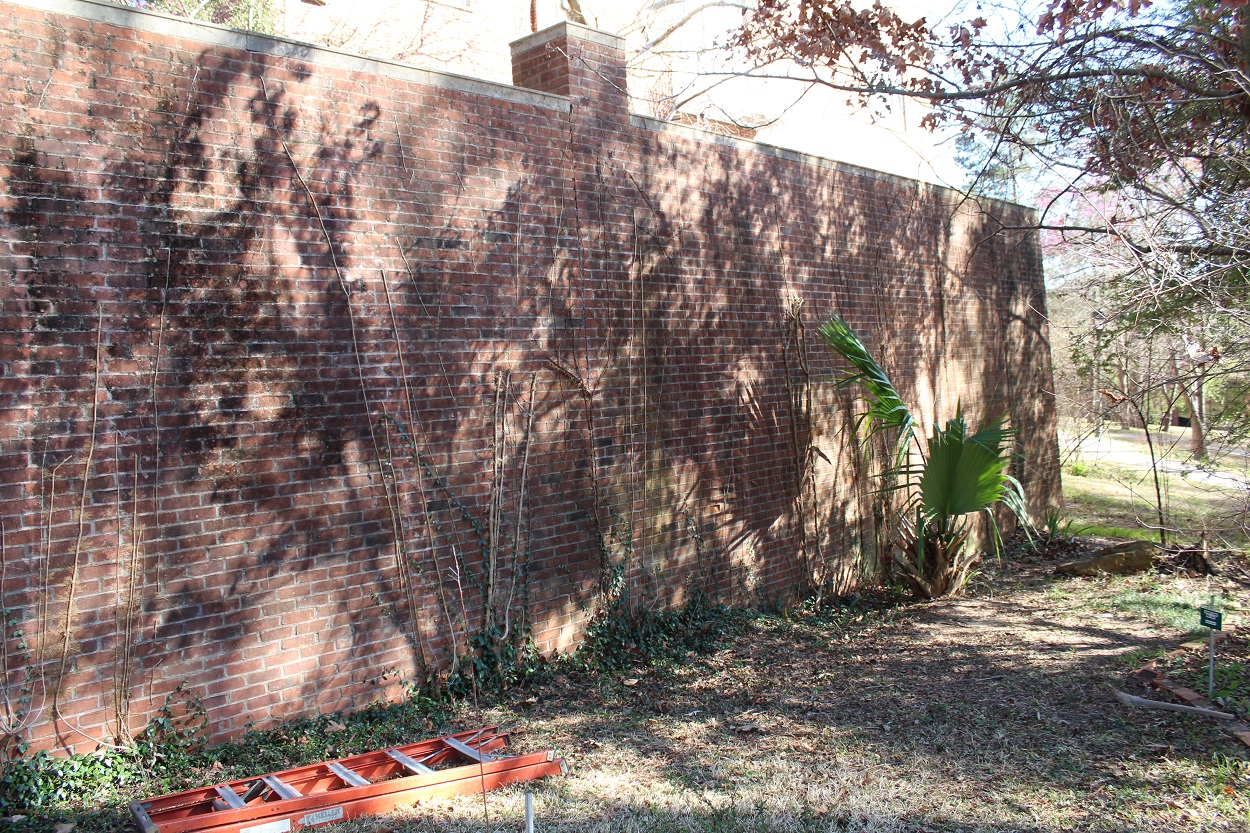
Here we can see a mix of vines which are properly attached to the wall, and some that have been detached and thrown over by the grounds crew. We'll finish the job by preserving as much as we can of the healthy vines while disposing of the clutter.


This aerial tangle is composed of dead vines, live vines, tree branches, and dead palmetto stalks.

Now it's all cleaned up!


Now the wall's cleaned up and will hopefully support some trumpet creeper flowers later in the year.

 
You've probably not recently seen a pile of vines this large.

Sunday, December 3, 2023

Routine Maintenance

Although many species of trees are capable of outliving humans, they still have limited lifespans, and just like us, they can be victims of physical damage and disease that result in 'untimely deaths'. Due to the large variety of species and conditions in the arboretum, we frequently see injured trees or sick trees and then must decide what to do with them. This week we took action on three cases.


This wax myrtle (Myrica cerifera) shrub has two main trunks that are beyond help.


Thoroughly rotted and moldy wood is immediately visible.


Upon being cut with a chainsaw and falling to the ground, the fallen trunk exploded in a blast of rotting pulp.
 

At the end, everything is much cleaner and the wax myrtle specimen itself is unharmed.


Among the palmettos, we see the trunk of a red bay (Persea borbonia) marked with pink tape. The red bay has certainly seen better days. It appears to be afflicted with some disease.

The leaves look dreadful, with crinkled edges and spots.

Both trunks, the dead one and the living one, have equally scarred and damaged bark. It's time for this one to go, in order to avoid spreading disease.

What's wrong with this tree was wrong all the way through it. Sometimes you don't know the condition of a tree until you saw it down. In this case, we're vindicated.

This titi tree (Cyrilla racemiflora) has two trunks. The right trunk has branches with leaves, but the left trunk, marked with pink tape, does not have leaves or leaf buds.

Due to its proximity to the footbridge, this individual has endured much pruning over the years.

Luckily, several swamp titi shrubs, of varying age and size, still remain in this area, and with the dead material removed, pedestrians have more room on the boardwalk.