Showing posts with label Family: Aceraceae. Show all posts

Tuesday, November 26, 2019

Tree of the Week: Red Maple (Acer rubrum)

Maples are widely appreciated for their fall foliage. In the arboretum, you can compare the autumnal color of five different maple species. Variety of color is also to be found within a single species. Our tree of the week is a red maple (Acer rubrum) with bright yellow leaves. Compare the pictures below with older photos of the other red maples in the arboretum. You can find a red-leaved red maple here, and an orange-leaved red maple here. Below, we discuss only the yellow-leaved red maple.

The yellow-leaved tree pictured center is a red maple (Acer rubrum). Note the oval shape produced by the yellow leaves. Details concerning its history are not available in the arboretum catalogue. We simply know that in 2004, it was planted as a young tree, making it more than 15 years old. This species is a common weed that pops up in disturbed soil and flower pots, so more likely than not, it simply volunteered in a pot in the campus greenhouse and was later relocated to this spot.
This red maple grows in a sunny location on a slope near the intersection of two sidewalks. The southwest corner of Mickle Hall is pictured in the background.
The bright yellow leaves are particularly stunning against a blue sky.
Fall foliage of Acer rubrum
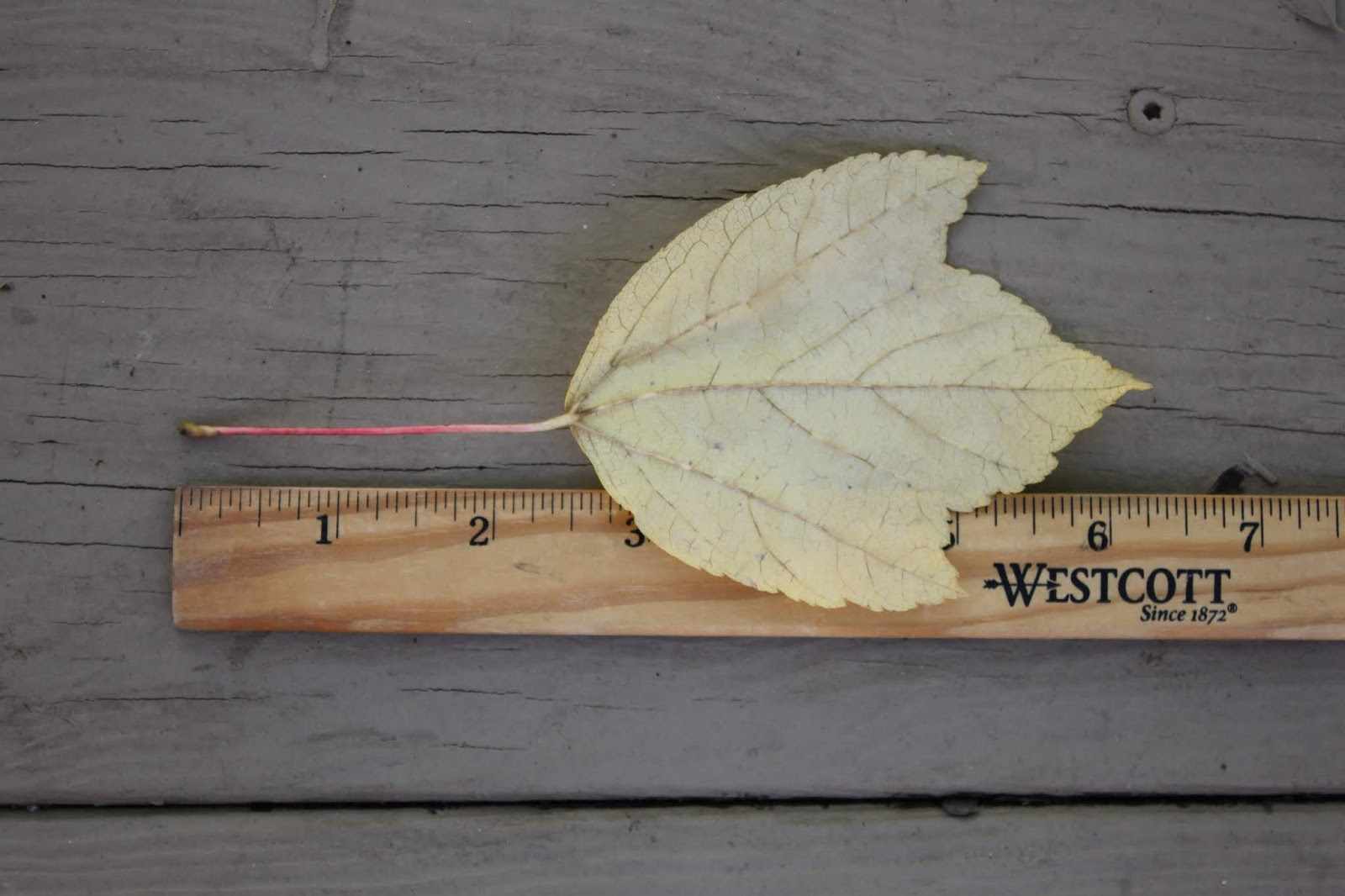
From the leaf litter, the leaves appear to be uniformly yellow with long, pink petioles. The 3-lobed leaves have serrate margins.
Petiole length and leaf size vary. In the photo above, the petiole measures 1¼ inches long, and the leaf measures 3 inches long.
Petiole, 1¾ inches long; Leaf, 3½ inches long
Petiole, 2¼ inches; Leaf, 3¾ inches
Underneath, leaves are cream colored.
Leaf margins are serrate.
The trunk shows two different types of bark. At eye level, we see smooth, light-gray bark.
Toward the base of the trunk, the rough, dark gray bark has shallow fissures.

Sunday, July 28, 2019

Tree of the Week: Chalk Maple (Acer leucoderme)


This week we are taking a look at the leaves and fruits of a chalk maple (Acer leucoderme). Our tree of the week is pictured center, next to the gravel path. It's growing in a shady spot, on a gradual slope along with four other native maples.
This chalk maple is 23 years old. In 1995, Professor Ed Leuck collected seeds from its parent, a chalk maple growing in Shreveport, located on Albany Avenue. The seeds successfully germinated, resulting in 17 plantings in the arboretum. Six trees remain after the workings of vandalism, competition and drought. This particular specimen was planted for Earth Day 2000.
Chalk maples, like our other native maples, are marvelous shade trees.
The trunk is still quite small after 23 years of growth. The bark is light gray and smooth.
Chalk maple twig with leaves and fruit
Chalk maple leaves are simple, palmately lobed, and dark-green above. Underneath, leaves are light-green and a little fuzzy to the touch. These two leaves measure 2¼ inches wide.
This leaf is a little larger, measuring 2¾ inches wide.

It's more than 2½ inches long. Also, note the long petiole.

Chalk maples have winged fruits. Each seed has a wing, and two seeds are fused together, forming a pair.

The samara pair measures 1¼ inches wide. These fruits resemble those of the southern sugar maple, but the chalk maple samaras are smaller.

You can find more images of the arboretum's chalk maples here and here.

Compare this species with our southern sugar maple (Acer barbatum). You can find comparable photos here.

Sunday, July 14, 2019

Tree of the Week: Southern Sugar Maple (Acer barbatum)

There are three distinct maple enclaves in the arboretum. One such location is pictured above. This spot near the Student Union Building has great comparative value for our maples: you can easily examine 1) boxelder, 2) chalk, 3) red, and 4) southern sugar specimens. Last week we examined the boxelder. This week we are turning to the southern sugar.
There are four southern sugar maples (Acer barbatum) in the arboretum collection. You can see additional pictures of these individuals here and here.
Our tree of the week is pictured center. It was previously featured to highlight its shadiness. You can see evidence of that attribute and read about its history here. This week we are back, taking leaf and samara measurements. Hold on, little maple; this will only hurt a bit.
Southern sugar maple leaves are simple with a palmate shape. Leaf base measures 3 inches. Overall width measures closer to 4 inches.
Leaves are approximately 3 inches in length.
Petioles are long. This one measures more than 3 inches.
In mid-July, well-developed orange-colored fruits standout against the dark green foliage.
Specifically, the wings of the samaras make the fruits conspicuous. Each orange wing is attached to an enclosed seed. The bulbous seed coating is the same green color as the dorsal side of the leaf.
Underneath, leaves are pale green, verging on white. Note that the samaras are clustered together.
Each samara consists of one wing and one enclosed seed. Two seeds are fused together, making a pair.
Each samara is approximately an inch in length.
Each pair measures approximately 1½ inches across.
Samaras can help us differentiate among the maple species. Boxelder samaras are pictured on the left: these fruits appear in long, dangling chains, and in the middle of July, they are inconspicuously light green.


Sunday, July 7, 2019

Tree of the Week: Boxelder Maple (Acer negundo)


The boxelder maple (Acer negundo) is a fast-growing, drought-tolerant shade tree that naturally occurs in river bottoms with the likes of willows and cottonwoods but will grow under a wide variety of conditions. Our tree of the week, pictured center, is a 25-year-old boxelder. In 1994, it unexpectedly appeared growing in a pot in the campus greenhouse, located on the second floor of Mickle Hall. Two years later it was planted in the ground of the arboretum, only to be dug up 6 months later to avoid a construction crew. In March 1997, the boxelder was replanted in its current location.
Our boxelder maple helps shade the gravel path that runs from the Student Union Building to the Fitness Center.
Backing up, we can appreciate a slight westward bent. The boxelder leans westward because to the east a southern sugar maple out-competes it for sunlight.

Unlike all other maples, boxelders have compound leaves. These pinnately compound leaves typically have 3 or 5 leaflets. Leafstalks are long, and they appear opposite from one another along the branchlet. In the photo above, we have a branchlet with 11 leaves and 33 leaflets.
This particular leaf has 5 leaflets. Leafstalk and leaflets together measure 10 inches in length.
Leaflets vary in size and shape, even on the same leaf. Ovate or elliptic leaflets with coarsely toothed margins are common. It's also common to see lobed leaflets. Leaves of young boxelders are often mistaken for poison ivy (Toxicodendron radicans).
In this first week of July, the pale-green, immature fruits hang in long clusters from boxelder twigs. The fruits are numerous, but not showy.
This cluster of fruits measures more than 5½ inches in length. Our tree of the week is laden with these inconspicuous drooping ornaments.
Like the other maples, boxelders produce samaras, which are winged seeds. Each seed is attached to one wing for wind dispersal. The samaras appear in pairs attached to a stalk, altogether measuring more than 2 inches in length.

Of course, nature is full of exceptions. Here we have 3 samaras fused together.

Our 25-year-old boxelder has rough, light-gray bark with shallow furrows.
Surface roots are noticeable along the gravel path.
Surface roots can become tripping hazards and the roots themselves commonly suffer damage from trimmers and lawn mowers.
Note the splotches of orange bark on this surface root.


You can find more pictures of the arboretum's boxelder maples here.

For more information about this species consult the following online sources:
United States Department of Agriculture
U.S. Forest Service
Louisiana Plant Identification and Interactive Virtual Tours (LSU AgCenter)
Virginia Tech Dendrology 

Sunday, February 3, 2019

Tree of the Week: Red Maple (Acer rubrum)

In the first week of February, people in northwestern Louisiana can find something delightful outside: red maple flowers. Not only are red maples (Acer rubrum) a common landscape choice in our area, they can also be found throughout the wilds of Louisiana and neighboring states. It's a handsome, low-maintenance, fast-growing tree adapted to a generous range of growing conditions.What more could we ask for?

Our tree of the week is a 25-year-old red maple. This individual is a true Shreveport native. It was collected in the fall of 1994, on Line Avenue. On April 15, 1996, it was planted in the ground, in the west floodplain near the stream. Initially, there was more shade in this area, but over the past two decades several large on-site native trees have passed and been removed.

The individual in question, pictured center, is growing on the west side of the arboretum drainage channel. The leafless red maple is shown with an upright trunk and an asymmetrical crown. It's tall and straight. Let's talk a bit about the area. This part of the arboretum, located near the Fitness Center, is a floodplain. During heavy rains, water flows down hill and spans out across the grass, leaving the ground soggy for several days. Some trees would find this situation too wet,  but the red maple loves it. This little floodplain is also home to two sweet bay magnolias, a water tupelo, a basswood, and a clump of four bitter pecans, all pictured in the above photo.
From another angle, we can see the bifurcation of the trunk. Despite the split, the two main branches go straight up. Mickle Hall stands at the top of a steep hill on the opposite side of the drainage channel.
The trunk divides into two main branches. A heavy-looking, light-colored vine is attached to the thicker branch, which, incidentally, is also the south-facing branch. This is a volunteer trumpet creeper (Campsis radicans).
Trumpet creeper is a woody, deciduous vine. Its yellowish gray bark is rough and marked with aerial roots by which it attaches itself to any available structure.
The vine appears to dead-end into the ground. Below ground as above ground this tree and vine are surely intertwined.
Red maples are known for surface roots. This individual exhibits the trait of the species, but so far it hasn't been a problem for the mowers. Should we add a 'watch your step' advisory?
Mature red maple bark is rough with shallow ridges.
This is the immature bark on a small limb. This bark is smooth by comparison.


Finally, we come to the originating comment of this post. This week, our red maples are showing out. Can you see the specks of red along the branches? These are the flowers.
Looking up, we can see more of the red coloration.
In Louisiana, the tiny, red flowers appear during the winter months, well in advance of spring.


Red maple flowers appear in clusters. This particular tree seems to only have female flowers, at least within reach.


Female red maple flowers