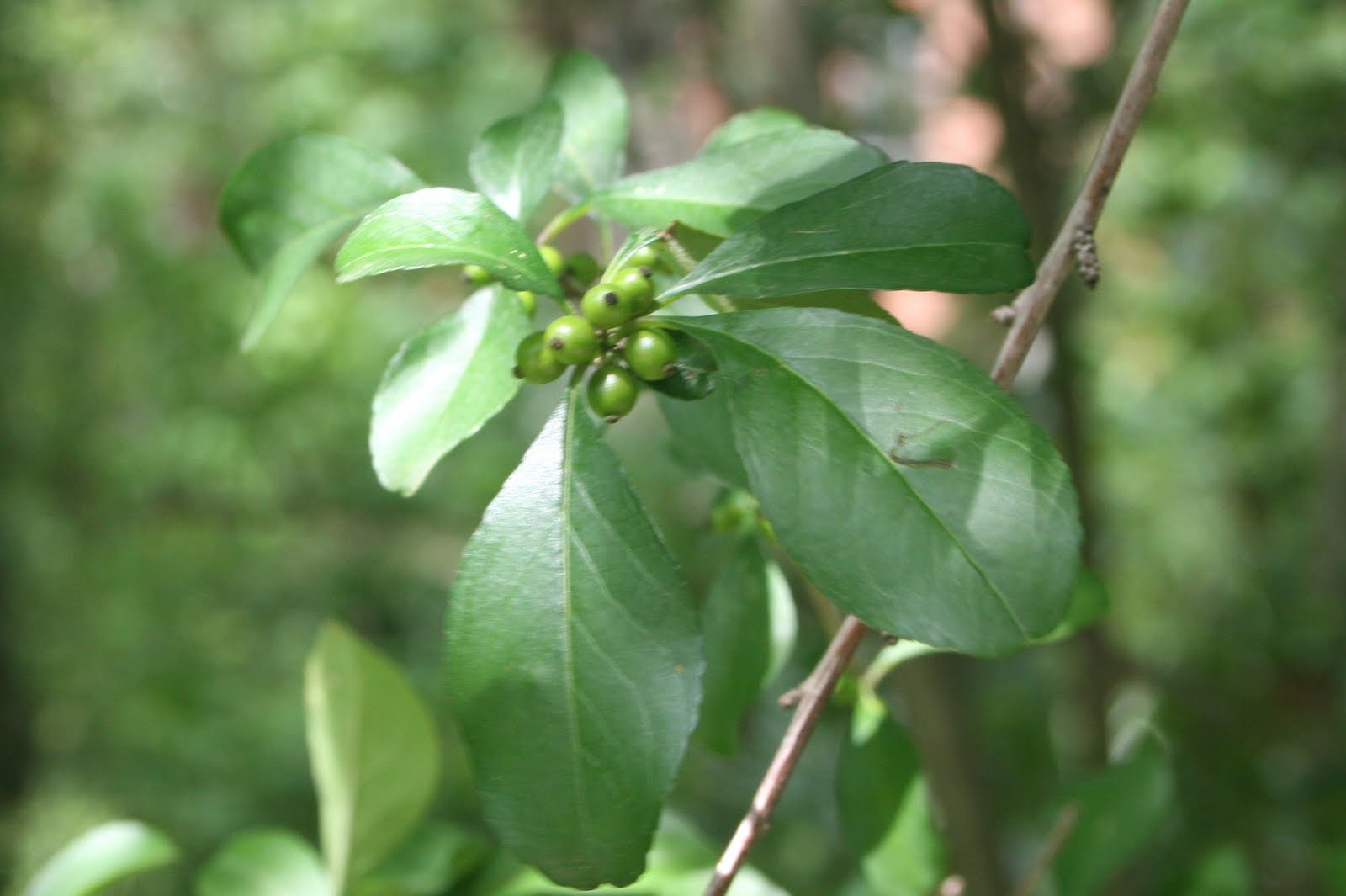
Our tree of the week isn't a tree. It's a shrub. We need to appreciate this evergreen individual before the deciduous trees start putting out there leaves, obstructing the view. Our new inkberry (Ilex glabra) was planted this season, back in December. It was purchased from Centenary College alumnus Dr. Gladden Willis, who owns and operates a tree farm in Webster Parish.
According to the online literature, inkberry (Ilex glabra) grows in a wide range of wild conditions. Generally speaking, it prefers wet, even soggy, soil and full sun, but will tolerate some shade and drier conditions, too. One known associate is serviceberry (Amelanchier arborea), so for the new inkberry shrub we found a fairly sunny spot near a healthy patch of serviceberry in the western floodplain. During periods of prolonged rainy weather, this area has standing water for several days, as water slowly drains down the slopes of the campus.
Evergreen, thick, leathery leaves alternate along the twig.
Leaves are more than an inch in length, but less than two.
Underneath, leaves are pale green. Note the elliptic shape, acute base,and subtle serration around the apex.
Inkberry fruits are small, black, persistent drupes. When we purchased this individual back in December, the shrub was covered in these little drupes. Now in mid-February, we found more than a few for a photo shoot. Since inkberry shrubs are dioecious, we will need to acquire a male plant if we want to see more of these fruits.
Our tree of the week is a shrubby fellow. The deciduous holly (Ilex decidua) tends to form multi-stemmed groupings rather than developing a single, upright trunk. In the wilds of northern Louisiana you might indeed come across a small, single-stemmed individual, but here in the arboretum, our deciduous hollies have taken on a shrubby habit. Let's look at a specific case.
Our shrubby tree of the week is pictured (center) growing both in front of and behind the large rock. This multi-stemmed deciduous holly is an on-site native. It was added to the arboretum catalogue in 1995. The gray, bare stems are, for the most part, upright.
The deciduous holly grows at the bottom of a slope on the bank of the drainage channel. We have had standing water in this spot for several months now.
This particular deciduous holly is a female, and its fruits are conspicuous this week.
Deciduous holly fruits are persistent, round, red drupes.
Our gray January sky provides the opportunity for a silhouette, outlining the leafless branch ornamented with spherical fruits. This winter-leaflessness is the source of its species name, decidua. You will recall that American holly (I. opaca) and yaupon holly (I. vomitoria) are both evergreen.
ABOVE: The deciduous holly twig is leafless. BELOW: The yaupon holly twig has evergreen leaves.
LEFT: Deciduous holly fruits are orange-red and measure approximately a quarter of an inch. RIGHT: Yaupon holly fruits are dark red and measure under a quarter of an inch.
You can find more photos of the arboretum's deciduous hollies here.
The American holly (Ilex opaca) is an evergreen tree long associated with the American experience of Christmas. Before the days of mass manufacture and petroleum-based fascimile of everything under the sun, fresh-cut branches of the American holly were used for Christmas decorations. The dark green foliage and bright red berries enlivened the home during the sometimes dreary days surrounding the winter solstice. The tradition was widely practiced, to such a degree that the wild American holly population suffered from hack-jobs and over-use. Today, vestiges of this tradition remain with us. We see the caricatures of holly leaves and berries printed on wrapping paper, greeting cards, and gift tags, and we also have plastic replications of holly leaves and berries wired to wreaths and plastic trees. Incidentally, Christmas time is an excellent time of the year to plant your very own American holly tree in your lawn or on someone else's property, with the permission of the landowner of course.
Our tree of the week is pictured center. This American holly (Ilex opaca) hails from Bienville Parish. It was collected by Professor Ed Leuck's botany class in 1987.
This tall, slender tree grows in the middle of a clay slope. Over the past 30 years, the presence of the sidewalk necessitated the removal of all lower branches: the limbs needed to be removed so as to allow easy passage for pedestrians and golf-carts.
The simple leaves are richly green with edges that curl under, making it difficult to see the overall shape of the leaf. Interestingly, the curling of the leaf makes the trees deceptively friendly: the prickly leaf edges are hidden!
Leaves are light-green, almost white, underneath. Note how they alternate along the twig.
Leaves have an elliptical shape with prickly edges. The curled leaf appears to measure less than 3 inches in length.
Flipping the leaf over and pressing flat reveals a length closer to 3 full inches. We count four prickly points on the edges plus a pointed leaf tip.
There are a few berries (drupes) hidden among the leaves.
This is a specimen collected from the wilds of northern Louisiana. We aren't seeing a great number of fruits. For your own planting project, you might desire more seasonal ornamentation that can be found on nursery stock specimen. American holly has long been under cultivation, so you can find nursery-grown trees that are positively covered in these bright red fruits.
Also, American hollies are dioecious, which means you will need two plants, a male and a female, to produce these pretty red fruits, which are only found on female plantings.
These drupes measure 3/8 of an inch in length. They are egg-shaped.
American holly fruits are larger than fruits of the yaupon holly (Ilex vomitoria).
These yaupon fruits are an eighth of an inch shorter in length. Yaupon fruits also have a spherical shape, compared with the egg-shaped American holly fruits.
LEFT: American holly (Ilex opaca); RIGHT: Yaupon holly (Ilex vomitoria)
You can find more information about the arboretum's American holly trees here and here.
To most visitors of the arboretum the flowers of the American holly (Ilex opaca) will be passed by unnoticed. The clusters of tiny off-white flowers do not beg attention, and upon further inspection, the flowers produce only the faintest aroma. However, as the video below testifies, the six-legged, airborne visitors of the arboretum appreciate the American holly flowers quite a bit.
American hollies have grown happily in the arboretum. There are five individual trees and all thriving. The largest of the five is the on-site native, located near the Student Union Building. Ed Leuck made sure to give this tree plenty of room to take on its natural pyramidal shape. Only two plantings were made: the botany class of '87 contributed an individual from Bienville Parish, and in 1993, Ed Leuck planted a specimen collected from Cypress Lake. The last two American hollies volunteered at just the right time and in just the right places. They were added to the collection in 2002 and 2003, located not far from the '87 and '93 plantings.
Typical pointy holly leaves are pretty at Christmas but not appreciated while pruning (ouch!)
Flower cluster with leaves
Pollinator hard at work
Trunk detail of 2002 volunteer
Mottled bark of the on-site native
You can see additional photos of the arboretum's American hollies here.