Showing posts with label Family: Fabaceae. Show all posts

Sunday, March 15, 2020

Tree of the Week: Redbud (Cercis canadensis)


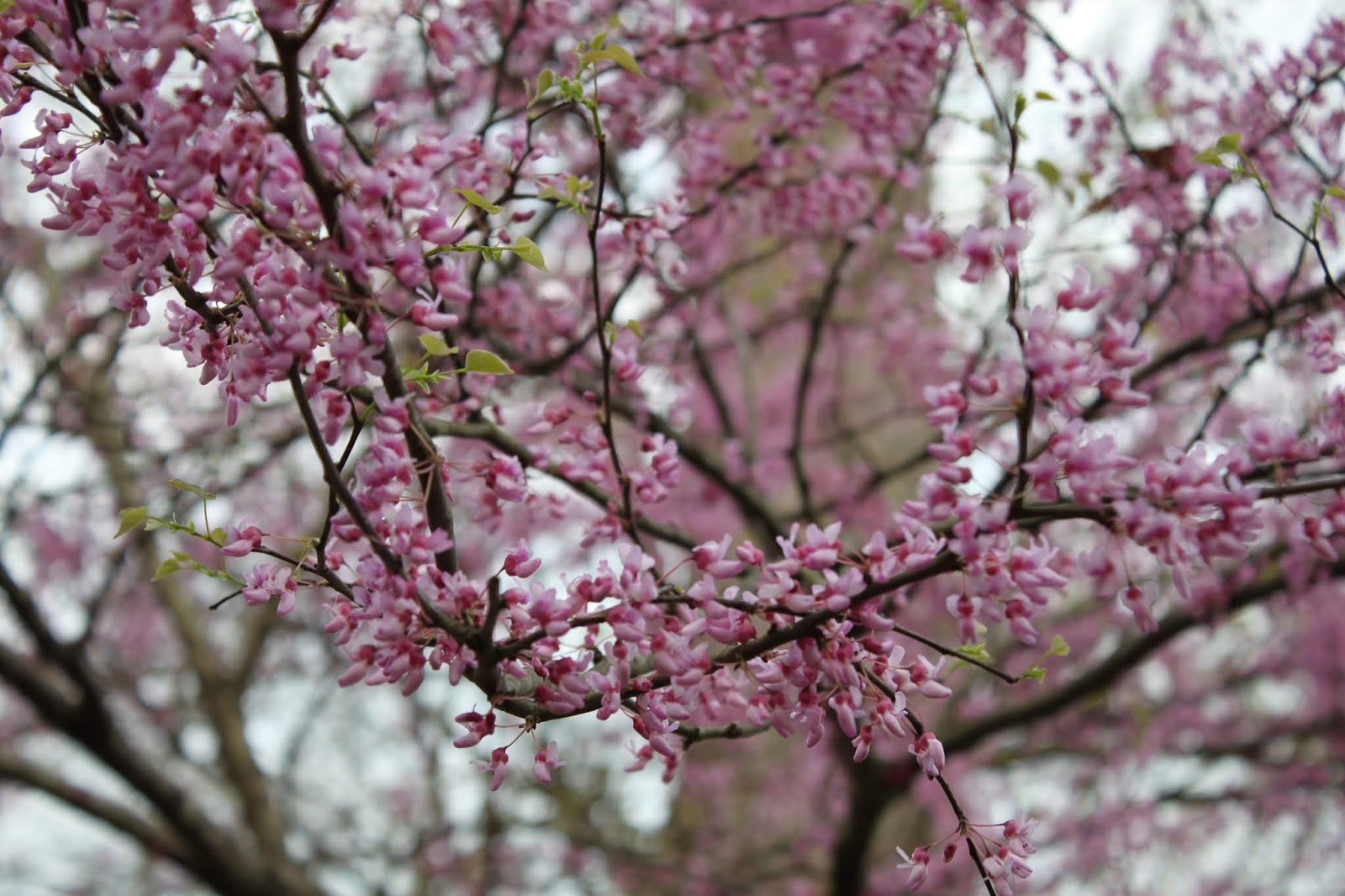
It's mid-march, and the redbuds have been blooming for more than a week in northwest Louisiana. You can find five very fine individuals in the arboretum on the Centenary College Campus. The specimen pictured above is particularly neat.
Our tree of the week appears to grow at a 45ยบ angle, leaning over the junction of two gravel paths. The redbud's unique lean is a product of how it came into this world: a seed germinated beneath an old post oak (Quercus stellata). During its formative years, our special redbud struggled to find its own space while growing in the shadow of a large tree, which, as it were, also leaned. Today, the redbud remains with the stump of the now deceased post oak.
Redbud flowers are small but numerous and bees find them very attractive.

Thursday, November 14, 2019

Texas Mountain Laurel (Sophora secundiflora)


Texas mountain laurel (Sophora secundiflora) is not a southeastern plant. However, the native range isn't too far from Caddo parish―you can find Texas mountain laurel growing in the wilds of central Texas and further west. The photos below attest to the success of this species in northwest Louisiana. The ornamental potential is currently being tested on a large scale in the neighboring parish: Texas mountain laurel was one of the few species selected for the urban street planters that line Barksdale Boulevard in the recently renovated downtown Bossier City.
The large Texas mountain laurel shrub can be found at the southeast corner of Mickle Hall. It's the evergreen shrub growing opposite the yellow-orange Mexican buckeye shrub. In the summer, this is a hot, full-sun location that receives regular watering from the campus irrigation system. The ground slopes down and away from the corner of the building, so water does not accumulate around the base of the mountain laurel.
Our Texas mountain laurel shrub is approximately 25 years old. In 1997, it was purchased from Home Depot, and Professor Ed Leuck planted it in this spot the following year. The lower foliage has been removed to allow for more visibility. The natural habit is much denser. You can see older pictures of its fuller form here. If so desired, Texas mountain laurel shrubs can be cultivated to serve as handsome, thick screens all year long.
In mid-November we are noticing the fruits drying out and wrinkling.
The fruit pods significantly darken upon drying out.
These blackened seed pods are ready to split open.
This bean pod has five compartments, in which we expect to find five seeds.
The outer husk breaks up under just a little pressure.
Individual capsules are long, measuring more than an inch in length.
The large seeds are a handsome shade of red. Is there a hint of purple?
Seeds measure approximately a half inch in length.
The vibrant red seeds are conspicuous among green leaves. Be careful when handling or transporting these seeds. Sources agree that the seeds, along with other parts of the plant, are poisonous!
Seeds are numerous and readily available for any desired attempts at germination. Pick up a handful and try your luck with getting these to sprout. These seeds are notoriously difficult to germinate, so good luck! It's worth it if you can figure out the trick. The USDA claims that "Fresh seeds reportedly germinate readily, requiring no scarification." So, try to find a mature pod still attached to the tree.
Along with the attractive seed pods and the beautiful red seeds, we find these strange growths on the Texas mountain laurel. What are these odd, asymmetrical masses?
These unusual growths are a product of fasciation, a type of abnormal growth, which is a known problem for Texas mountain laurel.

Thursday, September 20, 2018

Tree of the Week; or, a Case of Mistaken Identity

When is a Locust not a Locust?

In 2013, the arboretum's curator Lacey Anderson collected seed pods of a thorny locust from the side of Old Mooringsport Road north of Shreveport. The seeds germinated in the campus greenhouse under Dr. Ed Leuck's supervision, and a seedling was planted in the arboretum in 2015. The tree pictured below is about four years old. Dr. Ed Leuck had previously collected and planted a Black Locust in 1997, but the tree was displaced by the construction of the Fitness Center and it later died.

Locust tree approximately 4 years old
This young locust tree has required significant pruning to develop a single trunk. Several long, spindly branches haven been removed over the past several months.


The initial identification of this tree as Black Locust (Robinia pseudoacacia) was made on the basis of the seed pods and thorns of the donor plant. As the tree has grown up, some doubts have entered the mind. Let's examine the evidence.

Left pane: Robinia pseudoacacia diagram
 Right pane: photograph of the specimen


The Petrides reference volume states that Robinia pseudoacacia  has opposite thorns of between half-inch to one-inch length, while our specimen has single thorns of two-inch length. Robinia pseudoacacia has around thirteen leaflets with a single terminal leaflet, while our specimen has sixteen to twenty leaflets and a terminal pair. Robinia pseudoacacia has smaller flat seed pods while the parent tree had large, twisted seed pods.

Thus, the arboretum's specimen is a Gleditsia, probably the Honey Locust (Gleditsia triacanthos). There is a possibility that it may be a hybrid between the Honey Locust and the similar Water Locust (Gleditsia aquatica) but the tree will have to grow up more before we can make this determination.

Thorns of the Honey Locust are fearsome and longer than an inch.
Cultivars have been selected for fewer thorns, but this wild strain is very concerned with self-preservation.
The base of the tree is also heavily thorned, discouraging climbers and nibblers.
This young tree has not yet developed bark with a lot of character. It might be called scaly.

Saturday, February 3, 2018

Tree of the Week: Water Locust (Gleditsia aquatica)

The winter months are a great time to appreciate our water locust (Gleditsia aquatica). This is a water-loving tree that typically grows in wet, soggy areas. Unfortunately, what's good for the tree is also good for breeding mosquitoes. Right now, we have moments of perfect weather without the irksome bloodsuckers. And despite being leafless, the water locust has plenty of winter-time interest: this tree produces spikes that recall a medieval torture chamber!

We have one water locust in the arboretum collection. It was collected locally, on the west shore of Cross Lake, at the home of Centenary professor Dana Kress. The specimen was collected in spring 1995, and planted the following November. It was planted in what was historically the lower pond of the arboretum. Although that permanent body of water was dismantled more than a decade ago, this area remains the wettest part of the arboretum. Several water-loving plants thrive in this area: bald cypress, Louisiana irises, palmettos, and river birch.

Addendum: The genus Gleditsia got its common name 'locust' from a similarity to a Middle Eastern tree, the carob, whose fruits resemble the locust insect.

The water locust can be found near the long white wooden bridge. It is growing beneath the embankment in an area that was historically called the lower pond. Today, water no longer accumulates in the area, but due to its status as a drainage basin, it remains the wettest section of the arboretum. The water locust is pictured center, on the other side of the wooden guardrail. On the far right of the photograph, we have two palmetto trees and a grouping of river birch.
Standing in the 'lower pond', we get another view. The water locust is again pictured center. Sabal palmetto is to the left of the locust. Louisiana irises cover the ground.
The palmetto casts an interesting shadow on the trunk of the water locust.
Having a look at the ground around the water locust, it appears as if the locust has knees like the bald cypress (Taxodium distichum). This is a trick. The bald cypress is simply an opportunist and sends its knees up wherever is pleases, including in the space allotted to the water locust. These knees could belong to either of the two bald cypresses.
Getting a little closer to the water locust, we see that this tree is well armed.

The red-tinged spikes are impressive.
Presumably these spikes protect the tree in some way. Perhaps the spikes dissuade wildlife from devouring the (tasty?) fruits or leaves.
Bald cypress leaves have collected on the lower spikes.

The spikes provide spider-habitat. This picture also captures the undulating surface of the trunk. It isn't round, but rather rippling, similar to the muscular trunk of the ironwood (Carpinus caroliniana).
The bark is gray and bumpy.


You can find additional information about this species from the following sources:
Stephen F. Austin University State University
United States Department of Agriculture 
University of Florida IFAS Extension
Virginia Tech Dendrology

Friday, June 23, 2017

Tree of the Week: Redbud (Cercis canadensis)

It is now officially summer. Time to look for a spot of shade. For the next several weeks we will be looking at the arboretum's shade trees.

The redbud (Cercis canadensis) is a small shade tree. The long, slender limbs of the redbud stretch outward from the trunk, allowing the handsome heart-shaped leaves to block a good bit of the sun. Since the redbud stays small, it's a good tree to plant around buildings; you needn't worry about it getting too big and potentially hazardous. In the wild, redbuds occur as understory trees. As a result, they're shade tolerant and don't need full sun to thrive.

Due to their prolific seed production, redbuds spring up all over the arboretum. Ten individual trees of this species have been part of the arboretum collection. Currently we have eight and all have been volunteers. Since these trees started growing without authorization, it is impossible to say how old they are. The pictures below are from a tree that is at least a decade old, probably older.
This redbud tree (Cercis canadensis) grows along a major thoroughfare in the arboretum, providing good afternoon shade during summer time.
Mickle Hall stands to the east of this tree.
The redbud tree has slender branches and big leaves, blocking plenty of light.
Twigs and branchlet: underside of the heart-shaped leaves
The leaves of the redbud are a dark green in the summer.
The leguminous fruits of Cercis canadensis remain on the tree, maturing throughout the summer. They block additional sun.
Bark detail of mature Cercis canadensis

Flowers of the arboretum's redbuds can be seen here.

For more information about this species consult the following:
United States Department of Agriculture
Louisiana Plant Identification and Interactive Virtual Tours (LSU AgCenter)
University of Kentucky College of Agriculture, Food and Environment

Friday, April 27, 2012