At present, there is one Mexican buckeye (Ungnadia speciosa) in the arboretum collection. This species is not native to Louisiana or any of the other southeastern states. It's native to south-central Texas and further west. This species has excellent fall color and interesting fruits. Despite its name, the Mexican buckeye is of no immediate relation to our native red buckeye (Aesculus pavia)
The Mexican buckeye isn't growing in the arboretum proper--this is the southeast corner of Mickle Hall. In the photo above, the Mexican buckeye is the yellow-orange shrub pictured on the left. A Texas mountain laurel grows across from it.
In 1997, Professor Ed Leuck purchased this shrub, in a smaller form, from a local Home Depot store. The following year it was planted in its present location.
This shrub is more than 20 years old. It's large, with an irregular shape. A more desirable shape could perhaps be achieved. This particular shrub has only been trimmed to keep the sidewalk clear.
This Mexican buckeye was planted as one of a pair. The other buckeye was purchased from Woodlanders Nursery (Aiken, SC). It was planted nearby, but down the slope. It was removed in fall of last year, 2018, due to its poor health and unsightly appearance.
Large, interesting fruits can be found among the bright yellow-orange leaves.
Fruits are numerous. If so inclined, please take some! No need to hurry; fruits persist on the branches throughout the winter. However, keep in mind that they are reportedly poisonous.
The fruits resemble sleigh bells. This time of year they are dried and split, revealing the seeds.
These fruits have a musical quality--when shaken, they make a pleasing rattle.
Fruits measure more than an inch across.
The brittle capsules easily crack open.
Seeds are round and very dark, blue or purple black, measuring approximately a half inch in diameter.
This species also has beautiful flowers. You can find pictures here.
There is one soapberry tree (Sapindus drummondii) in the arboretum, and it has been a major attraction this week. A small flock of cedar waxwings gathered on the limbs of the tree. They inspected and pecked at the yellow fruits. The birds were likely eating some of the fruits, but they also knocked many loose, causing them to land among the leaf litter.
The soapberry is the tall, skinny tree pictured center, to the left of the arboretum sign. It was purchased from Woodlanders Nursery (Aiken, South Carolina) in the fall of 1990, and planted in October of the same season, making the tree approximately 30 years of age.
Towards the beginning of the fall semester, the soapberry was conscripted into an art project. Thin white string ties the soapberry to the nutmeg hickory (Carya myristiciformis).
The soapberry and nutmeg hickory were purchased from the same nursery and planted at the same time. They grew up together. The artwork seems to be an above ground representation of the intertwining that is surely occurring below ground.
The white string draws out the greyness in the flaky outer bark.
The string has worn on the flaky grey outer bark, revealing the rust-colored inner bark.
A small flock of cedar waxwings (Bombycilla cedrorum) brought our attention to the soapberry tree. This is a short clip, showing the cedar waxwings in action.
The birds were interested in pecking at the yellow drupes, and they possibly consumed a few.
Once the camera started rolling, the cedar waxwings were quick to take flight, leaving plenty of fruits dangling from the twigs. These drupes are far out of our reach.
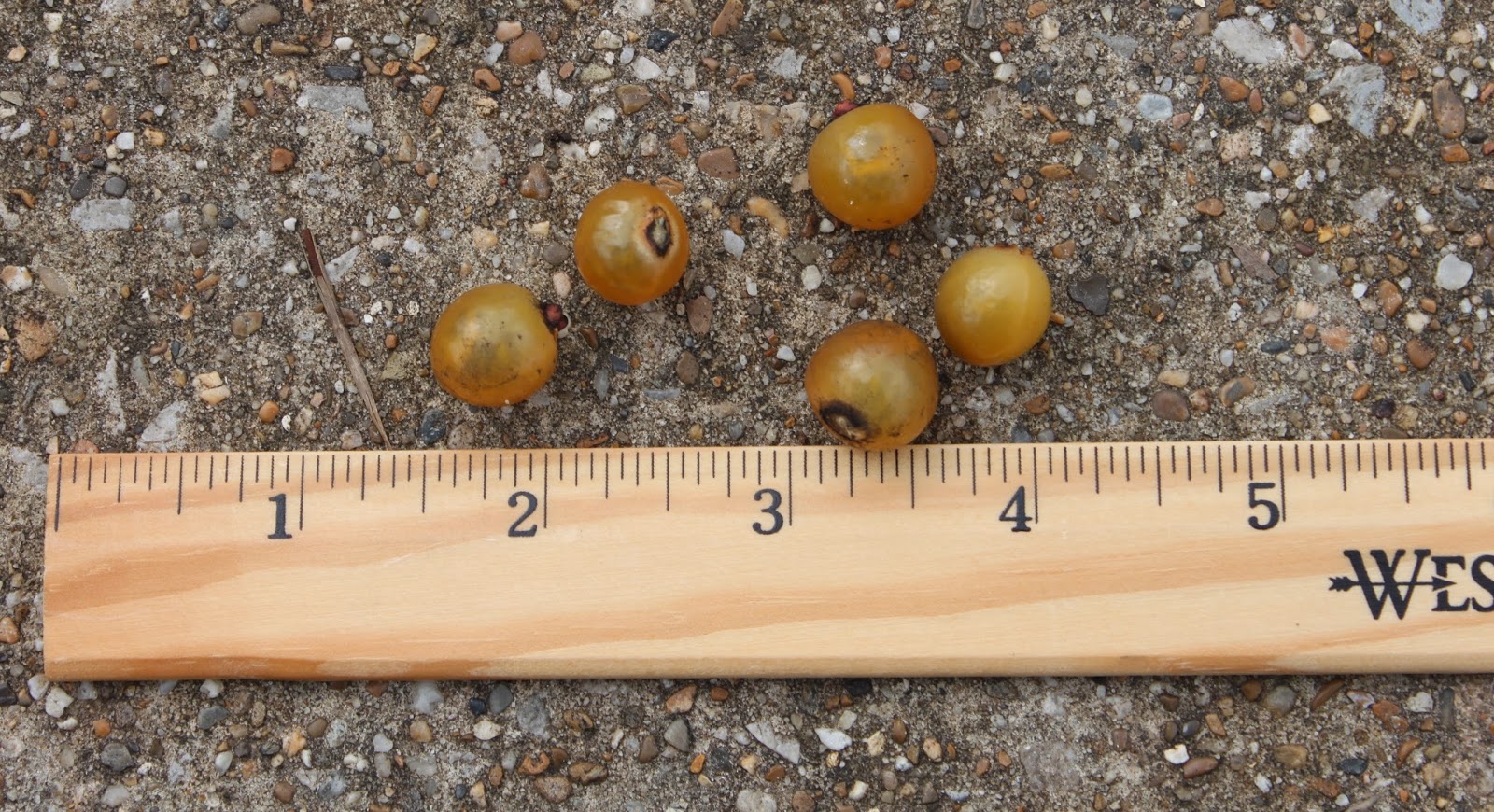
Luckily, the cedar waxwings, and other birds, have knocked the fruits loose for our own inspection. The yellow soapberry fruits aren't hard to find in the leaf litter.
The squishy globular fruits are half an inch in diameter.
A purplish-black seed is concealed by the yellow casing. Getting to the seed is a sticky business.
You can find additional (leafy) photos of the arboretum's soapberry tree here.